No Fiji-licensed insurer publishes an event insurance product. No Fiji venue publishes what it requires you to insure. No Fiji insurer publishes a commercial premium. The difficulty in insuring a Fiji conference is not that cover is expensive — it is that almost nothing you need to make a budget decision is in the public domain, and the few hard numbers that exist are not the ones you expect.
Here is what is actually published, and how to work with it.
Who can even write the cover?
Fiji's insurance market is supervised by the Reserve Bank of Fiji, which maintains the authoritative licensing register. As at 27 September 2026 it lists:
| Category | Licensed entities |
|---|---|
| General insurers (8) | AMA Insurance, BSP Health Care, TISA Insurance (Fiji), FijiCare Insurance, New India Assurance, Sun Insurance, QBE Insurance (Fiji), Tower Insurance (Fiji) |
| Life insurers (2) | BSP Life (Fiji), Life Insurance Corporation of India |
| Brokers (6) | Aon (Fiji), Marsh (Fiji), Unity Insurance Brokers (Fiji), Insurance Holdings (Pacific), Complete Insurance Services, Howden Insurance Brokers (Fiji) |
The register also records 496 licensed agents as at 31 December 2024, of which 86 are general. Total general insurance gross premium for the whole country in 2024 was FJ$272.9 million — useful scale context for a market that has to absorb a large event's risk.
Three changes in the last ten months are worth noting because stale lists circulate: Howden was licensed as a broker in December 2025, AMA Insurance was licensed in January 2026 taking general insurers to eight, and Capital Insurance rebranded to TISA Insurance (Fiji) Limited in March 2026. If you see a 2024 list, it is out of date. Re-check the register on the day you need it.
Is there an event insurance product in Fiji?
No. We checked the published product pages of every licensed general insurer plus the brokers with public product listings, and not one markets an event insurance or event cancellation policy.
What is available:
- Sun Insurance publishes the broadest commercial suite — public and products liability, commercial fire, all risks, money, burglary, fidelity guarantee, contractors all risk, directors and officers, marine cargo, carriers liability. Its public and products liability page describes customisable limits tailored to business size, and publishes no limits and no premium — the page renders a zero placeholder where a price would go.
- Tower Insurance Fiji is unusual in publishing section limits for its SmartPac SME product: business property to $2.8m, loss of income to $2m, business liability to $2m, money to $10,000, burglary to $50,000. Note the territorial wording — the liability section covers legal liability in Fiji, which is not the same as an organiser's own worldwide policy.
- QBE Fiji, in Fiji since 1907 and broker-distributed, publishes commercial property, contract works, professional indemnity, directors and officers and general liability.
- TISA Insurance (Fiji) publishes public and products liability, industrial special risks, contractors plant, machinery breakdown and electronic equipment.
So the practical route is not an event policy. It is a public and products liability policy written for your event as the insured activity, arranged through one of the six licensed brokers. If you are used to buying a one-off event policy online in Auckland or Sydney, adjust the expectation now: in Fiji this is a broked placement with a lead time.
The rule nobody tells you about: offshore placement
This is the most commercially significant thing in this article and the one most likely to surprise a New Zealand or Australian organiser.
Section 17(1) of Fiji's Insurance Act 1998 states that no person may place Fiji insurance business with an insurer not licensed under this Act. Sections 17(2) to (5) allow exceptions on application to the Reserve Bank with written permission and prescribed notice to the insured. Section 17(7) makes unapproved offshore placement an offence, with penalties up to $10,000 or an amount equivalent to the brokerage or premiums involved.
The Reserve Bank's Insurance Brokers Guideline No. 1, revised 2021, sets the mechanics. A licensed Fiji broker holds delegated authority to approve an offshore placement where gross premium is FJD 250,000 or less and both of two conditions are met: that no insurer licensed under the Act carries on the insurance business to which the application relates, and a published premium-comparison test. Above FJD 250,000, or where either condition fails, Reserve Bank approval is required. Brokers report monthly within 10 working days of month end, and non-compliance carries a fine of $5,000 and 12 months' imprisonment plus loss of delegated authority.
Two honest caveats. We could not retrieve the Act's interpretation section, so we cannot tell you the statutory definition of "Fiji insurance business" — and whether an Australian or New Zealand policy that happens to respond to a Fiji event is caught turns entirely on that definition. We are not going to guess it.
But note how the first condition cuts. Offshore placement is easier where no licensed Fiji insurer writes that class — and no licensed Fiji insurer publishes an event cancellation product. So the cover an organiser most wants is the cover least likely to be available locally, which pushes it offshore, which is precisely the situation this regime governs.
Action: put one question to a Fiji-licensed broker or Fiji counsel before you rely on your home-market policy. Is our cover for this event Fiji insurance business, and if so what approval does it need. Ask it at contracting, not at load-in.
Cyclone: the window closes when it gets a name
The Fiji Meteorological Service, the official Regional Specialised Meteorological Centre for the South-West Pacific, publishes the season as November to April, with peak activity January to March — elsewhere describing the peak as January to February — and notes that cyclones have occasionally formed in October and May, rarely in September and June. Its 2025–26 outlook forecast four to five cyclones in the Nadi area of responsibility, one to two passing through Fiji's exclusive economic zone, and one likely to reach severe Category 3 or above.
Now the commercial mechanism, which matters more than the dates. The clearest published statement of the principle comes from Allianz Partners: When a hurricane (or other severe weather) becomes a named storm, it also becomes a 'foreseeable event'... If you buy travel insurance after a storm is named, your plan won't provide coverage for storm-related claims.
That is the known-event principle, and it is standard across weather-exposed classes. The window to buy closes when the system gets a name, not when it makes landfall.
Read against a November to April season, that has one unavoidable consequence: for an in-season Fiji event, the decision to insure has to be made at contracting. For a February conference, that means placing cover many months before the peak. It is not a decision you can defer until the forecast looks concerning, because by then it is unavailable.
What we could not find, and will not invent: any published event cancellation wording stating a cyclone waiting period in days, or a named-cyclone cut-off, for Fiji or the South Pacific. Event cancellation is a specialty line written on bespoke wordings through brokers, and insurers do not publish them. Get the definition of "named windstorm" or "tropical cyclone" out of your actual schedule and endorsement, in writing. That term has been litigated; do not assume you know what it means.
What does cancellation cover actually cover?
From Marsh Australia's published material, which is the clearest on the record:
Typically covered — non-appearance of headline speakers or acts; extreme weather making it unsafe to proceed; venue or equipment damage preventing the event; civil commotion including protests and access restrictions; terrorism or credible threats in proximity; catastrophic non-appearance where significant attendee numbers cannot arrive, such as airline strikes.
Typically not covered — communicable diseases, stated plainly: Event cancellation or postponement due to communicable diseases like Covid-19 aren't covered; poor event preparation or organisational failure; financial failure of the organiser; breach of contract; lack of ticket sales or attendee support; and weather below insurable thresholds — you won't get insurance coverage for a little bit of drizzle.
Two structural points. Cover is written on an indemnity basis — you substantiate your loss rather than collect an agreed value. And K&K Insurance publishes a 45-day minimum lead time for event cancellation applications to allow underwriting and quoting. That is a hard published number and it belongs in your critical path.
What will the venue require of you?
Nothing is published — and that is the finding.
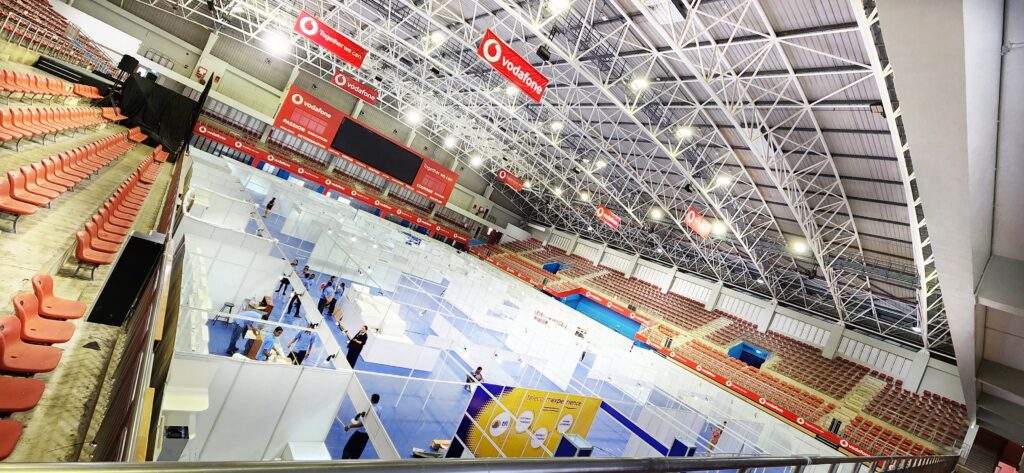
We checked the conference and events pages of Sheraton Fiji Golf & Beach Resort, The Westin Denarau, Sofitel Fiji, Shangri-La Yanuca Island, Outrigger Fiji, Crowne Plaza Fiji Nadi Bay and Vodafone Arena, Fiji's main non-hotel large venue. None publishes an insurance requirement, certificate of currency requirement, indemnity clause or minimum liability limit. Vodafone Arena publishes no rates either, listing booking information as available soon.
In Fiji these obligations sit in the banquet event order or group contract, issued on request and not published. The budgeting consequence is real: you cannot cost your insurance obligation until you have the venue contract, which is usually after the destination decision and often after a deposit. That sequencing problem is the actual commercial story.
One published Fiji data point, correctly framed. Mick's Fiji Tours & Transfers discloses that it carries public liability of FJ$3,000,000 with New India Assurance, plus comprehensive passenger insurance of $100,000. That is one supplier's own disclosure, not a market standard or a regulatory minimum — but it tells you the order of magnitude Fiji ground suppliers carry, and FJ$3m is materially below the AU$10m or AU$20m that Australian councils and venues routinely demand. Worth knowing before you assume your home-market expectations transfer.
Crew, permits and the things that are actually mandated
Workers compensation. Fiji's Workmen's Compensation Act was repealed in 2018. The Accident Compensation Commission Fiji now runs a no-fault scheme under the Accident Compensation Act 2017 covering motor vehicle, employment and school accidents, funded from general levies — employers do not need to pay anything to ACCF. Published maxima: permanent total incapacity $150,000, permanent partial incapacity $75,000, death $75,000. Employers retain direct obligations, including paying two-thirds of weekly earnings for up to 260 weeks and reporting accidents.
So there is no compulsory employer policy to buy. But ACCF does not publish whether visiting or foreign crew are covered, and the scheme is built around Fiji employment relationships and funded by a Fiji training levy. We could not resolve it and will not assert it. Assume your own employers' liability, corporate travel and personal accident cover is doing the work, and confirm with ACCF and your broker rather than relying on a Fiji safety net. Separately, Health and Safety at Work Act 1996 duties apply to build, rigging and load-in, and no insurance discharges them.
Work permits. A Fiji Short Term Work Permit carries a base fee of FJD 650.05 per person plus payment processing, and requires a certified national police report valid one year, a medical report valid three months, certified qualifications and a signed employment contract. The published requirements mention no insurance. Note the sequencing — those two report validity windows have to be timed against each other, and crew working on a visitor permit is an immigration problem, not an insurance one.
Drones — the one hard insurance mandate. The Civil Aviation Authority of Fiji requires commercial operators to hold Liability and Third-Party Insurance Cover from a recognised Insurance broker that has dealt with Unmanned Aircraft Operations Insurance, regardless of drone weight class, with written authorisation on form OP-138 before commercial flights. This applies to visiting and foreign operators. Given that aerial content is near-universal in destination event marketing, and the certificate is a gating document for the approval rather than an afterthought, this belongs in your lead-time plan.
Public gatherings. Under the Public Order Act as amended, a permit is required for a meeting or procession in a public park or public road, on written application at least seven days in advance, and the authority may impose such conditions as it thinks fit. No insurance condition appears in the legislation, but note the open-ended conditions power. A ballroom conference does not engage this. A street activation, beach party on a public beach or fun-run element does. Fiji Roads Authority requires five working days for march processions and corridor access with a traffic management plan.
Tax on the premium. Fiji VAT applies to general insurance premiums and the current standard rate is 12.5 per cent, effective 1 August 2025. Stamp duty was abolished on 1 August 2020. Withholding tax of 5 to 15 per cent may apply to fees paid to non-resident professional service providers — relevant if you are paying an offshore PCO, AV supplier or broker.
Medical evacuation: no number exists
We checked every provider marketing Fiji aeromedical services. Medical Rescue, which collects patients from Nadi and Suva with doctor and nurse crews, states that the cost of our Fiji air ambulance varies depending on the specifics of each situation and quotes by phone. A competitor's page titled cost of an air ambulance publishes no figure or range.
Australia's Smartraveller is blunt and quotable: medical care standards are significantly below Australian levels, rescue and emergency services are limited, and if you become seriously ill or have an accident, you may need to be evacuated to Australia. Medical evacuation can be very expensive. It adds that the Australian Government will not pay for these costs. New Zealand's SafeTravel recommends cover that includes provision for medical evacuation by air.
Do not put a medevac figure in your budget, because none is publishable. The cost is unquotable in advance and effectively uncapped, which is exactly why it is managed through evacuation and repatriation cover with an adequate limit rather than a line item. The organiser's real exposure here is not financial — it is running a medical crisis for a delegate who arrived uninsured. Make delegate travel insurance an explicit, written condition of registration.
What to actually do
The honest conclusion is a process conclusion, not a number.
- Get the venue contract early, before the destination is locked, purely to read its insurance and indemnity clauses.
- Brief a Fiji-licensed broker at contracting, not at planning. Ask specifically whether your home-market policy is Fiji insurance business.
- Place cancellation cover when you sign, not when the forecast turns — allowing the 45-day underwriting minimum.
- Get "named windstorm" defined in writing in your schedule.
- Budget the four published numbers you do have: FJD 650.05 per crew work permit, 12.5 per cent VAT on premium, the CAAF drone insurance certificate as a gating document, and a 45-day cancellation lead time.
- Make delegate travel insurance with air evacuation a registration condition.
If you want a working figure for the budget before a broker quotes, you will not get one from published Fiji sources, and any consultant who offers a percentage of event spend is importing it from another market. Carry it as a to-be-confirmed line with a named owner and a date, and treat the broker conversation as a milestone rather than a purchase.
Insurance, legal and immigration content here is a guideline only. Confirm current requirements with the Reserve Bank of Fiji, a licensed Fiji insurance broker, the Accident Compensation Commission Fiji and the Civil Aviation Authority of Fiji before you rely on any of it. Last reviewed 27 September 2026.
Next step
Read your venue's cancellation and force majeure clauses alongside whatever cover you place — the two have to interlock, and in Fiji the contract usually moves first. Cancellation, force majeure and attrition clauses covers that side, and building a Fiji conference budget shows where to carry an unpriced line without losing track of it.
More in this cluster: What a Fiji Conference Costs · Wet-Weather Contingency Planning for Outdoor Programmes · browse DMCs and PCOs.