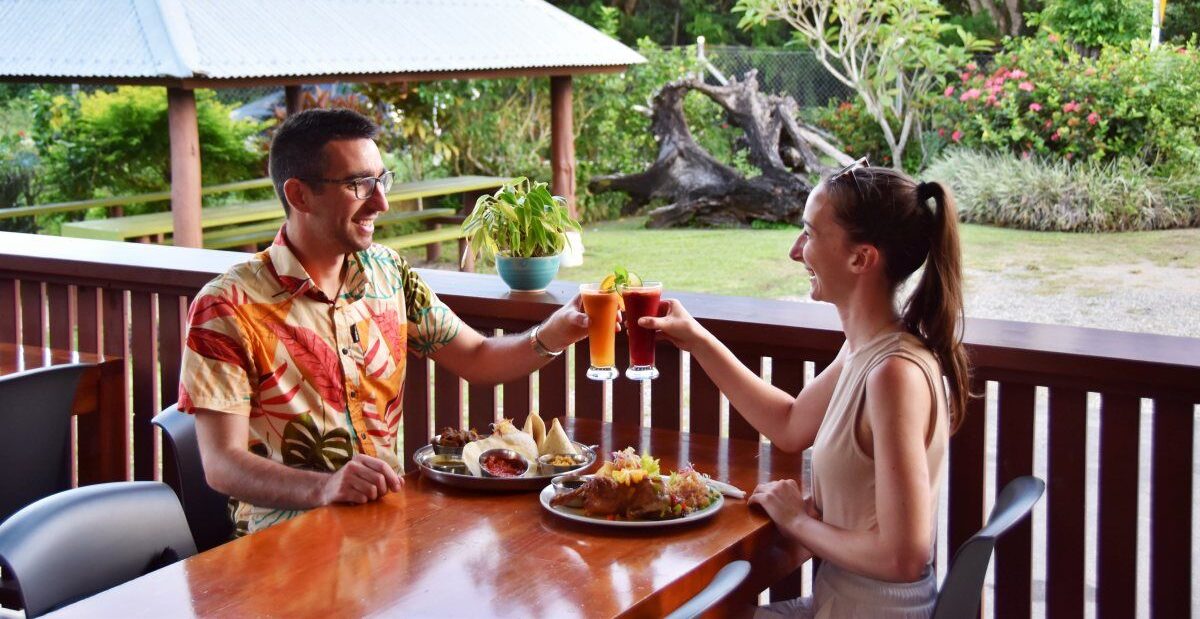
Most of the money spent on a Fiji conference leaves Fiji. It goes to international hotel brands, imported food and equipment flown in from Australia. Making event spend reach Fijian businesses and villages is a procurement decision, not a CSR activity — and it is measurable if you decide up front what you are measuring.
Why does "local sourcing" usually fail in Fiji?
Because it is scoped as an afterthought. A programme is contracted in February, and in April someone asks whether there is a community element. By then the catering is signed, the AV is shipped and the only option left is a half-day beach clean-up that costs the delegates two hours and the local economy nothing.
The fix is to set a leakage target before you brief anyone. Decide what proportion of the event budget should land with Fiji-registered, Fiji-owned businesses, write it into the brief, and ask every bidder to report against it. That single line changes what you are offered.
What should you actually measure?
Four numbers, all of which a DMC can report if you ask in the brief.
| Metric | Definition | Why it matters |
|---|---|---|
| Fiji-registered spend | Share of total budget invoiced by businesses registered in Fiji | The floor. Easy to hit and easy to game. |
| Fiji-owned spend | Share invoiced by Fijian-owned businesses, not local branches of offshore groups | The real number. Harder, and far more meaningful. |
| Direct-to-maker and direct-to-performer spend | Paid to the individual or village group, not through an agency margin | Where community benefit is most concentrated |
| Imported line items | Food, beverage, AV and décor flown in rather than sourced locally | What you are trying to shrink |
The distinction between Fiji-registered and Fiji-owned is the one that matters. A global hotel brand operating in Nadi is Fiji-registered and employs Fijians; the margin still leaves. Neither fact is a reason to avoid it — it is a reason to be precise about what you are claiming.
Where can spend realistically be redirected?
Four categories where Fijian suppliers are genuinely competitive, not charity picks.
Experiences and offsite programme. This is the easiest and largest win. Sigatoka River Safari and Off Road Fiji on the Coral Coast, Talanoa Treks Fiji, Rivers Fiji and Kila Eco Adventure Park at Pacific Harbour, and Ecotrax Fiji all run Fijian-operated programmes that work for groups.
Food knowledge, not just food. Flavours of Fiji Cooking School turns a catering line into a delegate activity with the money staying local.
Performance. Pay groups directly. VOU Fiji is a professional company with published rates; village groups generally are not, which is exactly why they need a clear fee agreed in advance rather than a donation at the end. Our guide on booking Fijian performers respectfully covers the terms.
Craft and gifting. Delegate gifts are usually the most wasteful line in an event budget and the easiest to convert. The constraint is real: only around 20 women are registered with the Fiji Arts Council as masi makers, though hundreds depend on the craft for income. That thin maker base cannot absorb a 300-delegate order placed three weeks out. Commission four to six months ahead or buy from outlets that name their makers, such as Baravi Handicrafts & Cafe.
What is Loloma Hour, and should you use it?
Loloma Hour is Tourism Fiji's nationwide sustainability initiative, launched with 21 resorts. Loloma means acting with generosity driven by love, and the ask is simple: spend at least one hour of your visit on a sustainability activity, organised through your resort's reception desk.
It runs on four pillars — Wildlife, Community, Reef and Coastline — with activities including guided nature walks, coral planting, village visits and beach clean-ups.
For a conference group, Loloma Hour is a useful on-ramp rather than a programme in itself. It is already structured, already staffed, and it gives you a defensible framework to report against. What it will not do on its own is move money. Pair it with the procurement targets above; otherwise you have an hour of goodwill and an unchanged budget. Tourism Fiji publishes no outcome figures against the initiative beyond the launch resort count, so do not cite impact numbers you cannot source.
How do you get spend into a village without it going wrong?
Village engagement is where good intentions do the most damage. Four rules.
- Go through the village, not around it. Approach via the resort, your DMC or the Turaga ni Koro, and follow sevusevu properly. Fijian protocol and etiquette for visitors sets out what that involves.
- Agree the fee in advance, in writing, in FJD. A number agreed beforehand is respect. A collection taken afterwards is a tip.
- Buy something, don't just donate. Commissioning craft, catering, guiding or performance creates an ongoing relationship. A one-off donation creates a dependency and ends when your event does.
- Do not photograph the visit for a deck. If the images are going into a post-event report or a social post, ask, explain where they will appear, and accept no.
What does a credible claim look like afterwards?
This is the part most reports get wrong. Compare:
"Our Fiji conference supported local communities."
against
"Of a FJ$412,000 event budget, 34% was invoiced by Fiji-owned businesses and 6% was paid directly to performers, guides and makers. Delegate gifts were commissioned from named makers five months ahead. Two catering lines remained imported and are our target for next year."
The second is harder to produce and impossible to dismiss. It also tells you what to fix. If your DMC cannot report against those lines, that is useful information about your DMC — see how to brief a Fiji DMC and get comparable quotes.
Verdict
Set a Fiji-owned spend target in the brief, before anyone quotes. Convert the offsite programme and the delegate gifting first, because that is where the money moves most and the quality is genuinely good. Pay performers and makers directly and in advance. Use Loloma Hour as the delegate-facing frame, not as the strategy. And report the actual percentages, including the ones you are not happy with.
Next
Fiji sustainable events is the cluster hub. See also the carbon cost of a Fiji conference, calculated, CSR and legacy activities for incentive groups, and the one-stop sourcing guide for the supplier side.