Fiji uses the Fiji dollar (FJD, written FJ$). Cards are accepted at resorts, larger hotels and town businesses, often with a surcharge; cash is still what runs taxis, village visits, markets and most small island purchases. Tipping is not customary. ATMs are common on the mainland and largely absent on small island resorts.
What is the Fiji dollar worth?
Mid-market rates at 29 September 2026:
| From | 1 unit buys | FJ$100 costs about |
|---|---|---|
| New Zealand dollar | FJ$1.27 | NZ$78.75 |
| Australian dollar | FJ$1.57 | A$63.87 |
Those are mid-market rates from XE, taken on 29 September 2026. What you actually receive will be worse: bureaux, banks and cards all apply their own margin. Budget on getting 3–5% less than the mid-market rate and you will rarely be unpleasantly surprised.
The Fiji dollar is not a currency most travellers can buy well before departure. Rates offered outside Fiji are usually poor, and you cannot spend leftover FJD anywhere else. Change what you need on arrival or draw it from an ATM.
Where do cards work in Fiji, and where do they not?
Visa and Mastercard are widely accepted at resorts, hotels, established restaurants, supermarkets and tour operators. American Express is accepted less consistently. Expect a card surcharge of around 3% in many places — it is common enough that you should assume it and be pleased when it is absent.
Cash still matters for:
- Taxis, especially outside the Denarau and Nadi hotel strip
- Market stalls and roadside produce
- Village visits, including sevusevu contributions
- Small island resorts and day boats, where card facilities can be limited or depend on a connection that is not always up
- Tips and koha for performers, if you choose to give them
A practical split for a week: enough FJD cash for taxis, markets and village visits, and cards for everything on a resort bill.
Are there ATMs on the islands?
On the mainland, yes and plentifully — Nadi, Denarau, Lautoka, Sigatoka, Suva and the larger towns all have bank ATMs, including at Nadi International Airport. Resorts on Viti Levu such as Tanoa International Hotel in Nadi and Grand Pacific Hotel Suva sit within easy reach of banking.
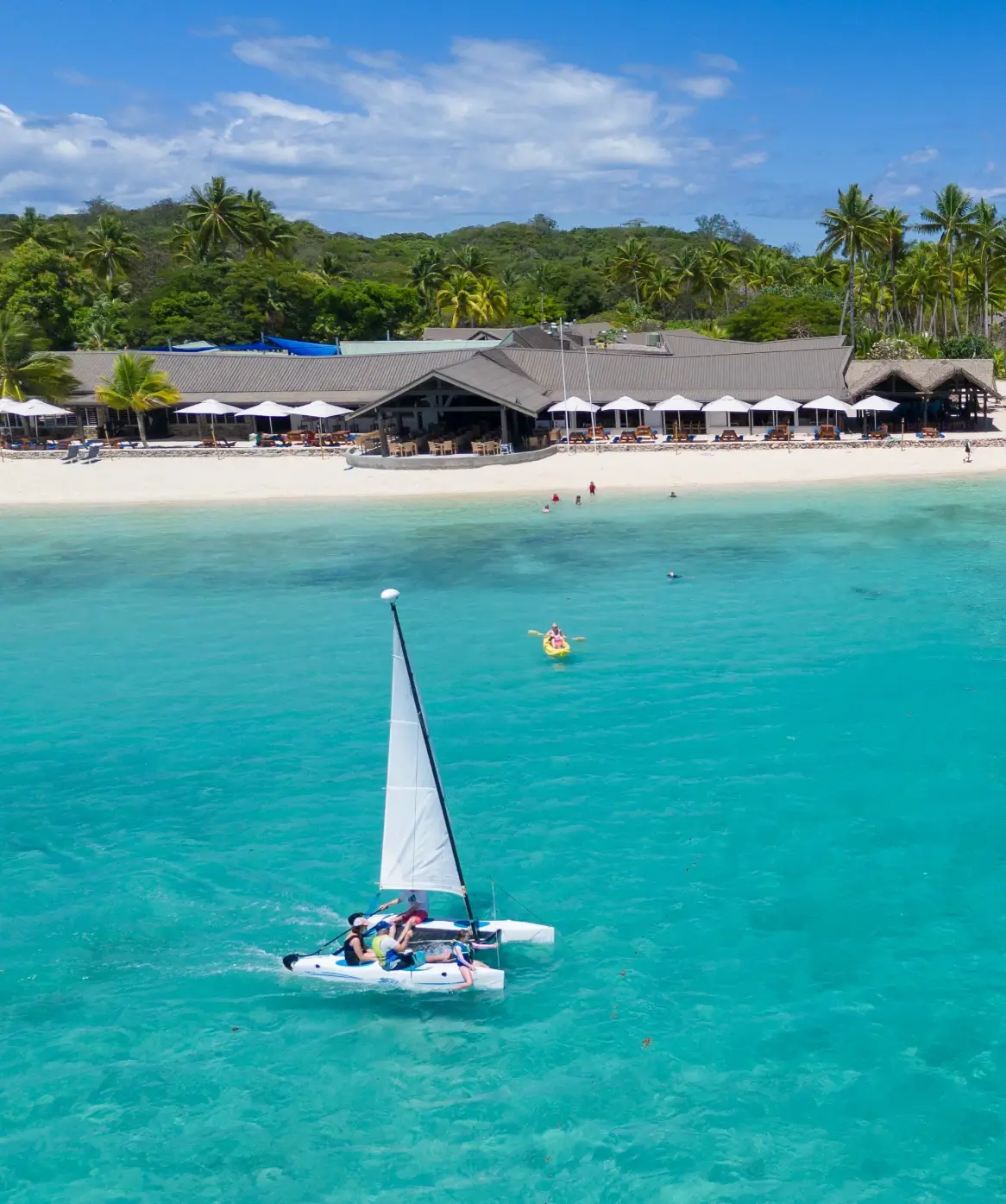
On small island resorts in the Mamanucas and Yasawas, assume there is no ATM and no way to get cash. Properties like Plantation Island Resort will generally let you charge to the room and settle by card at checkout, but that does not help with a boat crew tip or a village purchase. Draw your cash before you get on the boat. It is the single most common money mistake visitors make here.
What are the taxes on a Fiji bill?
This is where Fiji has recently become genuinely confusing, and where a lot of published guidance is now out of date.
| Charge | Rate | Who it applies to | Status |
|---|---|---|---|
| VAT | 12.5% | Most goods and services | Reduced from 15% on 1 August 2025 |
| Environment & Climate Adaptation Levy (ECAL) | 5% | Prescribed services where provider turnover is F$3m or more | Reduced from 10% on 1 August 2020 |
| Tourism Services Tax (TST) | 5% | Tourism businesses above F$2m turnover | New, from 1 September 2026 |
| Service Turnover Tax (STT) | — | Abolished for prescribed service providers | Removed 1 August 2020 (was 6%) |
| Departure tax | FJ$140 | Departing passengers | Normally built into your airfare |
Two things public sources currently disagree on, and you should know about both.
First, the VAT rate. Fiji raised VAT to 15% in August 2023 and cut it to 12.5% from 1 August 2025. A great deal of travel guidance online still says 15%, including otherwise reliable Fiji travel sites. The 12.5% figure is the one reflected in current tax and legal commentary.
Second, departure tax. FBC News reported the increase to FJ$140 taking effect 1 January 2024, and that remains the figure most commonly quoted. A 2026 commentary in the Fiji Sun refers instead to a $200 departure tax. We cannot reconcile those from public sources. It is normally included in your ticket price either way, so check your fare breakdown rather than budgeting for it separately.
Guideline only. Tax rates and thresholds change with each national budget — confirm current rates with the Fiji Revenue and Customs Service before relying on them. Last reviewed 29 September 2026.
What is the new Tourism Services Tax, and will it be on my bill?
A 5% levy on qualifying tourism services, commenced 1 September 2026 and announced as running to 31 August 2027. It applies to tourism businesses above a F$2 million turnover threshold — so large resorts, hotels, cruise companies and bigger tour operators, not the small family-run ones.
The transition rule matters: bookings made before 1 September 2026 are not subject to TST, even where the service is delivered after that date. If you booked earlier in the year and see the line on your final bill, that is worth querying.
For event and wedding budgets rather than holiday spending, our breakdown of VAT, service charge and levies on a Fiji event invoice works through what gets added to a quoted rate and in what order.
Do you tip in Fiji?
No, tipping is not customary or expected in Fiji. Nobody's wage depends on it and no one will react badly if you don't.
If you want to acknowledge service anyway, the conventions that have grown up around visitors are roughly 10% for a restaurant meal, taxi fare or tour guide, and 10–15% for a spa treatment. Many resorts run a staff Christmas fund or communal tip box instead of individual tipping, which spreads a gratuity across the housekeeping and kitchen teams who never meet guests. If a property has one, that is usually the better place to put it.
Where tipping genuinely does not belong is a village visit or a cultural performance. There the right gesture is the one the community asks for — a sevusevu contribution, or booking and paying the performers properly. Our guide to Fijian protocol and etiquette for visitors covers how that works.
Can you claim a VAT refund on the way out?
Yes, under the Tourist VAT Refund Scheme. It applies to purchases over FJ$500 from approved retailers, claimed on departure through the major airports and ports. Keep the tax invoices, keep the goods accessible, and allow extra time at the airport — the claim is processed there, not online afterwards.
The practical summary
- Draw FJD cash on the mainland before any island transfer.
- Expect a card surcharge of roughly 3% and check whether your own card adds a foreign transaction fee on top.
- Read the tax lines on your bill: VAT 12.5%, plus ECAL and TST at 5% each where they apply.
- Don't feel obliged to tip. If you want to, find the staff fund.
For the rest of the ground rules — health, connectivity, safety and entry — start at Practical Fiji, or see the Suva city hub for banking and business-district specifics.