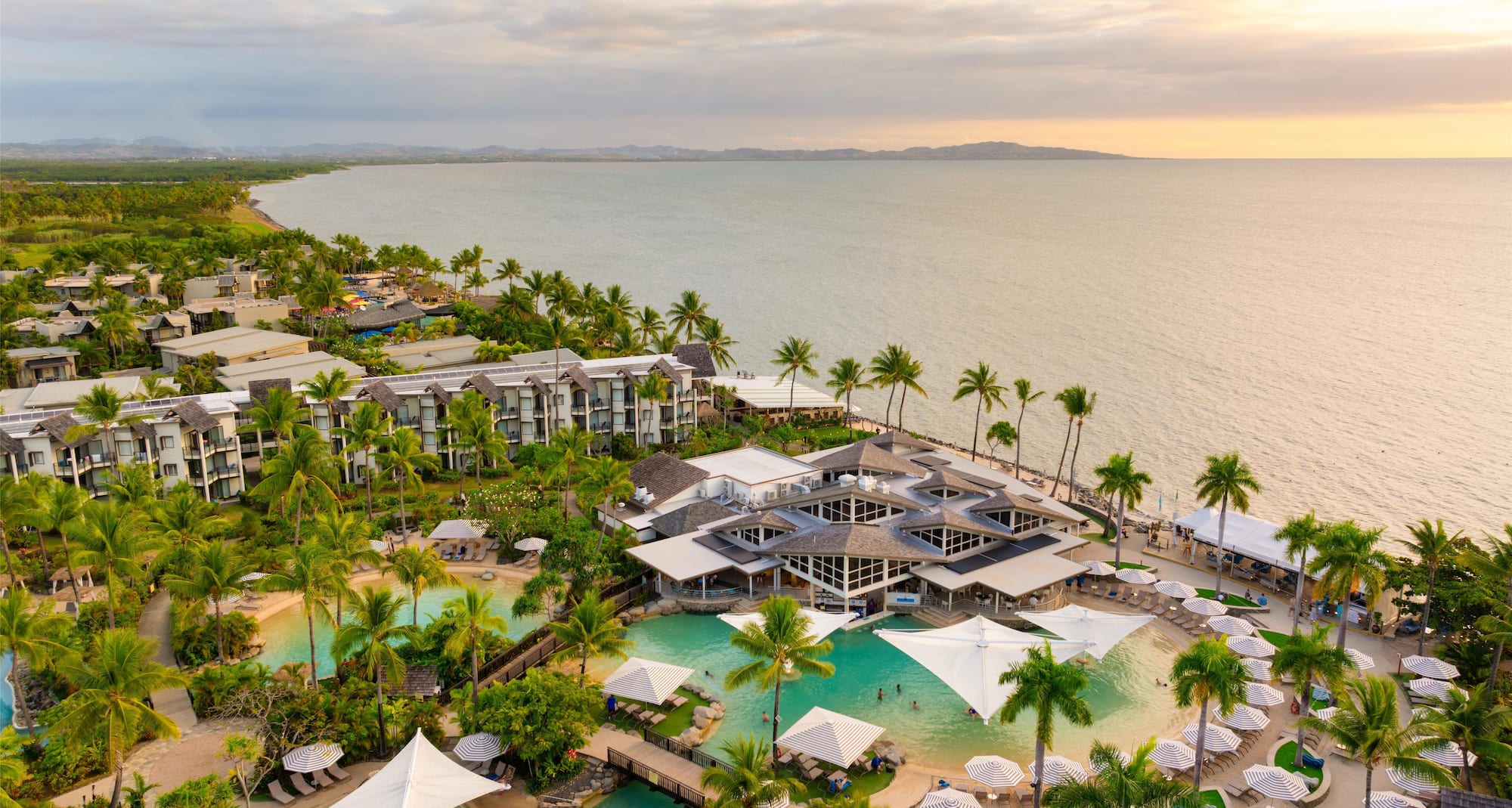
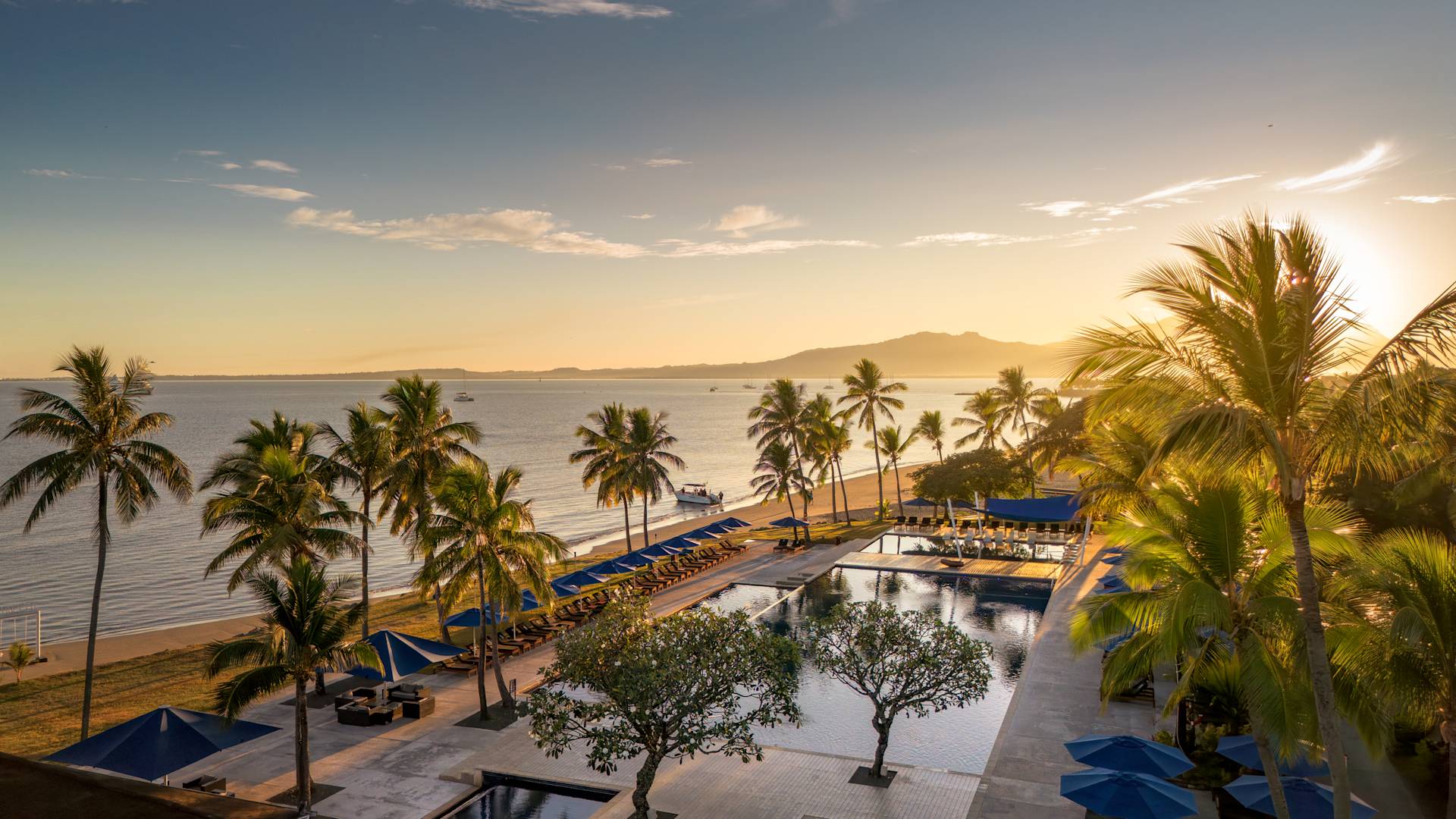
Nadi International Airport to Denarau Island is the shortest significant transfer in Fiji and the one most often got wrong. Allow 30 minutes door to door and you will almost never be late. Published figures range from 15 to 30 minutes, and the distance is given as either 10 km or 20 km depending on whose page you read.
For a group, the real decisions are per-vehicle versus per-person pricing, and whether you have a wet-weather plan for a road that has been cut by flooding before.
How long does the transfer actually take?
| Source | Figure |
|---|---|
| Denarau Corporation Ltd (the island's management company) | "approximately fifteen-minutes" |
| Tourism Fiji | "a short 20-minute drive" |
| Hilton Fiji Beach Resort & Spa | 20 km, "a 20-minute drive" |
| Port Denarau Marina | 15 minutes on one page, 20 minutes on two others |
| Tourist Transport Fiji | "approximately 25–30 minutes travel time"; airport "located just 10km from Denarau hotels" |
| Marriott's activities channel | 30 minutes |
Those cannot all be right. The 10 km versus 20 km discrepancy is the odder of the two — Hilton says 20 km, while the incumbent transfer operator says 10 km on two of its own pages — and neither of Fiji Airports' websites was functional when we checked, so there is no airport-operator figure to arbitrate.
The practical read: the island's own management company has an interest in the short number and the transfer operator has an interest in the longer one. Build your run sheet on 30 minutes. For a conference arrival day worked backwards from flight times, see arrival day design.
What are the published fares?
More is published on this route than on any other transfer in Fiji, which is useful — with the caveat that two of the three rate cards are past their own stated validity dates.
| Option | Published fare | Basis |
|---|---|---|
| Metered taxi | Nadi Airport flagfall FJ$5.00, drop charge FJ$0.15 per 100 m, waiting 18 cents per minute — set by the Fijian Competition and Consumer Commission, effective 22 June 2024 | Per vehicle |
| Shared shuttle | Airport Shuttle Fiji: FJ$39 one way, FJ$70 return to any Denarau resort, marina terminal or private residence | Per person — but see the warning below |
| Private vehicle | Tourist Transport Fiji: FJ$112 (1–3 pax), FJ$137 (4–6), FJ$158 (7–9), FJ$197 (10–17); 18+ by quote | Basis not stated on the page |
| Private vehicle | Xplore Fiji: FJD$50 (1–4), FJD$95 (5–9), FJD$155 (10–15), FJD$220 (14–22) | Basis not stated |
| Private vehicle | Tour Managers Fiji: from FJD 111.00 | "From" price on its booking catalogue |
| Coach charter | Go Local Fiji: FJD 275 one way / FJD 540 return for a 24–34 seat coach; FJD 330 / FJD 650 for 34–55 | Per vehicle |
| Public bus | Westbus, Nadi–Denarau, under FJ$5 per person; within Denarau under FJ$2. Cash is not accepted — an e-Transport card is required, sold at the Vodafone outlet in the arrivals terminal | Per person |
Three warnings on those numbers. Airport Shuttle Fiji's own rate page states rates are per person in its header while the Denarau row says transfers are "on shared basis, irrespective of number of pax" — a contradiction on a single page that, for a group of 40, is the difference between FJ$1,560 and one vehicle charge. Get it in writing. Second, that card states validity only to 31 March 2026 and Go Local's to 31 March 2024, so both are expired and must be re-quoted. Third, Tourism Fiji's own Nadi page gives the taxi flagfall as FJ$7.50 against the FCCC-regulated FJ$5.00 — the regulated figure is the one that applies.
Figures are as published in Fijian dollars in October 2026. We do not publish NZD or AUD equivalents because the rate moves — convert at the rate on the day you contract.
One operational point for return legs: metered LT taxis are not permitted to pick up passengers on Denarau, so a group cannot simply hail its way back to the airport. Book the outbound.
What vehicle sizes are available?
The fleet on this route is deep, which is why it works for conferences.
- Tourist Transport Fiji — nine 48-seat Yutong coaches, a 28-seat VIP executive coach, two 30-seaters, 17-seat mini coaches, 9 to 13-seat Hiace vans, and a wheelchair-lift vehicle
- Te Waka — 53-seat deluxe coaches built to Australian Design Rule standards, plus sedans, SUVs, vans and mini coaches; coach charter from 15 passengers
- Fiji VIP Transfers, powered by Rosie Holidays — 4-seat electric premium vehicles with wifi, 4 to 15-seat standard vehicles, and a 37-seat shared coach
- Go Local Fiji — Alphard and Prado cars, Higer vans, 22 and 35-seat buses, and a 15-seat bus with luggage trailer; it publishes luggage capacity per vehicle, which no other operator does
- Pehicle — 4 to 49-seaters, all air-conditioned with seatbelts
For a conference, the luggage figures matter more than the seat counts. Go Local's 22-seat coaster carries a maximum of 15 large suitcases; its 35-seater carries 35. A 48-seat coach full of delegates arriving from Auckland does not necessarily have room for 48 bags, and the trailer option exists for a reason. See coach charter in Fiji: fleet, capacity and cost.
What happens at the airport on arrival?
Transfer desks are inside the terminal. Tourism Fiji names six operating from the airport: Tourist Transport Fiji, Rosie Holidays, Tour Managers, Te Waka, Sunny Tours and Go Local Tours. Show your booking confirmation and collect your ticket; walk-ins are accepted if the fleet has space that day. Operators based outside the airport wait in the allocated transfer pick-up carpark, with drivers holding a placard bearing your name.
Tourist Transport Fiji's desk is "inside the arrivals hall and through the glass doors on the right" — the first glass-walled office on the right of the concourse — and its stated desk hours are 4am to 10pm daily. Note that the same operator also describes a 24-hour airport office and transport operation on other pages; those two statements are not reconciled anywhere on its sites, so for a red-eye arrival, get the staffing confirmed in writing. Go Local has an office at Office #6, ground floor, International Arrival Building.
Meet-and-greet with a shell lei is complimentary with TTF; flower leis, bottled water and cool towels cost extra. Private and shared transfers must be booked at least 24 hours ahead, and Fiji VIP Transfers asks for 48. Ride-share does not exist in Fiji — Tourism Fiji states plainly that Lyft and Uber "are not yet available". Yellow-plate taxis wait outside the arrivals hall; check the meter is on and carry Fijian dollars. See airport meet and greet for conference groups.
Car hire is available in the terminal: Tourism Fiji names Avis, Thrifty, Budget and Hertz, and gives normal hours as 5am to 10pm. Avis's own page says its Nadi counter is open 24 hours and Budget's says 6am to 10pm — three different answers, so confirm with the company you book.
What does the weather do to this road?
It cuts it. This is the part no operator publishes and every planner should know.
Flooding has closed the Denarau access road outright, isolating the island's resorts — a Fijivillage report describes the road toward Denarau closed by flooding so that hotel workers could not get to work and "guests cannot cross to the mainland," naming the Sheraton, Westin, Radisson, the Golf Terrace Apartments and the Denarau Golf and Racquet Club among those affected. That report carries no date on the page, so we will not attribute it to a year, but the event was specific and real.
The dated record is just as clear. The Fiji Roads Authority reopened the Queen's Road through Nadi Town on 26 December 2024 after floodwaters receded. Fiji Police reopened Sabeto Crossing, Nadi Back Road, the Malolo Bypass and the Nadi town area on 3 March 2026, with a flood warning still in force for low-lying areas downstream of the Nadi and Nawaka rivers; parts of Nadi flooded again the same afternoon. On 8 April 2026 a river flood warning was issued as the Nadi and Tuva rivers rose above warning levels, with traffic disruption expected at Irish crossings. Australia's Smartraveller states flatly that "flooding is common, especially in downtown Nadi" and that floods can cut road access, including to the airport.
None of the nine operators we checked publishes a wet-weather, flood-contingency or force-majeure transfer policy. The closest is Tourist Transport Fiji's note that travel times "depend on road conditions". So the contingency is yours to build: ask your operator what happens if the road closes, and put a cut-off decision point in the run sheet. See what happens to a conference if there is a cyclone.
Which option should you book?
One to four people: a pre-booked private car. At FJ$112 or FJD$50 depending on operator, it beats arguing about a meter after a long-haul flight.
Five to fifteen: a private van. One vehicle, one driver, one briefing — and the per-head cost falls below the shared seat.
Sixteen to fifty: a coach, and ask about luggage capacity before you confirm. Go Local's published FJD 275 and FJD 330 one-way coach rates are the only coach-scale figures published on this route, expired or not, so they are your only anchor for a negotiation.
Over fifty, or multiple flights: a ground handler running a staggered operation with a manifest. Tourist Transport Fiji has a dedicated groups, tours and series department and reports carrying over 100,000 passengers a year; Te Waka is a Fijian-owned DMC with its own arrivals lounge.
And if your delegates are heading to the islands rather than the resorts, Port Denarau Marina is the departure point for most Mamanuca and Yasawa services — the Yasawa Flyer leaves at 8.45am daily with check-in 30 minutes prior, which means a dawn transfer and a reason to stay at an airport-area hotel the night before.
More in real transfer times across Viti Levu, building a transport plan for a Fiji conference and the delegate transport hub. Resort pages: Sheraton Fiji, Radisson Blu Denarau, Hilton Fiji.