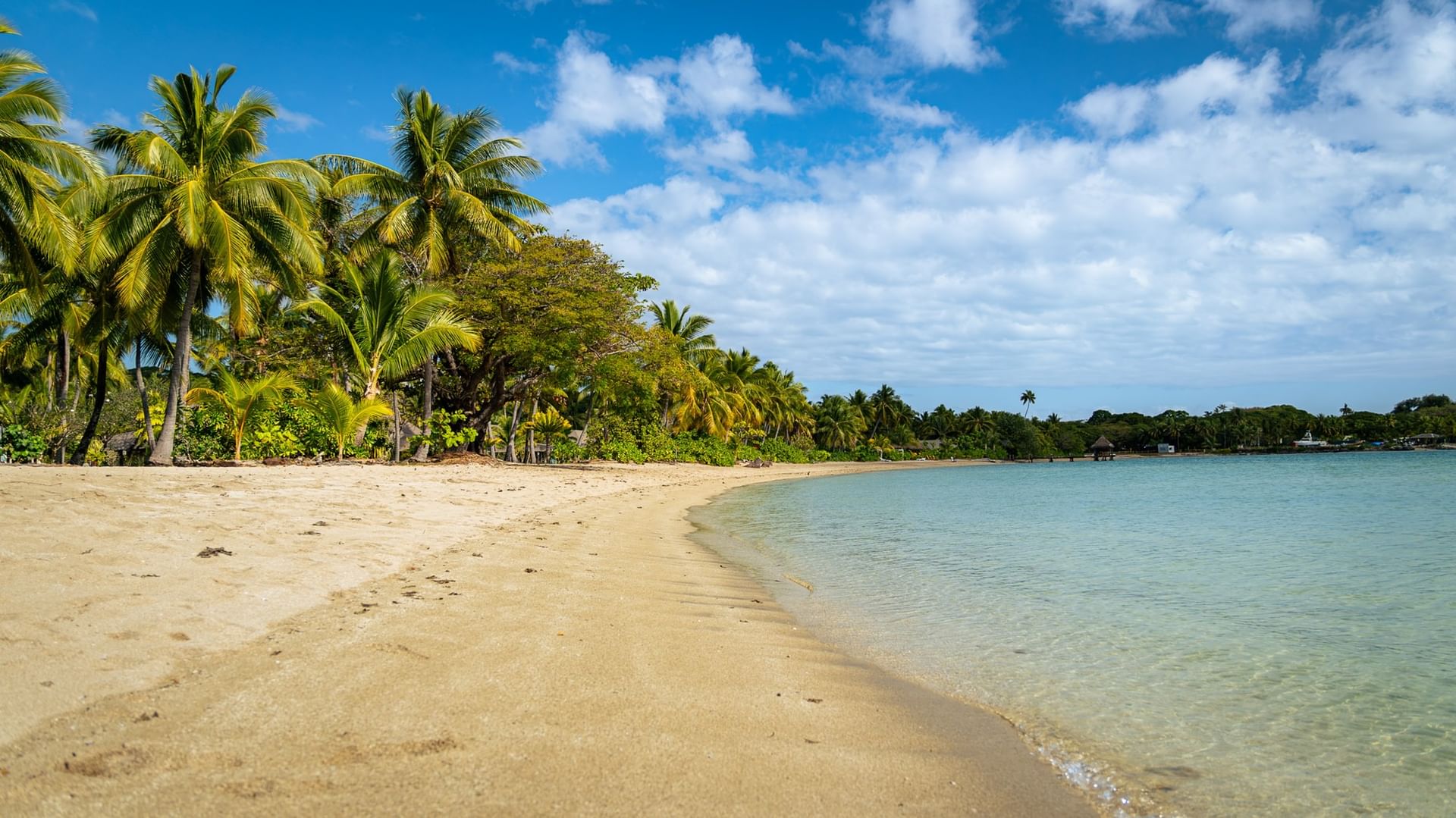
Fiji comprises 332 islands and 522 smaller islets, of which about 106 are permanently inhabited. The commonly quoted "333" is off by one. What matters for planning is smaller still: the islands with resorts, ceremony space and reliable transfers number in the dozens, and they cluster in five recognisable groups.
Figures in this section come from the Geography of Fiji summary of national statistics.
How big is Fiji, actually?
Small on land, enormous at sea. Fiji's total land area is 18,272 square kilometres — about the size of Wales, or a little smaller than New Zealand's Canterbury region. Its exclusive economic zone covers about 1,282,978 square kilometres, the 26th largest in the world.
Two islands do most of the work:
| Island | Share of land area | Approximate area | Population share |
|---|---|---|---|
| Viti Levu | About 57% | ~10,415 km² | About 69% |
| Vanua Levu | Just over 30% | ~5,482 km² | Most of the remainder |
| Everything else | About 13% | — | — |
Viti Levu is mountainous and volcanic, topping out at Mount Tomanivi, 1,324 metres. That ridge is why the west of the island sits in a rain shadow and is dramatically drier than the southeast — the single most useful geographic fact in Fiji for anyone planning an outdoor event.
What are the island groups, and how do they relate?
Fiji is usually described in six groupings. Here is what each actually is, and what it means if you are choosing between them.
Viti Levu — the mainland
Not an island you fly to so much as the island you land on. Nadi International Airport sits on the western side; Suva, the capital, is on the southeast. Between them runs the Queens Road, threading Denarau, Natadola, Momi, the Coral Coast and Pacific Harbour.
Everything that needs infrastructure happens here: the convention space, the hospitals, the AV suppliers, the coach fleets. It also holds the bulk of the accommodation — in the MICE Fiji directory, wedding-capable properties number 43 in Nadi, 39 on the Coral Coast, 38 in Suva, 25 in Lautoka, 20 on Denarau and 17 at Pacific Harbour.
The Mamanuca Islands — the accessible resort chain
A compact arc of about twenty small islands off Nadi, reachable by fast catamaran or speedboat from Port Denarau, and by helicopter or seaplane. This is where most people picture a Fiji island resort, and it is the only group where an island stay is genuinely easy to combine with a mainland arrival.
Properties here include Castaway Island Resort, Musket Cove Island Resort, Likuliku Lagoon Resort, Tokoriki Island Resort, VOMO Island Fiji and Six Senses Fiji. Mana Island Resort & Spa is closed for refurbishment with reopening targeted for late 2027.
The Yasawa Islands — the long, beautiful chain
A line of volcanic islands running northwest beyond the Mamanucas. Scenically the most striking of the groups, and operationally the most demanding: the Yasawa Flyer catamaran runs daily from Port Denarau through both chains, but the northern Yasawas are a long half-day away.
Resorts include Octopus Resort, Blue Lagoon Beach Resort and Barefoot Manta Island Resort. The directory lists 13 wedding-capable properties in the group, against 25 in the Mamanucas — a fair reflection of how much thinner the infrastructure is.
Vanua Levu and Taveuni — the second island and the garden island
Vanua Levu is Fiji's second island and feels like a different country: quieter, greener, with Savusavu and Labasa as its towns. Taveuni, off its southeast, is the "Garden Island", known for rainforest, waterfalls and the Rainbow Reef.
This is Fiji's diving heartland. Jean-Michel Cousteau Resort, Namale Resort & Spa, Koro Sun Resort and Garden Island Resort all sit here. The trade-off is a domestic flight on top of the international one — which for a wedding party means an extra transfer day, and for a conference usually means a different destination.
Lomaiviti, Kadavu and the outer islands
Lomaiviti sits in the middle of the group and includes Ovalau, home to Levuka, Fiji's former capital and a UNESCO World Heritage site. Kadavu lies south, with the Great Astrolabe Reef. Scattered further out are the private-island properties — Kokomo Private Island Fiji, COMO Laucala Island — along with Beqa Lagoon Resort off the south coast and Leleuvia Island Resort.
The Lau Islands and Rotuma
The Lau group runs down Fiji's eastern edge, remote and lightly served. Rotuma sits about 400 kilometres north of the main archipelago and is culturally distinct from the rest of Fiji. Neither has resort infrastructure of the kind used for weddings or business events. They belong in an understanding of Fiji's geography, not on a venue shortlist.
How far apart are they really?
This is where maps mislead. The islands look adjacent; the transfers are not.
| Route | Published time |
|---|---|
| Port Denarau to Castaway Island (Mamanucas) | About 90 minutes by catamaran; about 10 minutes by helicopter |
| Port Denarau to Mana Island (Mamanucas) | About 90 minutes by boat; about 20 minutes by seaplane |
| Port Denarau through the Yasawas | Daily scheduled catamaran; northern islands are a long half-day |
| Nadi International to Pacific Harbour | About 2.5 hours by road, or about 30 minutes by private air |
| Nadi International to Savusavu or Taveuni | Domestic flight required |
Sources: Outrigger Castaway Island; Radisson Hotel Group; Nanuku Resort; Yasawa Adventures.
The honest framing: a Yasawa island is worth the boat day, and you should build a rest day around it rather than pretend the transfer does not exist. A Mamanuca island is a genuinely easy add to a Nadi arrival. Vanua Levu and Taveuni are a second flight, and that changes the shape of the trip.
Which islands can actually host an event?
Far fewer than 332. The constraint is not land — it is rooms, ceremony or meeting space, power, water, and a transfer you can schedule around.
In practice: Viti Levu for anything over about 150 people, or anything needing real conference infrastructure. The Mamanucas for island weddings, small incentives and buyouts up to a few dozen rooms. The Yasawas for small groups willing to travel. Vanua Levu and Taveuni for dive-led programmes and retreats. The private islands for very small, very high-budget groups.
That is the whole practical map, and it is a lot shorter than the headline number.
So why does everyone say 333?
Because it is a better-sounding number, and because the count depends on where you draw the line between an island and an islet. The 332-plus-522 split is the figure used in Fiji's own geographic summaries, and it is more useful than a single round number because it tells you something true: most of Fiji is very small pieces of land with nobody on them.
Start here
For the full region-by-region breakdown including transfer times and what each precinct is good at, read Fiji's islands and regions: which one, and how long it really takes. For the two most-compared mainland options, Denarau vs the Coral Coast. For an island day without moving hotels, day trip islands from Denarau. Or browse properties by region from the Mamanuca Islands and the Yasawa Islands.
Last reviewed 26 September 2026.