Fiji is adding more than 125,000 international airline seats for 2027. Its own Civil Aviation Master Plan says Nadi's terminal works are scheduled for 2028, that only 15% of the 2024 approved capital expenditure was spent, and that Fiji Airports puts progress at about five years behind schedule. That gap between the demand being created and the infrastructure being built is the story of Fiji's pipeline, and it is what a planner looking three years out needs to understand.
What is actually happening at Nadi?
Real things, at the margins. Per Fiji Airports' own newsletter: Aerobridge Phase 1 delivered four aerobridges on time and within budget; Baggage Handling System Stage 1 was expected to complete mid-2026 and double bag-loading capacity; runway pavement maintenance ran as night works, tentatively 26 January to 22 May 2026; departure lounge early works are under construction, enabling the Fiji Airways lounge to double in size. More than 18 projects sit in the airside master plan pipeline with 25 tender awards approved. On 19 October 2026 Fiji Airports' GM Assets & Infrastructure, Kelepi Dainaki, said departure smart gates are all installed and arrivals smart gates are being rolled out.
Then the bigger picture, from the Ministry's own master plan, which is unusually candid:
| Milestone | As published |
|---|---|
| 2024 approved capital expenditure spent | 15% |
| Master plan solutions | run from 2028 |
| Terminal works | scheduled for 2028 |
| Parallel taxiway to Runway 02/20 | planned for 2033 |
| Movements per hour after taxiway | 40-45, against a current maximum of 13 |
| Runway 09/27 relocation | triggered around 2043 |
| Fiji Airports' own assessment | progress about five years behind schedule |
That 13-to-45 movements-per-hour figure is the number that matters for large events. It is also the number that does not change until 2033.
On the headline value, be careful: the modernisation programme has been published as $2.5 billion, $2.3 billion and FJD 1 billion in different places, and the 2026-2027 Budget Address frames it as "more than $700 million" over the next five years covering regional airport upgrades, digital technologies, renewable energy and aviation safety systems. Do not treat any single figure as settled, and note that the $700 million is a five-year programme figure, not an appropriation - there is no discrete Fiji Airports capital line in the budget we retrieved.
For scale: Fiji Airports' 2022 annual report puts Nadi at approximately 1,613,464 international and 731,549 domestic passengers in 2022. The same report elsewhere claims more than 2.1 million international annually, undated and inconsistent with its own table - so we are not using it. No post-2022 annual throughput figure was found. Peak-hour load is published at up to 1,058 departing passengers in the 08:00-09:00 Sunday hour.
Is Suva about to become viable?
Physically, closer. Commercially, no evidence yet.
Nausori's Phase 1 - a FJ$60 million runway lengthening, widening and navaid upgrade - reached practical completion in November 2021, roughly a year behind its original target. Phase 2, a FJ$64 million terminal redevelopment, broke ground on 30 April 2026, covering expanded departures and arrivals, upgraded check-in and security, improved baggage handling, air-conditioning and accessibility. No contractor and no completion date have been published, and the reporting attaches the $64m variously to the redevelopment and to the runway extension, so treat the figure as reported-but-imprecise.
The constraint is not concrete. On 4 September 2025, Fiji Airways' then-CEO Andre Viljoen said one weekly Auckland flight from Nausori could lose up to $15 million a year, and that adding Sydney could take losses to $37 million; the airline was reviewing it, but "the current data suggests it may not be financially sustainable." Suva-Auckland was discontinued in 2020 and Nausori currently handles flights from Tuvalu.
So Fiji is building a terminal ahead of any carrier commitment. For a planner, that means Suva remains a Nadi-plus-four-hours proposition for at least the next three years, and the Grand Pacific Hotel's Britannia Ballroom at 400 banquet remains the practical ceiling in the capital.
What about the outer islands?
Delivered: a $10 million runway pavement maintenance programme, fully funded by Fiji Airports, across Labasa, Rotuma, Savusavu, Lakeba and Matei (Taveuni). Labasa's runway strengthening closed the airport from 16 February to 27 March 2026 and reopened on 28 March, raising the pavement rating to support ATR 72 operations under an approved safety case, funded by the World Bank under the Na Vualiku Project. A $8.57 million Labasa terminal contract went to Pacific Building Solutions with a permanent terminal due June 2026 - no completion announcement has been published, and that date has passed.
Not happening: Savusavu will not be expanded. A World Bank-backed assessment found the existing airport can no longer meet demand; alternative sites are under feasibility, and construction is not expected to begin until 2031. Savusavu and Kadavu remain constrained to Twin Otter-class aircraft, and the Lau group airports to 19-seat Twin Otters.
One detail worth knowing for a programme with an outer-island leg: seven scheduled-service airports have no instrument approach at all - Matei, Kadavu, Cicia, Savusavu, Lakeba, Koro and Vanua Balavu. Instrument approaches exist only at Nadi, Nausori, Labasa, Laucala and Rotuma. In cloud, those seven do not operate.
Where is the capacity actually coming from?
The airline, not the airport. On 2 October 2026, Fiji Airways announced more than 125,000 additional international seats for 2027:
| Route | Change | Seats as published |
|---|---|---|
| Western Sydney | new, 3x weekly from 19 March 2027 | approx. 42,000 |
| Hong Kong | 3 to 5 weekly from February | approx. 40,500 |
| Christchurch | 3 to 5 weekly from March | approx. 20,000 |
| Singapore | 2 to 3 weekly | approx. 20,000 |
| Tokyo | 2 to 3 weekly in April, again from August | approx. 13,600 |
| Vancouver | A350 on 3x weekly | approx. 17,500 |
Two flags. Those route figures sum to about 136,100, not 125,000, and the source does not reconcile them. And a separate 9 September 2026 report puts Western Sydney at more than 53,000 seats annually, against approximately 42,000 in the October announcement. Use them as direction, not as a seat inventory.
Already delivered: Gold Coast launched 11 June 2026, three weekly on a 737 MAX 8, reported at approximately 53,000 extra seats a year and Fiji's seventh Australian port. Noumea resumed 22 September 2026, two weekly on an ATR 72, after being withdrawn in June 2024. Canberra is ending in early 2027.
We found no firm aircraft orders. Published data puts the fleet at around 23 aircraft - four A350-900s, four A330s, five 737 MAX 8s, ATRs and Twin Otters. A February 2026 transaction moved two A350-900s between lessors, which is an ownership change on aircraft already in service, not a fleet addition. In August 2026 CEO Paul Scurrah said the airline is considering leasing additional widebodies in the medium term, with near-term growth from better utilisation of the existing fleet.
And the financial context should be stated plainly, because it is unusual: the same airline adding 125,000 seats is receiving a planned $200 million Government guarantee (not yet approved by Parliament), approximately $10 million a year in waived fees and charges extended to July 2027, a tax loss carry-forward extended from eight to 15 years, and the proceeds of a temporary 5% Tourism Services Tax from 1 September 2026 on hotels and tour operators with turnover above $2.0 million, expected to raise about $70 million ring-fenced for the airline. In other words, the extra lift is partly being paid for by the venues your delegates will sleep in.
What is being built on the ground?
370 rooms, from one group. Yavu Collective - owned by BSP Life and Fiji Airways - has signed with Accor for three properties: Sofitel Fiji Vatu Talei on Denarau Island, 176 rooms, opening early 2027; The Sebel Nuku Loaloa Living at Wailoaloa, 76 self-contained apartments and villas, opening August 2026, a $70 million investment; and TRIBE Na Tomba on Denarau Island, 118 rooms, opening late 2026, $74 million, with conference facilities for up to 200 delegates.
Two caveats on those. Vatu Talei has moved from 190 rooms opening late 2026 (2024 reporting) to 176 rooms opening early 2027. And Na Tomba's conference capacity was reported in June 2025 at up to 300 delegates and in June 2026 at up to 200 - Accor's own announcement mentions no conference facility at all. Use 200 and know it was once 300.
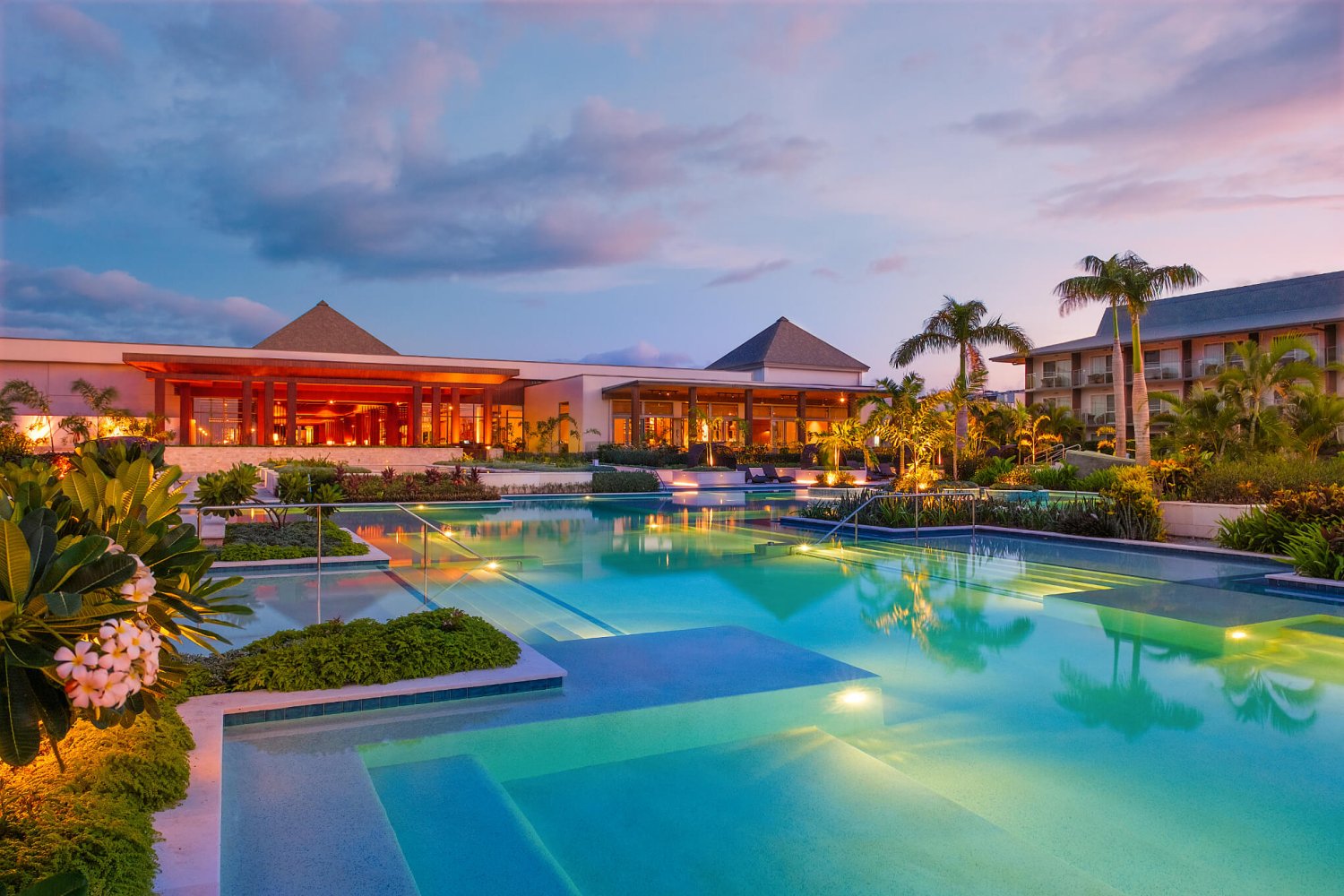
The most significant single addition for business events is already open and easy to miss, because the name changed: the former Pullman Nadi Bay is now Crowne Plaza Fiji Nadi Bay Resort & Spa, at 324 rooms, with a new convention centre reported at more than 900 square metres. On the published evidence that is the largest piece of new conference floor added in Fiji in this period. We could not verify the 900 sqm from IHG's own site, so confirm it before you build a floor plan on it.
Meanwhile 255 rooms and a 200-capacity ballroom remain offline on Denarau Island. The former Westin's reopening has been announced for later 2023, early 2025, later 2025 and 2026 - and Marriott's own page on 22 October 2026 still says the hotel is currently closed beside a notice promising reopening on 31 March 2023. No current reopening date exists.
Elsewhere: Radisson Mana Island Resort & Spa, 160 keys, renovation slated for 2027; Days Inn by Wyndham Nadi, 101 rooms, expected mid-2026; a $12 million Nanuku refurbishment; a $10 million Beachcomber Island refurbishment; and an InterContinental Fiji refurbishment planned to start early 2026. Official stock, June quarter 2026: rooms available 4,429, up 0.5%; rooms sold 3,664, up 0.7%.
The finding that matters most
Fiji has no announced purpose-built convention or exhibition centre. We checked the 2026-2027 Budget Address and Supplement, the Civil Aviation Master Plan, Fiji Airports' publications and Investment Fiji. Nothing in Nadi, nothing ON Denarau Island, nothing in Suva. The only occurrence of "conferences" in the Budget Address is a paragraph about cutting government spending on them.
Every piece of conference capacity in the pipeline is attached to a hotel. Resort ballrooms remain Fiji's ceiling, and the largest published one is the Sheraton Fiji's Denarau Island Convention Centre at 1,755 square metres with a banquet figure of 1,150.
And the roads, power and demand picture?
The Fiji Roads Authority has $369.8 million in 2026-2027. Of relevance to the corridor your delegates travel: $41.5 million in-year for civil works on four Queens Highway bridges, with the four estimated at about $400 million in total, and $14.9 million for new bus shelters on the Queens and Kings Roads. There is no funded Queens Road widening or realignment. A separate $20 million congestion package, including $15 million for widening Ratu Dovi Road, is Suva-area work. One oddity: the budget's itemised FRA lines total $270.5 million, $99.3 million less than the $369.8 million allocation, unexplained in the document.
Suva Port redevelopment is announced at over $1.5 billion over five years, with no contractor, no financier and no start date. Energy Fiji Limited's approximately $2 billion programme - 50MW of hydro, around 165MW of solar with storage - has implementation expected to start from 2027, meaning nothing is under construction now. We found no 5G and no data-centre project in any source consulted.
And the demand side, which is the quiet twist: the Ministry of Finance revised 2026 visitor arrivals growth down to 1.7%, from 2.0%, in the same budget that funds the capacity build. No 2027 arrivals forecast is published. September 2026 arrivals were 95,970, a record for the month and up 3.9% year on year, but down 4.0% on August. Fiji recorded 986,367 visitors in 2025 with earnings of $2,813.8 million.
What it means three years out
By 2029, on current published plans: more seats into Nadi, a terminal that has only just started its main works, a Nausori terminal with no confirmed airline, roughly 370 new rooms plus the Crowne Plaza's 900-plus square metres of convention floor, the Westin's 255 rooms still an open question, and no purpose-built convention centre anywhere in the country.
For events under 500 delegates, Fiji gets easier and better connected. For anything above 1,000, the Sheraton Fiji's convention centre remains the only real answer, Nadi's 13 movements per hour remains the chokepoint until 2033, and the sensible planning assumption is that nothing structural changes before then.
Converted at the Reserve Bank of Fiji's indicative rates for 22 October 2026: FJ$1 is about NZ$0.78 and A$0.63, published for indicative purposes only. Last reviewed 22 October 2026.
Next step: the Fiji event infrastructure hub assesses airports, roads, power and bandwidth for event risk, venue capacity changes and new event spaces tracks the rooms as they open, and Fiji Airways route changes follows the lift. For the venues named above, see Crowne Plaza Fiji Nadi Bay Resort & Spa, Sheraton Fiji Golf & Beach Resort, Grand Pacific Hotel Suva and Nadi Event Centre, or compare every room in the capacity chart.