Three carriers fly Melbourne to Nadi non-stop — Fiji Airways daily, Jetstar and Virgin Australia around three times a week each — giving roughly 13 weekly departures across a 3,887-kilometre route. Published scheduled times run from about 4 hours 20 minutes to 5 hours 50 minutes. The practical question for a planner is not whether you can get there, but which departure hour you buy.
Because that single choice decides whether your delegates arrive with an afternoon still usable or walk into a hotel lobby at dinner time. Everything else in this guide follows from it.
Who flies Melbourne to Nadi, and how often?
| Carrier | Weekly non-stops | Sample-week days | Sample departure | Aircraft |
|---|---|---|---|---|
| Fiji Airways | 7 (daily) | Every day | Early afternoon, around 1.35–1.55pm, varying by day | A330-200, A330-300, A350-900 or 737 MAX 8 |
| Virgin Australia | 3 | Tue, Thu, Sat | Around 10am | 737-800 or 737 MAX 8 |
| Jetstar | 3 | Mon, Thu, Sat | Around 7.15am | A321neo |
Those days and times are a snapshot of one published week and carriers reschedule, so treat them as the shape of the route rather than the timetable. Confirm against the carrier for your own dates.
Where the sources disagree. One schedule aggregator puts the route at 13 weekly flights in its summary and 12 in its own FAQ, and gives flight duration variously as 5 hours 50 minutes and about 4 hours 40 minutes. A second source gives a scheduled range of 4 hours 20 minutes to 5 hours 50 minutes. Some of that spread is the difference between the outbound and return legs, some of it is stale data. We publish the range rather than pick a number, and the only figure worth planning on is the one attached to your actual flight number.
What is not in dispute is the lift. Thirteen non-stops a week on a route served by three competing carriers, including widebody Fiji Airways equipment, is strong for a market of this size — and better than Melbourne groups often assume.
How does the departure time change your programme?
This is the part that matters. With a flight of roughly four and a half to five hours and one or two hours gained crossing into Fiji time, your arrival hour lands in three distinct bands.
| Departure from Melbourne | Lands in Nadi | What day one can be |
|---|---|---|
| Early morning (c.7.15am) | Early to mid afternoon | A genuine afternoon: registration, an opening session, a welcome function |
| Mid morning (c.10am) | Mid to late afternoon | Registration and a welcome reception; no working session |
| Early afternoon (c.1.45pm) | Evening | Transfer, check-in, dinner. Day one is gone |
On the time difference: Fiji operates on UTC+12 and Melbourne on UTC+10 or UTC+11 depending on Australian daylight saving, so Fiji normally runs one or two hours ahead. Fiji has at times observed daylight saving of its own, so confirm the offset for your travel dates rather than assuming — an hour either way moves a 4pm opening session.
The decision falls out cleanly. If your programme needs four working days, buy the early departure and accept the earlier alarm. If the trip is an incentive rather than a conference, the afternoon Fiji Airways service with a widebody cabin is the more comfortable buy and the evening arrival costs you nothing.
What should you ask the group desk?
Airlines handle bookings from around ten passengers through a group desk rather than the public site, but every carrier sets its own thresholds and terms and they change. Rather than assume, ask these in one email and get the answers in writing:
- The minimum group size and whether your number qualifies for group terms at all.
- The deposit, the amount and the date it is due.
- The name-list deadline — the date by which passenger names must be lodged, and what happens to unnamed seats after it.
- Change and cancellation rules, including whether names can be substituted and at what cost.
- Attrition, meaning how many seats you can release without penalty.
- Baggage allowance per passenger, and the cost of excess — significant if the group carries conference freight, banners or exhibition material.
- Seat allocation, and whether the group will be seated together.
- Whether the fare is held while you collect names, and for how long.
The two that catch planners out are the name-list deadline and attrition. Both are commercial terms, both are negotiable at volume, and neither is published.
What happens on the ground at Nadi?
A group of any size needs transfer capacity held against a flight number, not a date. Nadi's larger ground operators can handle delegation arrivals: Tourist Transport Fiji is based at the airport with coaches, minibuses and a dedicated groups department, TEWAKA Fiji runs 53-seat deluxe coaches and a meet-and-greet arrivals lounge at the terminal, Pehicle Tours Fiji operates up to 49-seat coaches, and Go Local Fiji runs 15, 22 and 35-seat vehicles around the clock. Fiji VIP Transfers adds a 37-seat shared coach alongside private vehicles.
Our guide to airport meet-and-greet for conference groups covers how to stage an arrival wave properly, and the Nadi Airport planner's guide covers the terminal itself.
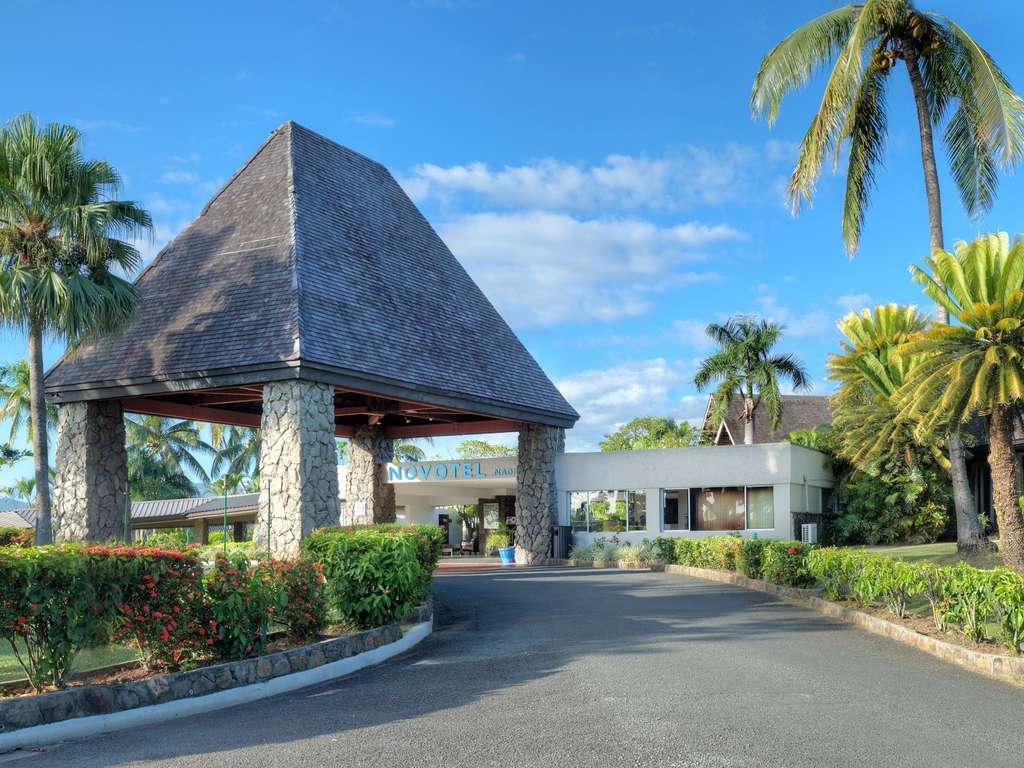
Where you stay changes the arithmetic too. If you have landed in the evening, do not add a 30-minute transfer to it: Novotel Nadi sits about 2.5 kilometres from the terminal with six meeting rooms, and Tanoa International Hotel about 3.5 kilometres with five function spaces and a convention centre. If the programme proper is ON Denarau Island at Sheraton Fiji Golf & Beach Resort, or at Crowne Plaza Fiji Nadi Bay Resort & Spa at Wailoaloa, consider a first night nearer the airport for the late-arriving wave.
The recommendation
For a conference, book the earliest Melbourne departure available on your dates, hold the transfer against the flight number, and build day one as a real working afternoon.
For an incentive, book Fiji Airways' afternoon service for the cabin and the schedule reliability of a daily operation, and plan day one as arrival and dinner only.
For a group above about 80, expect to split across services. Plan the transfers and the welcome function around the later arrival wave, not the earlier one.
Next step
Lock the flight before the ground programme, because every transfer, session and function hangs off the arrival hour. Compare the wider Australian and New Zealand picture in getting guests to Fiji, keep an eye on Fiji Airways route changes, and work through the air access hub. Ground operators and hotels are listed in the Nadi directory.
Schedules are a published snapshot and change frequently. Confirm carriers, days, times and group terms directly with the airline for your travel dates. Last reviewed 18 October 2026.