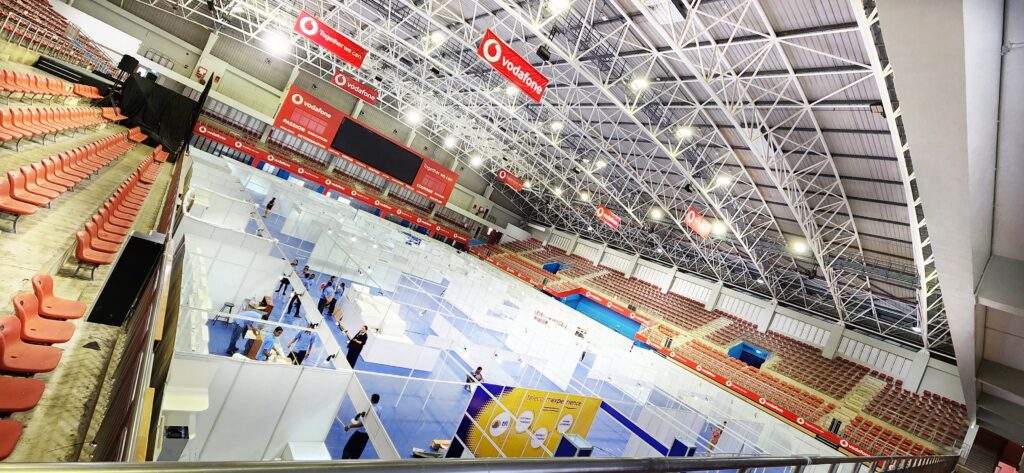
Fiji can host a technology conference, and the connectivity case is better than most planners expect: six submarine cables land here, Southern Cross NEXT came into service in 2022 with a 72 Tbps design capacity, and 5G went live in Suva, Nadi, Lautoka and Denarau in September 2025. The catch is that no Fiji venue publishes a bandwidth figure or an access-point count — so the country's strength is upstream, and the last hundred metres is on you to specify.
Is Fiji's connectivity good enough for a tech conference?
Upstream, yes. Fiji is a landing point for six submarine cables, landing at Suva or Savusavu: the Southern Cross Cable Network, Southern Cross NEXT, Tui-Samoa, Tonga Cable, ICN1 to Vanuatu, and Gondwana/Picot-2 to New Caledonia.
Southern Cross NEXT — about 13,700 km, reported at US$350 million — was expected in commercial service from 7 July 2022, with a 72 Tbps design capacity over 400G wavelengths across four fibre pairs and a branching unit to Fiji. FINTEL's own presentation describes that as adding to roughly 20 Tbps on the existing Southern Cross systems. Tui-Samoa, live since 2018, runs more than 1,470 km with at least 8 Tbit/s, landing at FINTEL's Vatuwaqa substation in Suva.
More is arriving. Google's Bulikula and Tabua cables, part of its Pacific Connect programme, landed in January 2025 and were expected operational in 2026, bringing a second cable landing station and a Tier 3 data centre with them — projected by APNIC to add around USD 250 million to GDP by 2030.
Domestically, the numbers are more modest and worth knowing before you promise anything to a sponsor.
| Measure | Figure | Source and date |
|---|---|---|
| Median fixed download speed | 30.57 Mbps | DataReportal/Ookla, Digital 2026 Fiji (published November 2025) |
| Median mobile speed | 20.37 Mbps | DataReportal/Ookla, Digital 2024 Fiji (January 2024 data) |
| Population 3G coverage | over 96 per cent | Fiji National Digital Strategy 2025–2030 |
| Population 4G coverage | over 92 per cent | Fiji National Digital Strategy 2025–2030 |
| ICT infrastructure ranking | 107th of 176 | Fiji National Digital Strategy 2025–2030 |
| Mobile connections | 1.42 million, 152 per cent of population | GSMA Intelligence via Digital 2026 Fiji |
Note the Digital 2026 report did not carry a median mobile figure, so the 20.37 Mbps above is the 2024 reading, not a current one.
5G is real but narrow. Vodafone Fiji went live on 15 September 2025, with Phase One covering the town and city boundaries of Suva, Nadi, Lautoka and Denarau; Phase Two in 2026 adds Nasinu, Lami, Labasa and Savusavu, with further towns in 2027–2028. Vodafone cites over $100 million in network upgrades. Digicel Fiji launched in parts of the same three cities and reports average data speeds of 600–700 Mbps, with the usual caveats about location and load.
There is real peering depth for a Pacific market: Fiji-IX has grown from four ISPs at its 2017 founding to seven members, data centres operate at FINTEL Vatuwaqa, the Government ITC Centre, Telecom Fiji, Centrecom and Datec Fiji, and Google, Meta, Netflix and Cloudflare all have local presence. Even so, only 41 per cent of Fiji's top 1,000 websites are served from local caches, against an Oceania average of 59 per cent.
What bandwidth will the venue actually give you?
This is the honest gap, and it is the single most important sentence in this piece: we could not find a single Fiji venue publishing a dedicated bandwidth figure, an Mbps commitment or an access-point count.
Grand Pacific Hotel Suva lists "high speed guest Wi-Fi" with no specification, alongside an in-house AV team, portable PA, built-in projectors and video conferencing across six function venues and 2,361 m² of meeting space. The Westin Denarau Island Resort & Spa lists LCD projectors, microphones, PA, videoconferencing and teleconferencing with no technical specification and no internet detail. Shangri-La Yanuca Island lists "Conference Facilities" among its amenities and nothing further. Vodafone Arena publishes no internet specification at all.
The only venue in the country that prices internet as a line item is the Japan-Pacific ICT Centre at USP's Laucala campus in Suva — and even it publishes no speed.
So specify it yourself, in the contract:
- A dedicated, wired, event-only circuit with a stated committed rate, separate from guest Wi-Fi, and a stated upstream provider.
- Access-point count and placement for the room's actual peak concurrency, not its seat count — a tech audience brings two or three devices each.
- A redundant path, ideally on a different carrier, with a tested failover. With three operators and two cable systems in the country, genuine diversity is achievable; it will not happen by default.
- An on-site network engineer for the duration, named in the contract.
- A load test with the exhibition floor and streaming encoders live, not an empty-room speed test.
Where should a tech conference actually sit?
Three venues have a genuine claim, for different reasons.
Japan-Pacific ICT Centre, USP Suva. Opened in 2010 with about JP¥2.2 billion of Japanese grant aid, it houses computer laboratories, PacCERT, the Pacific Islands Telecommunications Association and incubator space. Its Multipurpose Theatre seats 307 in fixed folding chairs plus four spaces for people with disability, with a full stage, film screens, preset stage lighting, a control room and an in-house media system, and USP supplies a technician when the hall and lighting are hired. Published hire rates effective 1 January 2026, per session, in FJD:
| Item | Organisations, NGOs, schools, universities | Corporate |
|---|---|---|
| Basic hall | 1,000 | 1,600 |
| Air-conditioning | 300 | 500 |
| Full stage lighting | 300 | 400 |
| Internet | 100 | 200 |
| Kitchen | 200 | 300 |
| Cleaning | 250 | 250 |
| Security, per person | 100 | 100 |
Two gotchas that will shape your programme: applications go to the Director IT Services at least 60 days before the activity, and food, drink and liquor are prohibited in the theatre. Plan catering elsewhere on campus. Sessions run 9:00am–1:00pm, 2:30–5:30pm and 6:00–10:00pm.
InterContinental Fiji Golf Resort & Spa, Natadola. The venue with the strongest tech-conference precedent: Fiji Tech Summit 2025 ran there on 30–31 October 2025, organised by Datec Fiji with over 350 delegates, 25 exhibitors, more than 25 international speakers and more than 30 sessions on cybersecurity, AI, cloud and enterprise networking. Its pillarless ballroom seats up to 600 and it has three theatre-style meeting rooms each taking up to 110 delegates, each divisible. It also put a quarter-million-dollar AV upgrade through in-house provider Encore, including a Video over IP system and wireless access points routing video to handheld devices, explicitly to support hybrid events.
Holiday Inn Suva. Hosted the PacNOG 35 plenary on 23 June 2025, with the technical training tracks running at the Japan-Pacific ICT Centre across 24–27 June. Its own pages give up to 350 delegates overall, with the Lali Room at 200 and the Banyan Room listed inconsistently at both 150 and 100. For a network-operations or standards meeting, the Suva pairing of a hotel plenary and USP labs is a proven format.
Can you bring demo kit and devices in?
Yes, through two separate processes that both need starting early.
Customs treats demo and trade-show equipment as privilege goods under Regulation 97(1), which expressly covers "goods for display or use at exhibitions, fairs, meetings, or similar events". Apply on Form C.21 with an $11.00 fee, entry type IM5; the officer may require security for the duty or a duty deposit, and goods must be exported within three months, extendable to twelve months from importation. Fiji is not an ATA Carnet country, so a carnet is no help. A licensed customs agent is mandatory for commercial goods and must be engaged before arrival.
Anything that transmits radio waves — including every handset, radio mic and wireless demo rig — needs a Telecommunications Authority of Fiji import permit under s55(4) of the Telecommunications Promulgation 2008. The fee is FJ$11.25 per model or type approval, charged per model regardless of unit count, with processing typically one to two days, and you must supply brand, model and serial number for every device. TAF also notes that an approved network is tied to a specific site or radius and cannot be moved without approval — relevant if you plan a private demo network.
These are guidelines only — confirm current requirements with the Fiji Revenue and Customs Service and the Telecommunications Authority of Fiji before shipping.
What should your programme committee know about Fiji's policy position?
Two things that will come up from the floor.
Fiji has no comprehensive data protection law. A Data Protection Bill has been under consideration and there is no dedicated data protection authority. The Online Safety Act 2018 exists, overseen by the Online Safety Commission, with a limited mandate. If your event involves delegate data, health data or cross-border transfer sessions, brief speakers accordingly and take your own advice on handling.
The government's direction is clear and quotable. The National Digital Strategy 2025–2030, launched in April 2025, targets 95 per cent 4G and 50 per cent 5G population coverage, 1,000 km of domestic optical fibre, satellite reaching 90 per cent of remote areas, 40,000 ICT jobs by 2030, 80 per cent of key government services online, ICT at 10 per cent of real GDP and over USD 100 million of investment. Minister Filimoni Vosarogo announced the 80 per cent target while opening Fiji Tech Summit 2025. Fiji ranks 93rd of 193 on the 2024 E-Government Development Index.
The verdict
Choose Fiji for a regional Pacific technology or telecommunications conference, and specify the venue network yourself. The cable capacity, the peering, the 5G footprint in the four main centres and the Datec and PacNOG precedents all stand up. What does not exist yet is a venue willing to publish a number you can hold it to — so make that number a contract term, add a second carrier, and load-test it before the doors open.
Next: read internet and bandwidth at Fiji venues for the venue-by-venue picture, then compare against the banking and financial services and Pacific regional associations playbooks, which share the same Suva infrastructure. The hub is Fiji conference sectors, and rooms are listed by size in the capacity directory.