Fiji hosts Pacific regional association conferences more often than any other Forum member, because Suva is where the regional institutions already are — the Pacific Islands Forum Secretariat and the Pacific Community's Suva campus among them. That advantage comes with three specific problems: rotation politics, per-diem arithmetic, and two airports that do not work the same way.
Why does Fiji keep getting the regional meeting?
Because the secretariats are here. Suva hosts the Pacific Islands Forum Secretariat and a Pacific Community (SPC) regional office, alongside the University of the South Pacific's Laucala campus, which serves twelve member countries. Australia's Department of Foreign Affairs and Trade lists Fiji as a base for multiple Pacific regional organisations.
For an association whose secretariat, members and funders are already routed through Suva, holding the congress elsewhere means moving the institutional attendees as well as the delegates. That is the same proximity argument that governs government and public sector conferences in Fiji — but with a complication those events do not have.
What is the rotation problem, and how do you manage it?
Most Pacific regional associations rotate their annual meeting among member countries. It is a principle, not an administrative habit: rotation spreads the economic benefit and signals that the body belongs to all its members, not to the country where its office happens to sit.
So a Fiji-hosted congress is often not the default but the fallback — chosen when a smaller member cannot absorb the delegate load, or when a date moves and only Fiji has the inventory free. That has three consequences for planning.
Your lead time is shorter than a comparable corporate event. Rotation decisions are made at the previous year's meeting, and the host sometimes changes afterwards. Build the venue hold strategy around that; see booking lead times for Fiji venues.
Say why Fiji, in the papers. "Only member with available 400-seat plenary capacity on these dates" is a legitimate reason and worth stating. Members notice when it is not.
Expect a Fiji-hosted meeting to carry a regional programme. If the economic benefit is not being spread by location, it should be spread by procurement — see local sourcing and community benefit.
How do per diems change the accommodation brief?
This is the single biggest practical difference from corporate work, and it catches planners out.
A large share of delegates at a Pacific regional conference travel on a fixed per diem set by their own government or by a donor. The per diem does not flex to your room rate. If your contracted rate exceeds it, the delegate pays the difference personally — and if the difference is material, they do not come, or they book somewhere else and your room block collapses.
What that means:
- Contract a rate band, not a single rate. Secure allocation at two or three price points across properties, not one.
- Find out the prevailing per-diem levels before you negotiate. Ask the secretariat, not the venue.
- Keep at least one option well below the mid-market rate. Peninsula International Hotel, Tanoa Plaza Hotel and Studio 6 Apartments sit in a different band from Grand Pacific Hotel, and your room block needs both.
- Check whether the per diem is inclusive of meals. If it is, a conference that provides lunch is doing delegates a financial favour; if not, an all-inclusive package may put them out of pocket on paper.
Which Suva venues take a regional congress?
| Venue | Space | Size | Theatre | Banquet | Cocktail |
|---|---|---|---|---|---|
| Grand Pacific Hotel | Britannia Ballroom | 600 m² | 600 | 400 | 550 |
| Grand Pacific Hotel | Britannia 1 / 2 / 3 (each) | 200 m² | 140 | 70 | 100 |
| Grand Pacific Hotel | Matua Function Room | 291 m² | 200 | 140 | 200 |
| Grand Pacific Hotel | Britannia Pre-function | 297 m² | — | — | 250 |
| Japan-Pacific ICT Centre | Multipurpose theatre, USP Laucala | Not published | Not published | — | — |
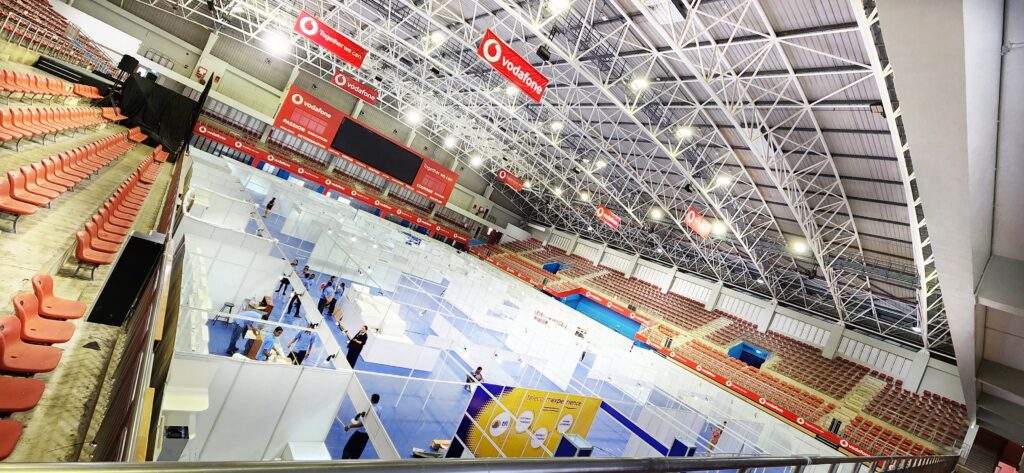
| Vodafone Arena | Indoor arena | Not published | Not published | — | — |
The Britannia configuration is what makes Grand Pacific the default: one 600-seat plenary that divides into three 140-seat rooms, with 250 cocktail of pre-function space to work the breaks in. That is exactly the shape a multi-stream regional congress needs.
Note the caveats. The hotel's own page describes "six dedicated meeting venues" while its fact sheet lists nine rooms, and the on-page capacity callouts contradict the chart. Treat the fact sheet as the working number and confirm in writing. Neither Vodafone Arena nor the Japan-Pacific ICT Centre publishes a conference capacity chart. Holiday Inn Suva and Novotel Suva Lami Bay carry additional meeting space alongside rooms.
What about interpretation?
Several Pacific regional bodies operate bilingually in English and French, and others work across multiple Pacific languages. Simultaneous interpretation is therefore a recurring requirement rather than an exception — and it is not a line that Suva venues bundle into a day delegate rate.
Treat it as a specialist procurement with its own lead time: booths, receivers, technicians and interpreters, all of which may need to be brought in. Confirm with the venue whether the plenary room can physically accommodate interpretation booths with sightlines to the stage, because a 600-seat ballroom at capacity plus booths is not a 600-seat ballroom. See AV and production in Fiji.
How do delegates actually get there?
The two-airport problem is the most under-planned part of any Suva congress.
Nadi International (NAN) has the international lift. Nausori (SUV) serves Suva directly but with far less. Most regional delegates will land at Nadi and then need to reach Suva — a long road transfer or a domestic hop, either of which adds a half-day each way and a cost line. Our guides to the Nausori airport access problem and real transfer times from Nadi set out the options.
Build the arrival day into the programme rather than pretending it is a travel day. Delegates arriving from Micronesia or Polynesia may be on multi-leg itineraries of a day or more.
Entry requirements differ by nationality and by whether the delegate travels on an official or ordinary passport. Guideline only — confirm current requirements with the Fiji Immigration Department well before invitations go out. Visas and entry for conference delegates in Fiji covers the ground. Last reviewed 13 October 2026.
Verdict
Fiji is the right host when the secretariat is here, the delegate load exceeds what a smaller member can absorb, or the dates leave no alternative — and it should be said in those terms rather than assumed. Build the accommodation brief around per diems before you build it around standards. Book interpretation as a separate procurement. And treat Nadi-to-Suva as a programme day, not a transfer.
Next
Holding a development and multilateral agencies conference in Fiji covers the donor-funded variant. See also Suva or Nadi: choosing a Fiji conference city, how many delegates can Fiji host, and the Fiji conference sectors hub or the Suva city hub.