Government and public sector conferences in Fiji almost always land in Suva. The capital holds Parliament, the ministries, the Fiji Procurement Office and the diplomatic missions, so the people who must attend are already there — and the procurement rules that govern the spend are written and administered a short walk from the venues.
Why does Suva win government business over Nadi?
Because proximity is the whole budget argument. A ministry-hosted conference in Nadi means moving officials across Viti Levu, paying for two nights of accommodation they would not otherwise need, and losing a working day each way. In Suva the same officials walk or take a five-minute taxi.
That matters more than it sounds. Public sector events are judged on value for money, and the single largest avoidable line in a government conference budget is internal travel for your own staff. Holding the event where the staff already are removes it.
Nadi earns its place when the delegate list is dominated by arrivals from overseas rather than local officials — a donor-funded regional workshop, a ministerial meeting with Pacific counterparts flying in. At that point Nadi International Airport's lift advantage outweighs Suva's proximity to the ministries. Our guide to choosing a Fiji conference city sets out the trade in detail, and the Nausori airport access problem explains why that choice is rarely as close as it looks.
What venues in Suva actually handle a government conference?
Suva's inventory is modest by Australasian standards but adequate for the sizes government work usually runs at. Published figures below are taken from the venues' own capacity material.
| Venue | Space | Size | Theatre | Banquet | Cocktail |
|---|---|---|---|---|---|
| Grand Pacific Hotel | Britannia Ballroom | 600 m² | 600 | 400 | 550 |
| Grand Pacific Hotel | Britannia 1 / 2 / 3 (each) | 200 m² | 140 | 70 | 100 |
| Grand Pacific Hotel | Matua Function Room | 291 m² | 200 | 140 | 200 |
| Grand Pacific Hotel | Cession Room | 69 m² | — | 15 | — |
| Japan-Pacific ICT Centre | Multipurpose theatre, USP Laucala | Not published | Not published | — | — |
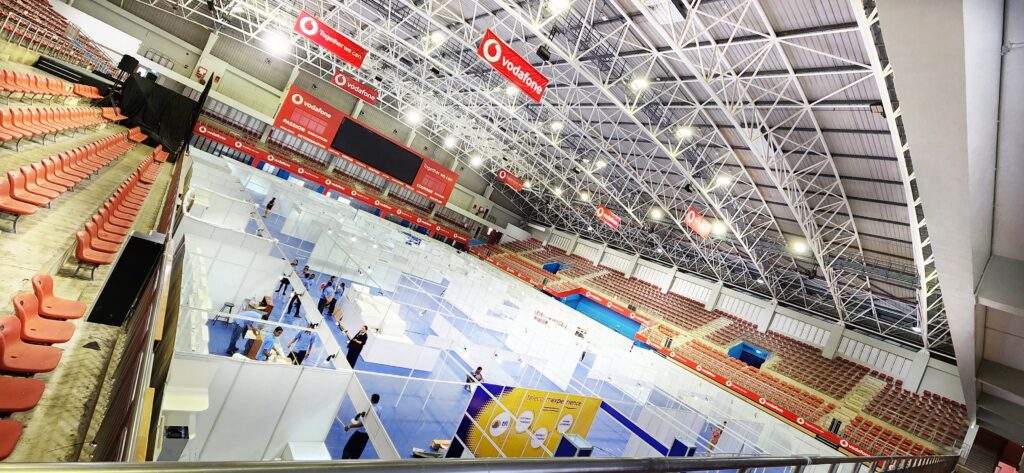
| Vodafone Arena | Indoor arena | Not published | Not published | — | — |
Two cautions on that table. The Grand Pacific Hotel's own venues page describes "six dedicated meeting venues" while its downloadable fact sheet lists nine rooms, and the on-page capacity callouts do not match the fact sheet figures — the Matua is labelled 15 on the page against 200 theatre in the chart. Treat the fact sheet as the working number and confirm in writing. Neither the Japan-Pacific ICT Centre nor Vodafone Arena publishes a conference capacity chart at all.
For accommodation-led events, Holiday Inn Suva, Novotel Suva Lami Bay and Tanoa Plaza Hotel carry meeting space alongside rooms. The full picture is in conference venues in Suva.
How does Fiji government procurement affect the way you quote?
If your event is funded by a Fiji government agency, the spend runs through the Fiji Procurement Office and, above the relevant thresholds, the Government Tender Board. In practice this changes three things for a supplier or planner.
You will be asked for comparable quotes, not a package. Procurement officers need to place line items side by side. A single "conference day delegate rate" that bundles room hire, AV, two breaks and lunch is harder to approve than the same cost itemised. Quote it itemised from the start.
Timelines are longer than commercial events. Tender advertisement, evaluation and board sign-off all take calendar time before a deposit can move. Venue holds that would be comfortable for a corporate client are not comfortable here — see booking lead times for Fiji venues.
Direct awards need justification. Sole-sourcing a venue because it is the only one in Suva with a 600-seat pillarless ballroom is a defensible position, but it has to be written down.
Guideline only. Procurement thresholds, approval routes and documentation requirements change; confirm the current position with the Fiji Procurement Office and the Ministry of Finance before relying on any of this.
What taxes will appear on the invoice?
Three separate charges can stack on a Fiji event invoice, and public sector budgets are routinely built without the third.
| Charge | Rate | Applies to |
|---|---|---|
| VAT | 15% | Most goods and services |
| Environment and Climate Adaptation Levy (ECAL) | 5% | Prescribed goods and services from businesses above the turnover threshold |
| Tourism Services Tax (TST) | 5% | Qualifying tourism services from businesses with turnover above FJ$2 million, from 1 September 2026 |
The TST is new. The Fiji Revenue and Customs Service confirmed a 1 September 2026 commencement after moving it back from a proposed 1 July to allow a two-month transition. It applies to businesses over a prescribed FJ$2 million turnover threshold — which captures essentially every hotel you would use for a government conference. Sources also differ on the ECAL turnover threshold, commonly cited as FJ$3 million; confirm both with FRCS rather than with the venue. Our breakdown of VAT, service charge and levies on a Fiji event invoice works through a sample invoice.
What protocol does a government event in Fiji require?
Protocol is not decoration here; getting it wrong is the thing people remember. A few fixed points:
- Seniority order matters. Chief guest, ministers, permanent secretaries, heads of mission and chiefly title-holders each have a place, and that place is decided before the run sheet, not during it.
- A formal welcome is normal. For ministerial-level events a traditional welcome may be appropriate. Book performers directly and pay them properly — see booking Fijian performers respectfully.
- An opening prayer is standard at Fijian public functions and should be in the run sheet by name, with the person confirmed.
- Dress code is usually stated on the invitation. "Island formal" has a specific meaning and your overseas delegates will not know it unless you spell it out.
Fijian protocol and etiquette for visitors covers the ground your delegates need.
Who should run it — a DMC, or in-house?
For an event inside Suva with fewer than about 150 delegates and no offsite programme, a competent ministry events team plus the hotel's conference coordinator is usually enough. The venues are close, the suppliers are known, and a DMC margin buys little.
Bring in a DMC when the event crosses any of these lines: delegates arriving through two airports, an offsite dinner or field visit, simultaneous interpretation, or more than about 200 people. See do you need a DMC in Fiji and how to brief a Fiji DMC and get comparable quotes.
The practical next step
Shortlist on published capacity first, then ask each venue three questions in writing: the fact-sheet capacity for your preferred set-up, the itemised day rate with VAT, ECAL and TST shown separately, and the deposit schedule against your approval timeline. Start from the Suva city hub and the Fiji conference sectors hub.