Fiji's best-documented snorkelling is on the sheltered inner reefs of Taveuni's Rainbow Reef and in Beqa Lagoon, where surveys record 30 to 76 per cent hard coral cover against a national average of about 45 per cent. The reefs worst hit in 2026 are in the north — Savusavu Bay, the Hibiscus Highway and Natewa Bay. Where you snorkel in Fiji now matters more than it used to.
What happened to Fiji's reefs in 2026?
In early 2026 the Fiji Meteorological Service raised a Coral Bleaching Alert Level 2 across most Fiji waters — the tier at which its own scale states that coral mortality is likely. Observed February sea surface temperatures ran 0.4 to 2.0 degrees above normal, with the highest anomalies west of Viti Levu and toward the southern and eastern reaches of Fiji's waters, including near Kadavu.
Reef Explorer Fiji, the Coral Coast reef science organisation, then confirmed what that meant in the water. In March 2026 it reported pretty severe bleaching in Savusavu Bay down to around 8 to 10 metres, severe bleaching on the reef flats along the Hibiscus Highway on Vanua Levu's south coast, and significant bleaching in Natewa Bay, with mortality already recorded in the shallowest areas. It also noted that some colonies showed strong bleaching resistance despite the heat, and flagged them for restoration work.
The longer pattern is worth knowing before you book. Fiji's reefs warmed 1.06 degrees between 1985 and 2023, among the largest increases recorded in the Pacific. Fiji experienced mass bleaching in both 2023 and 2024 — its first back-to-back event — and bleaching extended into 2025 at some sites. Against that, Fiji's reefs have a documented history of recovery: after the catastrophic 2000 and 2002 events, coral cover on monitored reefs returned to pre-bleaching levels by around 2005.
Where is the reef still good, region by region?
| Region | Published condition | Source and date |
|---|---|---|
| Taveuni / Rainbow Reef | Jerry's Jelly, inside the reef: over 60% cover at 10m, 76% at 5m. Great White Wall's shallow top badly damaged by Cyclone Winston | FCRMN monitoring, 2019 |
| Beqa Lagoon | Most reefs 30–60% hard coral; best site over 80%; Shark Reef Marine Reserve back reef nearly 70%. Fish and invertebrates very low | Sykes reef survey, 2019 |
| Coral Coast | 17.6–22.5% inside village marine protected areas vs 6.3–10.2% outside | PLOS ONE, surveys 2010–12 |
| Savusavu / Namena | Namena among Fiji's highest cover historically; Savusavu Bay severely bleached in 2026 | WCS; Reef Explorer Fiji, 2026 |
| Kadavu / Great Astrolabe | About 14% cover on the outer western barrier; higher inside the lagoon and on the eastern side | PCRF survey, 2005 |
| Mamanucas | No published coral cover figure since 2007. Crown-of-thorns outbreaks documented | Sykes & Morris, 2007 |
| Yasawas | No published coral cover figure from any year | — |
| Lomaiviti (Wakaya) | Comparatively lightly hit in 2000, losing under 10% of cover; researchers suggest deep channels and cool upwelling may make the group more resilient | Obura & Mangubhai, 2001–02 |
Two honest gaps sit in that table. Nobody has published a coral cover figure for the Yasawas, and nothing for the Mamanucas since 2007. Those are the two groups most day-trip snorkellers actually visit. Resort house reefs there may be excellent or ordinary; there is no survey data to tell you, and we are not going to invent any. In early 2026 both groups sat at Warning — the mildest tier then in force across Fiji — which is at least a positive signal.
Why does the Coral Coast depend entirely on which reef you swim?
It is the clearest result in Fiji reef science. At three paired sites — Votua, Vatu-o-lalai and Namada, in the Korolevu-i-wai district — researchers compared customary no-take areas against the fished reef next door, less than 10 kilometres away. Inside the protected areas, coral cover ran 17.6 to 22.5 per cent. Outside, 6.3 to 10.2 per cent. Seaweed ran the other way: under 7 per cent inside, up to nearly 25 per cent outside.
That is roughly two to three times the coral and a fraction of the weed, decided by a line on a map. The same case study records more than 50,000 corals transplanted since 2006 and village youth groups running snorkelling tours of the nurseries in two of the four villages — which is the single most interesting snorkel on the Coral Coast and almost nobody books it.
Practical consequence: on the Coral Coast, ask your resort which reef the snorkel trip visits and whether it is inside a village tabu area. If the answer is vague, the answer is probably no.
When is the water actually clear?
May to October. Tourism Fiji publishes dry-season visibility of 20 to 40 metres, often beyond 30, against 15 to 25 metres in the November to April wet season, which it attributes to plankton rather than river sediment. The only instrument-grade figures we found come from a 2005 survey off Kadavu, which measured up to 25 metres outside the barrier reef and about 12 metres inside the lagoon — a reminder that the outside-versus-lagoon difference can matter as much as the season.
Water temperature runs the opposite way to what many visitors assume. NOAA's satellite climatology for Fiji puts February and March warmest at about 28.4 degrees and August and September coolest at about 25.1. Some tourism sources have these seasons reversed; the satellite record does not.
So the dry season gives you the clearest water and the mildest bleaching risk, at the cost of slightly cooler swimming and, in exposed spots, more wind chop.
Which reefs are protected, and should you pay the levy?
Yes, pay it. Two customary reserves run published voluntary contributions and both are genuinely accountable.
- Namena Marine Reserve, established in 1997 by the traditional leaders of Kubulau District: FJ$30 for an annual tag, available to anyone who swims or dives in the reserve, not just divers. It has funded at least 160 tertiary scholarships, bus shelters, mooring maintenance and fish warden training, with more than 1,500 tags sold annually in recent years.
- Vatu-i-Ra Conservation Park, established in 2012 by the 28 villages of Nakorotubu District and covering 110.5 square kilometres: FJ$15 per person per year, split 70 per cent to education and 30 per cent to park management.
Two reserves are gazetted under Fijian law: Kiuva Marine Reserve near Suva and the Naiqoro Passage Spawning Aggregation Marine Reserve off eastern Kadavu, both created in 2018. All fishing is prohibited in both, including taking coral, and vessels must use the provided moorings. Shark Reef Marine Reserve, about 5 kilometres off Pacific Harbour, was established in 2004 and gazetted in 2014; its back reef surveyed at nearly 70 per cent coral cover in 2019 with better fish and giant clam numbers than the unprotected reef nearby.
One correction worth making: the Great Astrolabe Reef is not itself a marine protected area. What is gazetted there is the Naiqoro Passage reserve.
What about the mantas?
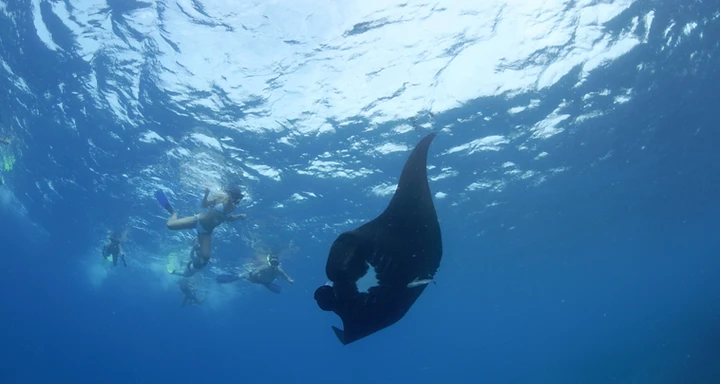
The Yasawa manta encounter is real, seasonal and well documented. A peer-reviewed study of the site at the northern end of Drawaqa Island describes a May to October aggregation of up to 40 reef mantas in a channel roughly 250 metres long and 10 metres deep at high tide, with a cleaning station. Snorkellers drift through with the current and are picked up downstream.
The published sighting rate is an average of three mantas per trip. The operator at Barefoot Manta Island Resort is straight about it: with nature there are no guarantees, though the mantas are usually there daily in season. Guests may not swim to the site independently because of currents and boat traffic, and may not touch the rays. Manta Project Fiji has identified over 410 individual reef mantas in Fiji from more than 6,000 photo-ID sightings, and notes that over 43 per cent of Fiji's reef manta population is melanistic — among the highest proportions anywhere.
Worth knowing: there are currently no legal restrictions on the Drawaqa site, and up to 70 people can be in the water at once during a high-tide encounter across the several resorts that run trips. Go early in the day if you can.
What should you actually watch out for?
Tourism Fiji's own snorkelling guidance names stonefish and lionfish (stonefish hide on the reef floor and are easy to step on), fire coral (which blends into the reef and stings on the lightest brush), sea urchins on shallow reef flats, cone shells, moray eels, banded sea kraits, stingrays and crown-of-thorns starfish. Shuffle your feet in shallow water to warn rays off. Leave shells on the reef. Do not touch coral at all.
For first aid, a Fiji-specific stinger guide gives the key detail most people get wrong: scrape stinging cells off with sand and apply vinegar before any fresh water, because fresh water can trigger further stinging. For stonefish, scorpionfish, lionfish, stingray or crown-of-thorns wounds, soak the whole wound in hot water at 45 to 50 degrees for 30 minutes or longer. Most jellyfish stings pass within 15 to 20 minutes.
On sunscreen: we could find no Fijian law or government policy banning oxybenzone or any sunscreen ingredient. Unlike Hawaii and Palau, this is a venue rule in Fiji, not a legal one — but resorts do ask, and it costs nothing to comply.
And if you are snorkelling off a village's reef rather than a resort's, the reef belongs to someone. Presenting sevusevu — a bundle of kava to the village chief — is the customary way to ask, and your guide will handle the protocol.
Reef condition changes. This guide reflects published survey data and Fiji Meteorological Service bulletins as at November 2026; for current bleaching status, check the Fiji Meteorological Service Ocean Outlook. Last reviewed 2 November 2026.
Where to go, in one line each
For the most coral: the inner Rainbow Reef off Taveuni — base yourself at Garden Island Resort or Nakia Resort & Dive. For reef structure and sharks: Beqa Lagoon Resort in Fiji's Outer Islands, accepting that fish numbers outside the reserves are low. For mantas: the Yasawas, May to October. For the restoration story: a village MPA tour on the Coral Coast. For remote and uncrowded: Kadavu, from Matava Eco Adventure Resort, though the published coral data there is two decades old. For the north with a dive-science pedigree: Jean-Michel Cousteau Resort near Savusavu — with the 2026 bleaching in that bay in mind.
Next: see every option in the 40 best things to do in Fiji, go deeper on sites and operators in diving in Fiji, weigh the two island groups in the Mamanucas vs the Yasawas, time your trip with Fiji's weather month by month, read the regional detail in the Taveuni and Vanua Levu guide, or start from Fiji's islands and regions.