The Coral Coast is the resort strip along the Queens Road on Viti Levu's southern shore, roughly an hour to an hour and a half by road from Nadi International Airport. It suits families, conferences wanting one-site control, and beach weddings. Its one honest catch is a shallow fringing reef that makes swimming tidal at many properties.
Where is the Coral Coast, and where does it actually start and finish?
The Coral Coast runs along the southern edge of Viti Levu, strung either side of the Queens Road, the sealed highway connecting Nadi to Suva. Sigatoka is its town, and its commercial anchor: the Sigatoka Town Council puts the population above 10,000.
Where the region begins and ends depends on who you ask, and the sources disagree. Wikipedia calls it "the stretch of coastline between Sigatoka and Suva". Fiji Pocket Guide draws a wider line, from Natadola Beach in the west to Pacific Harbour in the east. Both are marketing boundaries, not legal ones.
For planning, treat the working Coral Coast as Natadola and Cuvu in the west, through Sigatoka and Korotogo, out to Korolevu, after which resorts thin before Pacific Harbour begins. Properties at the Natadola end are sometimes marketed separately as the Natadola coast, so check which definition a supplier uses before comparing quotes. And it is always on the Coral Coast, never "in" it.
How long does it take to get to the Coral Coast from Nadi Airport?
Sigatoka Town Council states Nadi International Airport is 70 kilometres away. Fijieco puts the road distance at "about 66 to 70 km" and the drive at "about 1 hour to 1 hour 15 minutes". Rome2Rio routing returns 69.5 km and about 1 hour 3 minutes for the same trip, and about 93.5 km and 1 hour 24 minutes to the Korolevu end.
Treat all of those as approximate and best case: a dry, daylight run with no stops. The Queens Road is sealed throughout but is one lane each direction, passing through villages with reduced speed limits and speed humps, shared with buses, trucks and pedestrians. Rain, roadworks or a night arrival add time.
Properties publish their own numbers, and they do not agree:
- Yatule Resort & Spa (Natadola): "only 60 minutes' drive from Nadi"
- Likuri Island Resort: "only 45 minutes drive from Nadi", then a boat
- Gecko's Resort (near Sigatoka): "one hour from Nadi Airport", and 15 minutes from Sigatoka town
- Fiji Hideaway Resort & Spa: "90 minutes' drive from Nadi"
Gecko's and Fiji Hideaway are not 30 minutes apart; the gap is how conservatively each quotes. Schedule on the longer figure.
Fiji Pocket Guide reports the Nadi–Coral Coast express bus at around 1 hour 30 minutes for under FJ$20 (about NZ$15 / A$13 at Reserve Bank of Fiji indicative rates of F$1 = NZ$0.7731 / A$0.6279 on 14 September 2026 — rates move). Fijieco notes Pacific Transport runs direct express services from Nadi Airport and that fares are cashless, so load an eTransport card before boarding. From Suva it is about 127 km and two to two and a half hours.
For groups, a Coral Coast-based operator such as Coastline Fiji removes the deadhead leg a Nadi coach company must charge for. Our delegate transport guide covers how the coach maths changes at 100, 300 and 800 people.
Which part of the Coral Coast should you stay on?
| Precinct | Approx. road distance from NAN | Drive time (approx) | What the water is like | Suits |
|---|---|---|---|---|
| Natadola / Likuri | Not published | About 1 hour (Yatule) | Open sand bay, surf, no reef flat off the beach | Couples, photography, swimmable beach |
| Cuvu / Yanuca Island | Just west of Sigatoka | About 1 hour | Island setting, lagoon frontage, extensive pools | Large conferences, incentives, families |
| Sigatoka / Korotogo | About 66–70 km | 1 hr to 1 hr 15 | Fringing reef lagoon; tidal swimming, pools do the work | Families, mid-size meetings, self-drive |
| Korolevu | About 93 km | About 1 hr 25–1 hr 30 | Fringing reef lagoon, village reserves offshore | Weddings, retreats, longer stays |
What is swimming actually like on the Coral Coast?
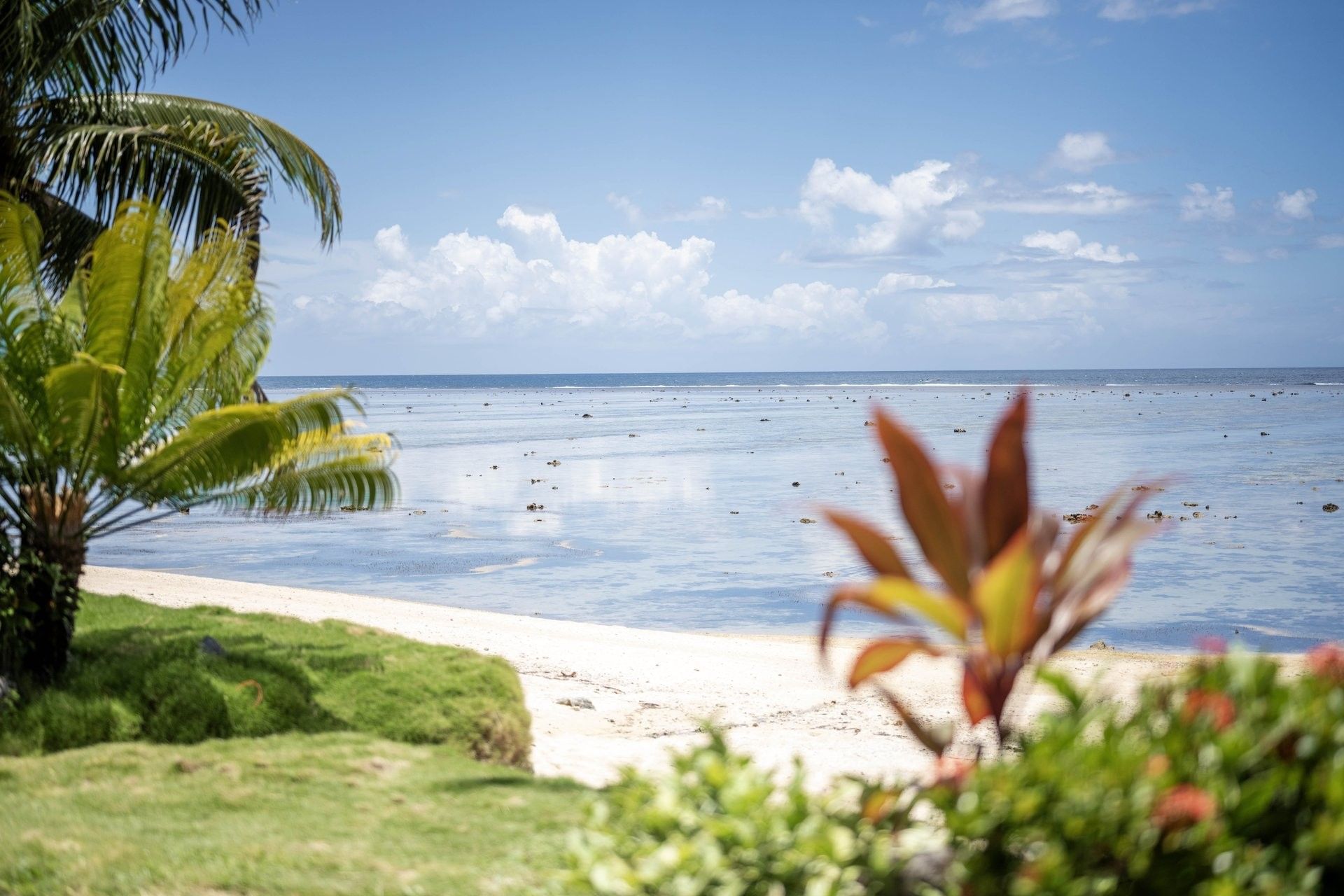
This is the fact most operators leave out, and the most useful thing to know before you book. The coast is named for a reef, and the reef is right there. The Reef Resilience Network describes it as the country's longest fringing reef system, with "wide, shallow lagoons filled with colorful fish and corals just meters beyond the white sandy beaches". A peer-reviewed PLOS ONE study of the Korolevu-i-wai reefs measured those lagoons: "shallow (~1 m below the surface at low tide, equal or shallower than 2 m at high tide), intertidal fringing reefs platforms (up to 800-m wide)".
In plain terms: in front of many Coral Coast resorts the water at low tide is knee- to waist-deep over a reef flat that can run most of a kilometre out. You wade; you do not swim. At high tide it deepens, but rarely enough to put you out of your depth near shore. That is a different proposition from Denarau or an island resort, and it is why the Coral Coast is full of very good pools. Practically:
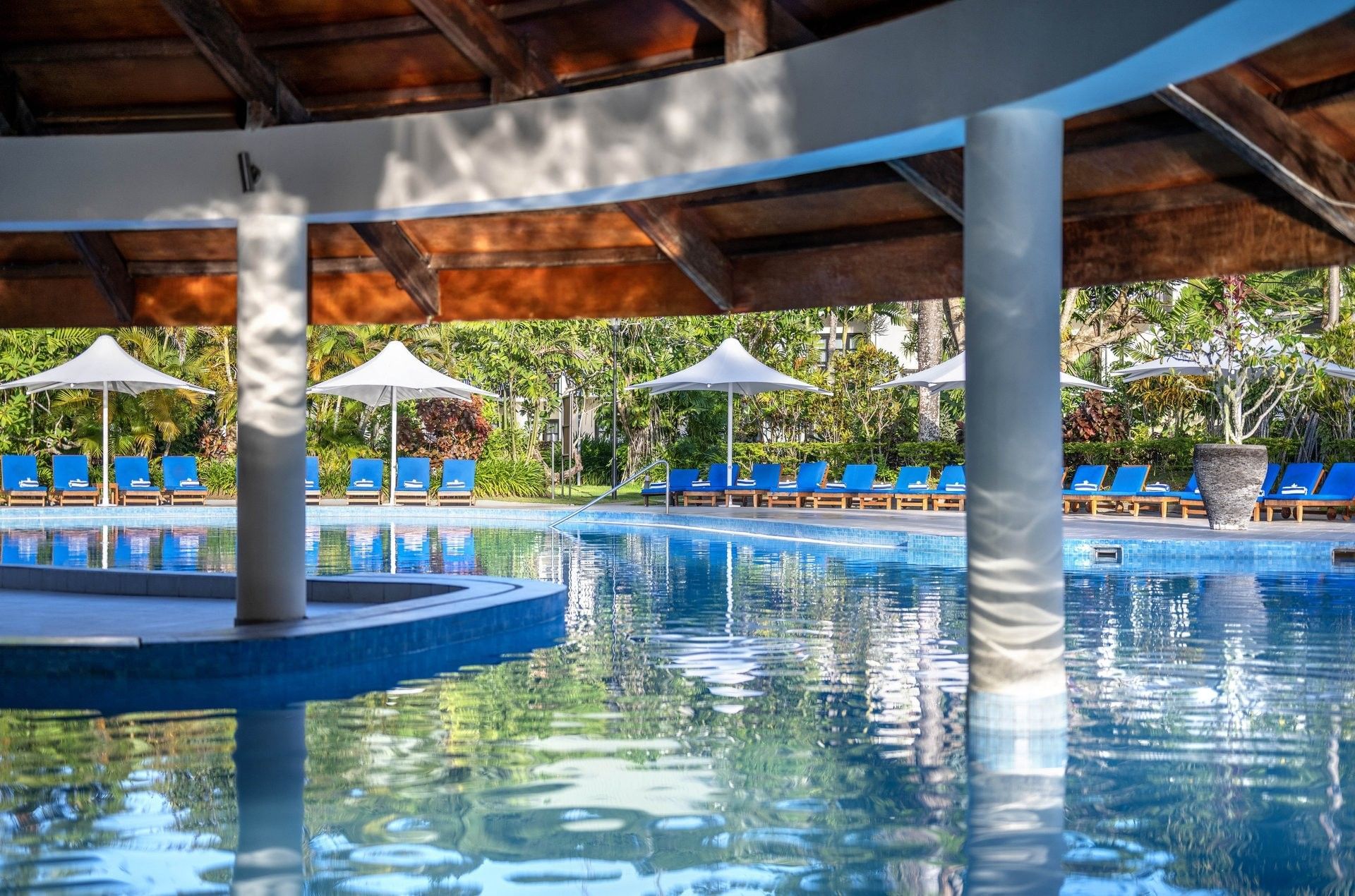
- The pool is the swimming. Check the pool photography as carefully as the beach photography.
- Plan around the tide, not the clock. Ask the property for tide times covering your dates, and put beach sessions, snorkelling and waterside photography in the high-tide window.
- Bring reef shoes. A reef flat is coral rubble, even where the beach itself is white sand.
- Go west for deep water off the beach. Natadola Bay has no reef flat in front of it, which is why it swims and surfs differently — and why its currents deserve respect.
- Or go out to the reef. Boat snorkelling and diving reaches the reef edge and drop-off, where the depth and the coral both are.
The reef has had a hard few decades. The Reef Resilience Network records less than 10 per cent living coral cover in parts of the Korolevu-i-wai system, largely overgrown with seaweed after the 2000 mass bleaching. The response came from the villages: Votua, Vatu-o-lalai, Tagaqe and Namada have set customary no-take marine protected areas over their own fishing grounds, and the PLOS ONE work found better fish and coral inside them. Snorkel one and you are a guest on a village's qoliqoli — go with a village guide and pay the fee.
Which Coral Coast resorts actually publish conference space?
Four publish real numbers. The rest give a room name and nothing else, and that gap matters when you are building a floor plan.
| Property | Largest published space | Published capacity | What else the site publishes |
|---|---|---|---|
| Shangri-La Yanuca Island | Ratu Makutu Events Centre, 648 sqm | Theatre 650 · banquet 500 · cocktail 500 | Davui Hall 264 sqm (theatre 400), Rara open space 1,305 sqm (cocktail 1,000), two pre-function areas |
| InterContinental Fiji Golf Resort & Spa | Watercourt Conference Centre, pillarless ballroom | 600 guests | Three theatre-style rooms to 110 delegates each, plus a boardroom; no sqm published |
| Warwick Fiji Resort & Spa | Talanoa Hall, 510 sqm | Theatre 400 · cocktail 500 | Coral Coast Conference Centre 312 sqm (banquet 200, cocktail 400); Vusu Boardroom 51 sqm, U-shape 18 |
| Outrigger Fiji Beach Resort | Reef 1 & 2 combined | Theatre 160 · banquet 80 · classroom 80 | Boardroom 12; Vahavu Pavilion banquet 100; Reef Lawns and Level 6 Terrace 80 each; no sqm published |
Others hold event space but publish no capacities. The Naviti Resort lists a 135 sqm Talei Conference Hall and two man-made islands used for functions, without seating numbers. Fiji Hideaway Resort & Spa refers only to "a dedicated conference room". Gecko's Resort runs the Kalevu Events Centre for conferences, reunions and weddings, and states it has 28 rooms on 4.5 acres, but no capacities. Crusoe's Retreat lists corporate retreats without detail; Bedarra Beach Inn and Mango Bay Resort publish none. Ask for a dimensioned floor plan before committing.
Two cautions. Published figures are maximums for an empty room — add a stage, screen, AV bump-out and catering and the real seated number drops, often by a fifth. And the biggest number on a resort's site is often an outdoor or pre-function area, not a wet-weather-proof room. Cross-check our Fiji conference venues and capacity chart.
What is there to do near the Coral Coast?
The Coral Coast has Fiji's densest cluster of land-based attractions, which is much of why it works for families and incentive half-days.
- Sigatoka Sand Dunes National Park — Fiji's first national park, over 650 acres of dunes and dry forest, almost half protected since 1989. The National Trust of Fiji lists hours of 8am–4:30pm daily (closed 1pm–2pm) and entry at $10 adult, $7 international student, $5 local student, free under 5. Two marked walks run about one and about two hours, and the dunes hold the largest collection of complete and near-complete Lapita pots in the Pacific. About 10 minutes from Sigatoka town.
- Kula Wild Adventure Park — at Korotogo, near Outrigger. Open every day of the year, 10am to 4pm, last entry 3:30pm. Hand-fed sea turtles, iguanas, free-flying birds, a jungle water slide and a canopy zip line. Admission prices are not published on the park's site, so confirm on booking.
- Tavuni Hill Fort — a hilltop fortified village about four kilometres from Sigatoka town, established by the Tongan chief Maile Latamai Finau and destroyed in 1876 during the Kai Colo wars. Around 60 house mounds survive, with lovo pits and a vatu ni bokola. The Fiji Times has published entry at $6 for locals and $12 for overseas visitors; treat that as indicative.
- Sigatoka town and market — the Saturday market is the big one, drawing growers from up the Sigatoka Valley. Tourism Fiji advises going early.
- Sigatoka River Safari — jet boat up the Sigatoka River to a highland village with a kava ceremony and lunch, departing from the Coral Coast, Sigatoka town and Nadi/Denarau. Pricing is not published on the operator's site.
- EcoTrax — electric-assisted railbikes on the disused sugar cane railway, running since 2016 through mangroves, rainforest and villages on a two-hour ride ending at Vunabua (Tourism Fiji).
- Biausevu Waterfall — inland of Korolevu, a 20-metre two-tiered fall with a swimming hole, on a roughly 30-minute rainforest walk with nine stream crossings. Tourism Fiji advises paying the entry and guide fee at Biausevu Village.
More across the country in our 40 best things to do in Fiji.
Who does the Coral Coast suit, and who should book elsewhere?
Choose the Coral Coast if you want a self-contained family resort with a serious pool and real attractions within 30 minutes; if you are running a conference and want every delegate, session and dinner on one site with no boat schedule; if you are marrying and want lawn and beach settings without an island transfer; or if you want to drive, stop at the market and see beyond a resort perimeter.
Choose somewhere else if the deciding factor is walking off the beach into deep water at any hour — an island or open-bay proposition, not a fringing-reef one; if a long transfer after a long-haul flight is a real problem, in which case Nadi and Denarau sit far closer to the terminal; or if your programme is built on island-hopping, which the Mamanucas do better.
Our precinct-by-precinct guide to where to stay in Fiji weighs the Coral Coast against the alternatives.
What should you do next?
The Coral Coast is Fiji's best value for one-site groups and for families who want a holiday with a road attached. You pay for it with an hour-plus transfer and a lagoon that swims on the tide rather than on demand — both manageable once you know in advance.
Running a conference or a wedding? Start with the four properties that publish numbers. Travelling with family? Book the pool first, the beach second.
Browse every verified property, restaurant and operator on the strip in our Coral Coast directory, and see how the region compares with the rest of the country in Fiji's islands and regions guide.