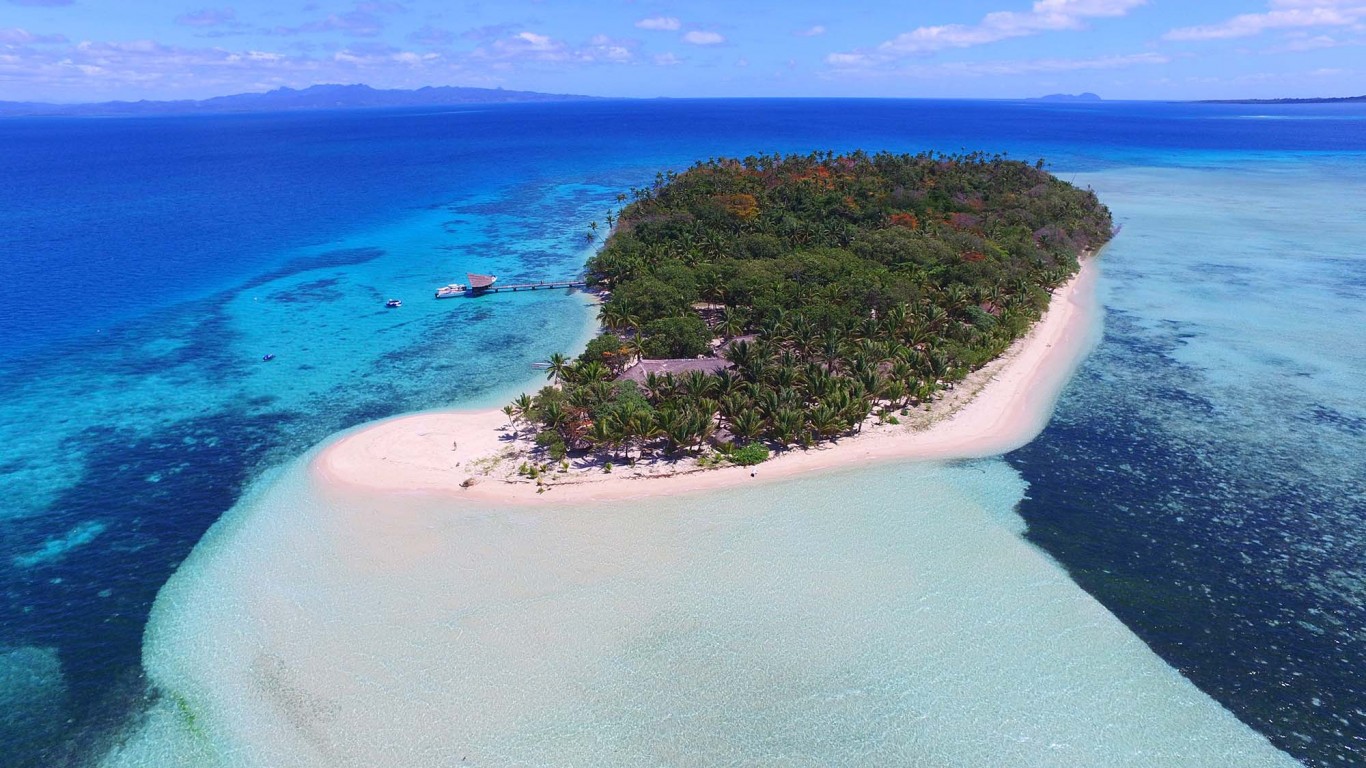
Fiji's dry season (June-October) delivers roughly a fifth of the rainfall of the wet season and near-zero cyclone risk, and resorts charge for it. The wet season (December-April) is cheaper and warmer, with a real cyclone threat and daily afternoon downpours. At Nadi the gap is stark: 50 mm of rain in July against 365 mm in January.
That is the whole trade, quantified. Everything else is about how much of that risk you are willing to carry for the saving.
How much does the rainfall actually differ?
More than most couples assume, and the difference depends heavily on which side of Viti Levu you choose.
| Month | Nadi rainfall | Nadi max temp | Suva rainfall | Suva max temp | Season |
|---|---|---|---|---|---|
| January | 365 mm | 31.4°C | 355 mm | 30.6°C | Wet / cyclone |
| February | 335 mm | 31.5°C | 290 mm | 31.0°C | Wet / cyclone |
| March | 350 mm | 31.3°C | 350 mm | 30.9°C | Wet / cyclone |
| April | 190 mm | 30.8°C | 310 mm | 29.8°C | Wet / cyclone tail |
| May | 90 mm | 29.7°C | 215 mm | 28.3°C | Shoulder |
| June | 55 mm | 29.0°C | 160 mm | 27.4°C | Dry |
| July | 50 mm | 28.5°C | 130 mm | 26.6°C | Dry |
| August | 65 mm | 28.6°C | 140 mm | 26.4°C | Dry |
| September | 70 mm | 29.2°C | 175 mm | 26.9°C | Dry |
| October | 85 mm | 30.1°C | 240 mm | 27.8°C | Dry |
| November | 125 mm | 30.8°C | 240 mm | 29.0°C | Shoulder / cyclone starts |
| December | 210 mm | 31.4°C | 335 mm | 29.9°C | Wet / cyclone |
Nadi's annual total is about 2,000 mm; Suva's is about 2,940 mm. Those two numbers explain most of what follows.
The western side is materially drier. Nadi, Denarau, the Mamanucas and the western Coral Coast sit in the rain shadow of Viti Levu's central range. Suva, Pacific Harbour and the eastern side sit in the path of the southeast trade winds and get rain year-round — Suva's driest month, July at 130 mm, is still wetter than Nadi's wettest dry-season month.
This is why nearly every Fiji wedding happens on the western side, and it is a sound reason rather than a fashion.
What does the wet season actually feel like?
Not a monsoon. This is the part that gets overstated.
A typical wet-season day in Nadi is hot and humid, bright in the morning, with cloud building through early afternoon and a heavy downpour of 30 to 90 minutes somewhere between 2pm and 5pm, then clearing. It is not four days of grey drizzle — it is intense, short and frequently over before the ceremony.
The problems with it are specific:
- The downpour lands in the exact window you want the ceremony. Mid-to-late afternoon is both the standard Fiji ceremony slot and the standard rain slot.
- Humidity is punishing. January and February combine 31°C with high humidity. Hair and makeup struggle, guests in suits suffer, and elderly guests are at genuine risk.
- Sunset photography becomes a lottery. A calculated sunset of 18:51 is worthless behind a solid cloud wall. See our golden hour table for what you are gambling on.
- The ground stays wet. A lawn ceremony the morning after a heavy night is a mud problem, not a rain problem.
What about cyclones?
Fiji's cyclone season runs from November to mid-May, with the highest likelihood from late December to early April.
This is a different order of risk from rain, and it should be treated separately. A cyclone does not spoil photographs — it closes the airport, cancels flights, evacuates resorts and can move a wedding by a week. It is also not a certainty: most wet seasons pass without a cyclone affecting any given resort on any given date.
The correct response is not to avoid the season outright but to insure and plan for it. We have set this out in full in cyclone season and your Fiji wedding: the honest risk guide, and wedding insurance for a Fiji wedding covers what policies actually pay out on. The short version: buy the cover before you pay the deposit, and read what it says about named storms.
Cyclone and weather planning is guideline information only — confirm current advisories with the Fiji Meteorological Service and your insurer. Last reviewed 19 September 2026.
Is the wet season actually cheaper?
Yes, though less dramatically than in some destinations, and the discount is not uniform.
The clearest published evidence is in resort package pricing that varies by date. Plantation Island Resort prices its Vakamau wedding package at FJ$8,393 for September-November 2026 and January-March 2027, rising to FJ$8,968 for the April-November 2027 window — the seasonality sits in the accommodation nights bundled into the package rather than in the wedding elements. Leleuvia Island Resort offers a full-island buyout with only 50 guests specifically in April, May, September and October, which tells you where its soft months are.
At FJ$8,393, that package is roughly NZ$6,617 or A$5,297 at the mid-market rate on 19 September 2026. Check the current rate before budgeting.
Note that Leleuvia's soft months include September and October — dry-season months. Fiji's pricing follows the Australian and New Zealand school holidays and the Christmas peak as much as it follows the weather, which creates genuine gaps. Late June, most of September and early October can be both dry and reasonably priced. Our shoulder-season value guide maps those windows.
Which should you choose?
Choose the dry season (June-October) if the ceremony is outdoors and unmovable, if you have guests who struggle with heat, if sunset photography matters to you, or if the thought of cyclone contingency planning will ruin the next twelve months. Expect to pay more and to book earlier — the best Fiji venues fill their July and August dates a year out.
Choose the shoulder months (May, November) for the best overall balance. May at Nadi averages 90 mm against July's 50 mm — a real difference but not a large one — and November at 125 mm is still comfortably drier than any wet-season month. Both sit outside the peak pricing windows. If we had to pick one month, it would be late May or the first half of November.
Choose the wet season (December-April) if the saving is decisive, if you are marrying indoors or in a chapel, if your guests are coming regardless, and if you will take the insurance seriously. Move the ceremony earlier in the day — a 10am or 11am ceremony sidesteps the afternoon downpour entirely, and in humidity that high your guests will thank you.
Whatever you choose, get the wet-weather plan in writing: the specific alternative space, who decides, and by what time. A resort that cannot name the room is a resort that has not thought about it.
Start at the best time to get married in Fiji for the full month-by-month picture, Fiji's weather month by month for the travel-side data, and the Fiji wedding venues hub to see which settings have a genuine indoor backup.