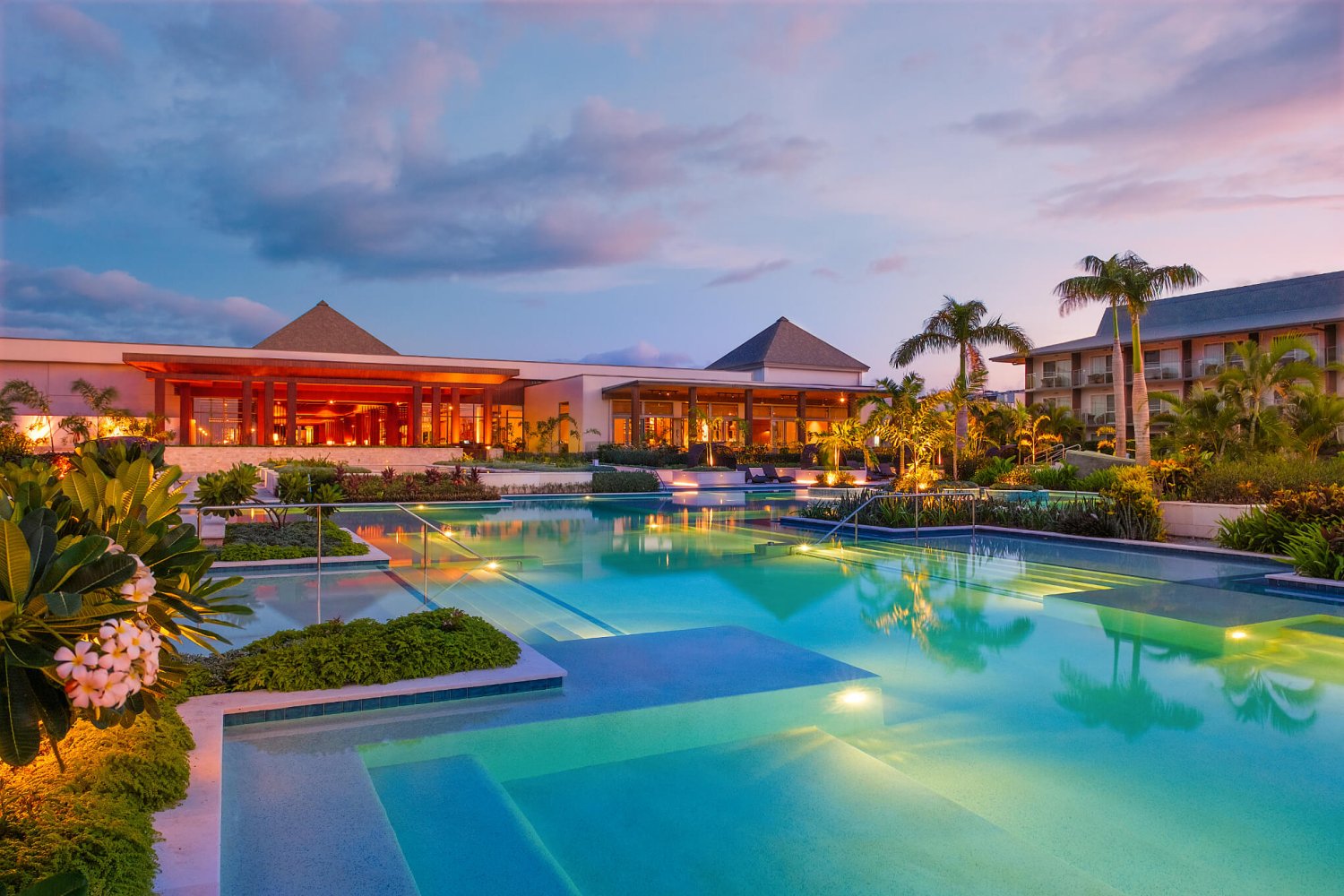
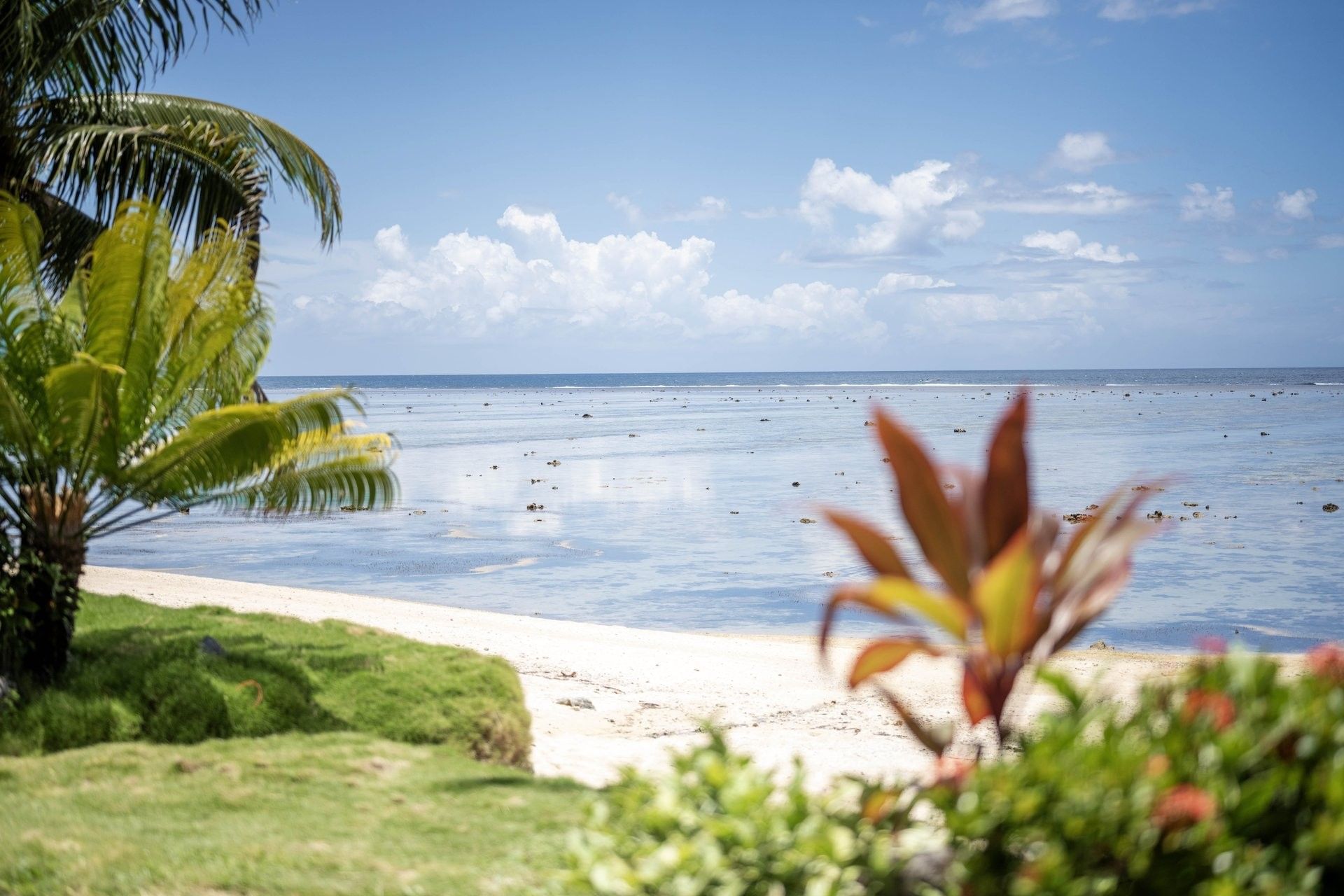
A December wedding in Fiji buys you the longest days of the year — sunset around 6.40pm at Nadi and over 13 hours of daylight — and costs you the highest rainfall risk, cyclone season and compulsory festive-season dinner surcharges. Pick the first three weeks, go west, insure at deposit, and get the indoor backup named in writing, and it works.
What is the weather actually like in Fiji in December?
Warm, humid and genuinely unpredictable. December sits in Fiji's warm wet season, November to April.
Here is the honest problem: the Fiji Meteorological Service publishes official December climate normals for Nadi Airport and Laucala Bay in Suva, but only as image-only scanned PDFs, which we could not read. We will not publish estimated normals. What we can give you is two actual observed Decembers from Fiji Met's own climate summaries — and the gap between them is the answer.
| December, as recorded | Nadi Airport | Laucala Bay (Suva) |
|---|---|---|
| 2022 total rainfall | 390.5 mm — 188% of normal | 221.3 mm — 82% of normal |
| 2022 rain days (≥0.1 mm) | 19 | 18 |
| 2022 mean maximum | 31.8°C | 31.7°C |
| 2022 mean minimum | 23.1°C | 24.3°C |
| 2004 total rainfall | 31 mm — 17% of normal | 369 mm — 162% of normal |
| 2004 rain days | 12 | 22 |
| 2004 mean maximum / minimum | 32.3°C / 23.9°C | 30.6°C / 24.2°C |
Nadi recorded 390.5 mm in December 2022 and 31 mm in December 2004. That is a twelvefold difference in the same month at the same station. Anyone who tells you what December will be like is guessing.
What is reliable is the geography. Nadi's lowlands average about 1,800 mm of rain a year with a well-defined dry season; Suva averages about 3,000 mm on the south-eastern slopes of Viti Levu. For a December wedding, the west — Nadi, Denarau, the Mamanucas, Natadola — is the materially drier side of the country, and it is not a close call.
We could not find an authoritative figure for December humidity or sea temperature, so we are not publishing one. And we could not find any official source confirming the common claim that December rain comes as short afternoon squalls rather than all-day rain. What the data shows is that it rained on most days in December 2022 at both stations, while the totals differed by nearly double — so intensity varies far more than frequency.
How serious is the cyclone risk?
Real, and worth understanding precisely rather than vaguely.
The South Pacific tropical cyclone season runs November to April, with peak activity usually January to February — and Fiji Met gives January to March for Fiji specifically. Out-of-season storms have occasionally formed in October and May.
On averages, the RSMC Nadi region sees about seven tropical cyclones a season, of which about three are severe (Category 3 or above). For Fiji itself, about two cyclones a season pass through Fiji's Exclusive Economic Zone.
Fiji Met's current outlook puts regional activity above average at 11 to 15 cyclones with 6 to 8 severe, while for Fiji it forecasts 2 to 3 passing through the EEZ with 1 to 2 reaching severe intensity — described as near-normal activity for Fiji, with equal risk across the Fiji group. The service's own line is worth quoting to anyone planning: "All communities should remain alert and prepared throughout the TC season."
One underrated point from the same source: tropical depressions that never reach cyclone strength have caused strong winds, heavy rain, landslides and flooding in Fiji. You do not need a named cyclone to lose a beach ceremony.
And December has form, all of it in the second half of the month:
| Storm | Date | What happened |
|---|---|---|
| TC Mick | 14 December 2009 | Storm-force winds around 90–100 km/h across the main islands; at least 2 deaths; 3,845 people in 68 evacuation centres |
| TC Evan | 16–19 December 2012 | Paralleled western Fiji past the Nadi and Denarau coast; over 8,000 people including tourists in shelters; flights from Nadi suspended; FJ$169.9 million damage; no deaths in Fiji |
| TC Sarai | late December 2019 | Insurers closed new cyclone cover from 27 December |
| Severe TC Yasa | 17 December 2020 | Category 5, landfall in Bua Province, Vanua Levu, 230 km/h sustained winds, 917 hPa; 4 deaths; damage put at about FJ$500 million |
The planning conclusion is specific: the first three weeks of December carry materially less historical exposure than Christmas week. If you want December, book early in the month.
What about the light?
This is December's real gift, and most couples miss it.
Mid-December at Nadi gives sunrise about 5.29am and sunset about 6.40pm — 13 hours 11 minutes of daylight, the longest of the year. Evening civil twilight runs to roughly 7.00pm. Golden hour falls in approximately the 30 minutes before sunset, so around 6.10–6.40pm in mid-December. That figure is derived from the published pattern rather than read off a December table, so confirm your exact date before you build a timeline on it.
Practically, a 5.00pm ceremony gives you a 20-to-30-minute service, portraits through golden hour, drinks in the last of the light and a full evening for the reception — without the heat of the afternoon. In the Fiji dry season you would be pushing that an hour earlier. In December you do not have to.
Wet-season cloud also does photographers a favour more often than not: it diffuses the hard tropical light that ruins midday portraits.
What will December cost you?
More than you think, and some of it is compulsory.
Fiji resorts publish mandatory per-adult gala dinner surcharges on 24 and 31 December, charged separately from your package and payable directly to the resort. Published examples: Tokoriki Island Resort at FJ$320 per adult on 24 December and FJ$350 on 31 December, both for a compulsory four-course gala dinner; Malolo Island Resort at FJ$250 per adult and FJ$95 per child aged 4–12 on 24 December, and FJ$295 per adult on 31 December, payable 45 days before arrival.
Multiply that across a wedding party and it is a line item, not a detail. Both figures come from reseller listings rather than the resorts' own rate pages, and the Malolo dates were published for 2025, so confirm current amounts directly.
Festive blackout dates also suspend inclusions: Malolo's kids-eat-free offer is blacked out 22 December to 23 January, and dining credits cannot be used on Christmas or New Year menus. We found no confirmed festive-season minimum-night requirement — the minimum stays we saw were package conditions, not festive rules. Don't accept one without asking which it is.
Two calendar facts to build around for 2026:
- Public holidays: Christmas Day falls on Friday 25 December 2026, and because 26 December is a Saturday, Boxing Day is observed on Monday 28 December. That creates a four-day Friday-to-Monday run — plan for reduced supplier availability and closures. Diwali is Monday 9 November 2026, seven weeks earlier, so it is not a December consideration.
- School holidays: Fiji's Term 3 ends Friday 4 December 2026 and the end-of-year holiday runs 7 December 2026 to 22 January 2027. The whole of December is Fijian school holidays, which affects domestic travel, staffing levels and how busy the kids clubs are.
When should you buy travel insurance?
Before you do anything else — because cover is set by the date you buy the policy, not the date you travel.
Once a storm becomes a publicly reported named event, it stops being "unexpected" and insurers close new cover for it, usually within hours and at a stated date and time. Two documented examples: for Cyclone Sarai, one insurer stopped providing cancellation and delay cover for policies bought after 10.00am on Friday 27 December 2019; for Cyclone Mal, cover closed for policies purchased after 12.00pm on 14 November 2023. In both cases, policies bought before the cut-off remained covered subject to terms.
So the rule is simple and absolute: buy travel insurance the day you pay your first deposit, and have your guests do the same. A policy bought in November for a late-December Fiji wedding may be worthless for the one risk you actually care about. Read the cancellation, change-of-journey and natural-disaster sections, and check whether the policy responds to a venue being damaged as well as to flights being cancelled.
Anything else about the wet season?
One health note. Fiji's Ministry of Health declared a dengue outbreak in the Central Division, including Suva, in April 2025, with 1,090 confirmed cases between 1 January and 23 March 2025, and stated that "heavy rain and flooding from November to April are expected to cause a significant rise in cases."
Its advice: use insect repellent outdoors, sleep under mosquito nets, use window and door screens, and remove or cover anything holding standing water. Clinically, it advises seeking care promptly if symptoms develop and avoiding aspirin and ibuprofen unless a doctor advises otherwise, because they can increase bleeding risk. Put repellent in the welcome bags.
This is a guideline only — confirm current advisories with the Fiji Ministry of Health and Medical Services, and current cyclone outlooks with the Fiji Meteorological Service, before you travel. Last reviewed 21 October 2026.
Should you get married in Fiji in December?
Yes, if you choose it deliberately. Here is what that looks like.
- Book 1–20 December, not Christmas week. Lower historical cyclone exposure, no gala-dinner surcharges, cheaper flights.
- Go west. Nadi, Denarau, the Mamanucas or Natadola over Suva and the south-east coast — roughly 1,800 mm a year against 3,000 mm.
- Set the ceremony at 5.00pm and use the long December evening.
- Get the wet-weather room named in your contract, with its capacity, and confirm whether moving costs anything. Crowne Plaza Fiji Nadi Bay, Sheraton Fiji Golf & Beach Resort, Warwick Fiji and Shangri-La Yanuca Island all hold substantial indoor function space; a small island resort may not.
- Insure at deposit, and tell your guests to.
- Accept that it may rain on your day and decide now what you will do about it. The couples who enjoy a December Fiji wedding are the ones who booked a venue with a real roof and stopped worrying.
If none of that appeals, the dry season is there and we have written about it. But a December wedding on the west coast, booked in the first three weeks, with an indoor plan and a policy bought on deposit day, is a reasonable thing to do — and the light is better than anything June will give you.
Next: read cyclone season and your Fiji wedding — the honest risk guide, then build your Fiji wedding wet weather plan. For the direct comparison, see dry season vs wet season for a Fiji wedding and getting married in Fiji in August. The hub is the best time to get married in Fiji, and venues with indoor capacity are listed in the capacity directory.