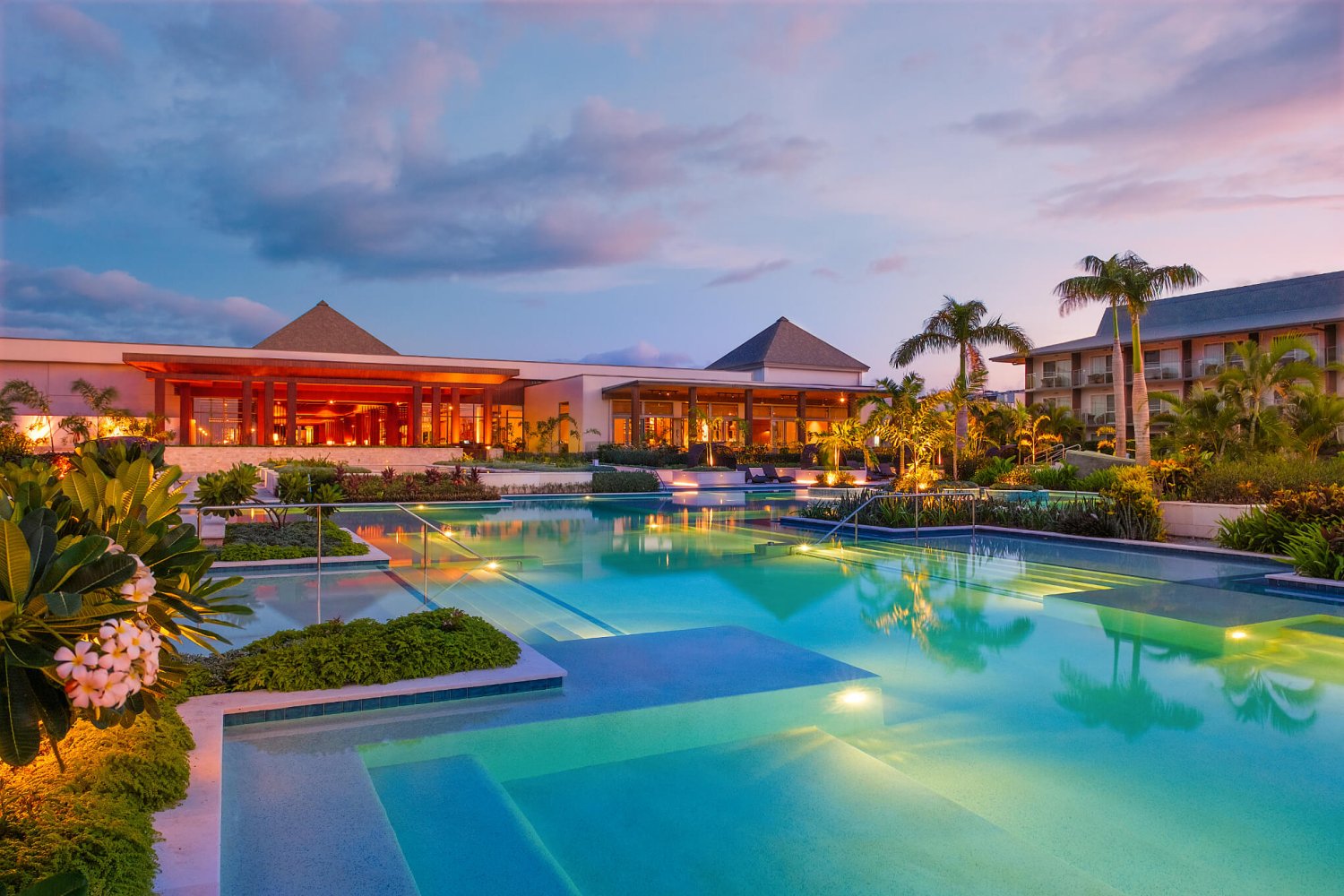
Fiji can run a seated plenary of about 1,500 delegates — at exactly one venue. It can run 400 comfortably at half a dozen properties, handle a 200-delegate incentive superbly almost anywhere, and put a board retreat on a private island with a service standard most destinations cannot match. What it cannot do is a trade exhibition with a purpose-built hall, a 3,000-delegate congress without marquees, or a conference on three weeks' notice in July.
This is the honest capability assessment, built from published capacity data and national room inventory rather than from destination marketing.
Is there a convention centre in Fiji?
Not a standalone one. Every facility marketed as a convention centre in Fiji is attached to a hotel. The Denarau Island Convention Centre is a Marriott-operated space within the Sheraton complex ON Denarau Island; the Crown Convention Centre is attached to the Crowne Plaza at Nadi Bay. There is no national convention or exhibition centre, and we could find no current government proposal for one.
The nearest thing to an exception is not a conference venue at all. Vodafone Arena in Suva, run by the Fiji Sports Council, publishes a 5,000-seat capacity — 4,000 on the grandstand, 1,000 on the floor, plus bleachers seating up to 800 — and its own page does list "conventions" and "trade/cultural/art/science exhibitions" among its uses. It is a sprung-floor sports arena with no conference fit-out, no breakout rooms and no attached accommodation. The University of the South Pacific's Japan-Pacific ICT Centre theatre at Laucala seats 307 and is genuinely marketed for conferences, at published hire rates of FJ$1,000 to FJ$1,600 per hour from 1 January 2026 — but it is plenary-only at around 300.
Worth knowing for context: Fiji's only formally proposed large convention facility, a 3,500-seat Conference and Exhibition Centre at Momi Bay tendered by the Fiji National Provident Fund in 2017, was never built. The resort that occupies that site today has a ballroom seating 400.
What is the real capacity ceiling?
About 1,500 to 1,700 seated, at one venue. Below that the field opens up quickly.
| Venue | Largest indoor space | Published theatre capacity |
|---|---|---|
| Sheraton Fiji — Denarau Island Convention Centre | 1,755 m² | 1,500 (Marriott's own chart; other Marriott and directory pages give 1,600 and 1,700) |
| Crowne Plaza Fiji Nadi Bay — Crown Convention Centre | Not published by the resort; trade press reports 925 m² | 900 (resort), 1,450 (IHG), 1,400–1,500 (trade press) |
| Shangri-La Yanuca Island — Ratu Makutu Events Centre | 648 m² | 650 |
| Grand Pacific Hotel, Suva — Britannia Ballroom | 600 m² | 600 |
| InterContinental Fiji — Natadola Ballroom | Not published in m² | 600 |
| Warwick Fiji — Talanoa Hall | 510 m² | 400 |
| Fiji Marriott Momi Bay — Grand Salon Ballroom | 355 m² | 400 |
| Novotel Suva Lami Bay — Convention Centre | 480 m² | 400 (per directory listing) |
Two honest caveats. The Crowne Plaza numbers conflict badly. The resort's own site says 900 theatre; IHG's corporate events page says 1,450; trade coverage of the November 2025 opening says 1,400 to 1,500. That is a 550-seat spread between a hotel group and its own property. Do not put any of those figures in a bid without written confirmation.
And Shangri-La Yanuca Island states on its own site that it is "home to Fiji's largest MICE facility" — a claim that rests on aggregate space including a 1,305 m² outdoor lawn, not on any single room. Its largest indoor space seats 650. Which Fiji venue is actually the largest? works through the competing claims properly.
Above about 1,700 seated, Fiji's answer is a marquee. When the Asian Development Bank brought 3,000 delegates to its 2019 Board of Governors meeting on Denarau Island, the solution was two 900 m² marquees added to the convention centre. That is a legitimate way to run a large congress and it works — but it is tenting, not infrastructure, and it should be priced and weather-planned as such.
Where does accommodation become the binding constraint?
Sooner than floor area does. No single Fijian property has more than about 443 rooms.
Horwath HTL's June 2025 Fijian hotel market overview puts national supply at approximately 12,423 rooms across 252 properties, with licensed hotel supply at 9,991 rooms at the end of 2024, and 5,172 rooms across 52 properties in Nadi and its offshore islands. Twenty-six branded hotels account for 4,101 of those rooms.
The arithmetic that follows is unforgiving. A 1,500-delegate conference at the Denarau Island Convention Centre draws first on the Denarau Marriott complex — roughly 300 rooms at Sheraton Fiji, 246 at The Westin and 82 villas — and then on the rest of the island. Beyond that you are block-booking a meaningful share of Nadi's entire inventory, and your delegates are spread across properties with different service standards, different check-in queues and a coach movement between them.
The practical threshold: above roughly 600 delegates, Fiji becomes a precinct event rather than a single-property event. That is a different operation, and it needs a DMC, a transport plan and a much more careful look at your arrival and departure peaks. Moving 100, 300 and 800 delegates around Fiji covers the movement side.
There is slack in the market, which helps. The Fiji Bureau of Statistics reported national room occupancy at 49.7 per cent for the March quarter 2026 and 56.6 per cent for the December quarter 2025. Government has a target of 4,000 additional rooms; the Fiji Hotel and Tourism Association's own reading is that sixteen projects under construction as of June 2025 will deliver just over 2,200 rooms, with roughly 1,800 realistically landing between 2025 and 2027.
What does Fiji do genuinely well?
Five things, and they are not marketing claims.
Incentives at 50 to 300. This is Fiji's strongest suit by a distance. The property quality, the beach and island settings, the short transfer from Nadi to Denarau Island, and a service culture that guests consistently respond to — all of it is built for reward travel. Designing a Fiji incentive programme covers the shape.
Conferences up to about 400. At that size you have real competition between properties ON Denarau Island, ON the Coral Coast and IN Suva, which means real negotiating leverage.
Board retreats and executive offsites. Exclusive-use small properties and private islands give a level of privacy that is hard to buy elsewhere in the region.
Cultural content that is not a bolt-on. A meke, a sevusevu welcome, a lovo dinner — done properly, with named performers who are paid directly — is content most destinations simply cannot offer. Done badly it is decoration, and delegates notice the difference.
Short-haul access from New Zealand and Australia. Auckland is about three hours. Sydney and Brisbane are four or under. Fiji Airways' group desk starts at ten passengers, which is far lower than most planners expect.
What can Fiji not do?
Five things, stated plainly.
A purpose-built trade exhibition. There is no exhibition hall with loading docks, floor loadings and three-phase power designed for stand build. Exhibitions in Fiji happen in ballrooms and marquees, with the constraints that implies.
A 2,000-plus seated plenary without tenting. Nothing in the country publishes a theatre capacity above 1,700, and the one venue near that figure is hotel-attached.
Matched on-site accommodation above about 450 rooms. Any larger group is a multi-property event.
Deep in-country AV redundancy. Fiji has capable AV and production suppliers, but the depth is not Sydney's. If your programme depends on a particular piece of kit, ask what is actually in-country and what would be freighted in — and read visas, permits, customs and duty of care in Fiji before you plan a freight schedule, because Fiji is not an ATA Carnet country.
Guaranteed bandwidth for a large hybrid programme. No Fiji venue publishes a bandwidth figure on its own website. Third-party directory entries, which are venue self-reported and of unknown vintage, range from 500 Mbps down to 10 Mbps at properties in the same tier. If you are streaming, this is a contract item, not an assumption — internet and bandwidth at Fiji venues sets out what to ask for.
Which events should choose Fiji, and which should not?
| Your event | Verdict |
|---|---|
| Incentive, 50–300, NZ or AU source market | Strong yes. This is what Fiji is best at |
| Conference, up to 400, single property | Yes. Competitive field, real leverage |
| Conference, 400–800 | Yes, as a precinct event. Budget the transport and the DMC |
| Congress, 1,000–1,700 | Possible, at one venue. Verify capacity in writing first |
| Congress above 1,700 | Only with marquees. Price and weather-plan them honestly |
| Trade exhibition with stand build | No. No purpose-built hall exists |
| Heavy hybrid or streamed programme | Only with contracted, tested bandwidth |
| Event in January or February | Think hard. Peak cyclone risk and wet season |
What about the season?
The Fiji Meteorological Service puts the cyclone season at November to April, with peak activity usually January to February, and expects around two tropical cyclones to affect Fiji in an average season. The wet season occupies the same window.
That means Fiji's comfortable weather and its business-events season coincide: May to October. Peak demand and peak rates fall together, and the value sits in the shoulder months, particularly May and October. A wet-season event will be cheaper and carries real disruption risk — and your force majeure clause needs to name airport closure and airline cancellation, not only damage to the venue. When to hold a conference in Fiji has the month-by-month detail.
The verdict
- Under 400 delegates, Fiji competes on merit against anywhere in the region, and you will have negotiating leverage.
- Between 400 and 1,500, it works — as a precinct event, with a DMC and a transport plan.
- Above 1,700 it means marquees. That is a real option, priced and planned as such.
- There is no exhibition hall, and there is no standalone convention centre.
- Verify every published capacity in writing. Fiji's largest venues contradict themselves and each other.
- Bandwidth is the unpublished risk. Contract it if your programme depends on it.
Next step: settle your delegate count and whether the programme is single-property or precinct, because that decision drives everything else. Business events in Fiji: the complete planner's guide is the starting point, Fiji conference venues and capacity chart has the full published dataset, and what a Fiji conference costs per delegate turns a delegate count into a budget. Browse venues and accommodation, or start at the capacity index.