A Fiji incentive programme is built around one decision: how far from Nadi you take the group. Everything else — the set-pieces, the reward mechanics, the budget shape — follows from whether the reward is a 15-minute seaplane to the Mamanucas, a two-hour coach ON the Coral Coast, or a full travel day IN the Yasawas.
This hub sets out how to structure a Fiji incentive at three, five and seven nights, which islands suit which programme, what the credible set-pieces actually are, and the two structural things about Fiji that will shape your budget before you have priced a single room night.
What makes Fiji work as an incentive destination?
Four things, in the order they matter to a qualifier.
It looks like the reward. This is not a small point. An incentive has to photograph as an obvious prize the moment it is announced, and Fiji does that work for you before the programme is designed.
It is close for an Australasian qualifier base. Air New Zealand publishes Auckland–Nadi at approximately three hours on daily non-stop services; schedule data puts Brisbane near 4h 20m and Sydney around 5h 10m. A three-night Fiji incentive is genuinely three nights, not one night plus two travel days.
Everything is close to everything. ON Denarau Island the resorts sit minutes apart. From Port Denarau, Malamala Beach Club publishes roughly 30 minutes by boat, and Turtle Airways publishes seaplane transfers of approximately 15 minutes to the Mamanucas and 33 minutes to the Yasawas. Very few destinations put a private-island lunch inside a 30-minute window from the conference hotel.
The cultural content is real. A meke, a sevusevu and a lovo are living practice, not a themed evening built for tourists. Programmes that treat them with respect land far harder than programmes that treat them as decoration. Protocol is covered in delegate experience in Fiji and Fijian culture and custom.
How long should a Fiji incentive be?
Three nights is the practical floor for an Australasian group, five is the sweet spot, and seven only works if you split it across two locations.
| Length | Structure that works | Where it falls over |
|---|---|---|
| 3 nights | Single property, ON Denarau Island or IN the Mamanucas. One big set-piece, one activity block, one free day | No time for an island transfer plus recovery — do not add a Yasawa day |
| 5 nights | Single property plus one full island day out, or two properties with a short transfer | Trying to fit three destinations in |
| 7 nights | Two properties: mainland or Mamanucas first, then an outer-island or Taveuni extension | Same resort for seven nights; qualifiers get restless by night five |
The single most common design error in Fiji is scheduling the long transfer at the start. Put movement in the middle or at the end, when the group has bonded and a boat is an experience rather than an ordeal.
Which island group suits which programme?
| Region | Transfer from Nadi | Suits | Watch for |
|---|---|---|---|
| ON Denarau Island | Short road transfer | Mixed conference-plus-reward, large groups, tight schedules | Feels like a resort precinct rather than an escape |
| IN the Mamanucas | ~15 min seaplane; ~30–55 min by fast boat | 3–5 night pure reward programmes, buyouts | Boat schedules constrain evening activity |
| ON the Coral Coast | Road transfer along the Queens Road | Groups wanting land activity — rivers, dunes, culture | Resorts are strung along a highway, so movement is linear |
| Pacific Harbour | Road transfer | Adventure-led programmes: diving, rafting, ziplines | Furthest from Nadi of the mainland options |
| IN the Yasawas | Full travel day by sea; ~33 min by seaplane | 5–7 night top-tier reward, small groups | The Yasawa Flyer departs Port Denarau by 8.45am and returns around 6.00pm — build a rest day around it or fly |
| Taveuni and Vanua Levu | Domestic flight | Small, high-value, longer extensions | Adds a flight sector for every qualifier |
Region-by-region detail sits in Fiji's islands and regions and where to stay in Fiji.
What are the credible set-pieces?
An incentive needs three or four moments that qualifiers describe afterwards. Fiji's are unusually well defined.
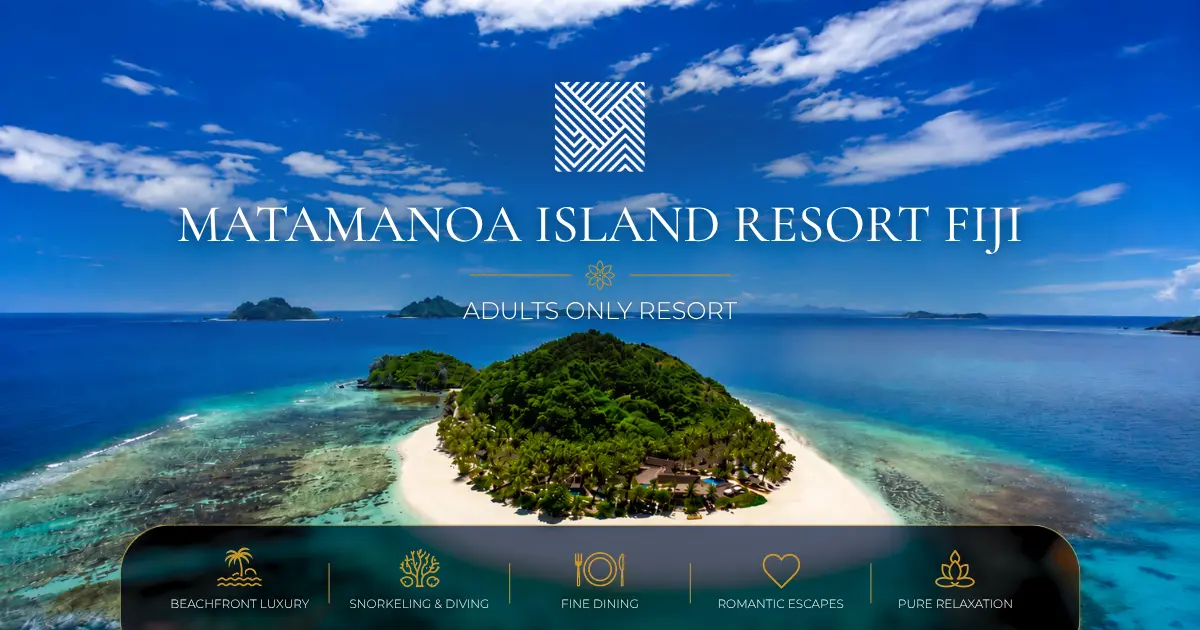
The island buyout. Fiji's private-island and small-resort market makes exclusive use genuinely attainable at incentive group sizes rather than only at corporate-retreat scale. Malamala Beach Club publishes capacity for up to 350 for corporate functions on its own island and offers a full-island private buyout. Small luxury properties including Likuliku Lagoon Resort, Tokoriki Island Resort, Vomo Island Fiji and Matamanoa Island Resort are sized for exclusive use by a single incentive group.
Dinner on the water. Cloud 9 is a two-level floating platform IN the Mamanucas with a bar and a wood-fired pizzeria that offers private functions and exclusive hire — it publishes no capacity figure, so establish that early. Captain Cook Cruises Fiji charters vessels from Denarau Marina for corporate events for 2 to 500 guests, including the tall ship Fiji One.
The seaplane arrival. Landing a group on water in front of the resort is the most photographed moment in any Fiji programme. Turtle Airways publishes 15 minutes to the Mamanucas; helicopter operators run to a published list of resorts across Denarau, the Mamanucas, the Coral Coast, the Yasawas and Pacific Harbour.
The lovo and meke evening. A properly done Fijian earth-oven dinner with a meke. Bring the group to the pit for the unearthing rather than serving from a buffet — the mechanics and the four-hour food safety constraint that shapes them are in event catering and themed dinners in Fiji.
Golf. Natadola Bay Golf Course is an 18-hole par-72 links-style championship course designed by Vijay Singh, which has hosted the Fiji International in 2014, 2016 and 2018 and publishes group and multi-round packages and charity tournament formats. Denarau Golf & Racquet Club is an 18-hole par-72 course inside the Denarau precinct — four tees from 5,169 to 6,513 metres — which means a golf afternoon costs zero transfer time.
How do you build the activity programme around Fiji's real limits?
This is where Fiji incentive programmes succeed or fail, and it comes down to published group constraints that most planners do not discover until the operations meeting.
ZIP Fiji publishes a maximum of 16 guests with five guides per departure, with a 135 kg weight limit and a roughly three-hour experience. For an 80-person incentive that is five staggered departures across a day. Design the day as a rotation with a second activity running in parallel, or do not put ziplining in the programme at all.
Most other Fiji operators publish no group figure whatsoever. Rivers Fiji runs Upper Navua rafting and Middle Navua kayaking from Pacific Harbour; Sigatoka River Safari runs jet boat and village visits with partnerships across 18 Sigatoka Valley communities and three pickup points; Off Road Fiji and Sleeping Giant Zipline round out the adventure set. None of them publishes a maximum, a corporate rate or a charter option — so send a written brief with your exact numbers and timings and compare what each will commit to.
For facilitated team content rather than adventure activity, Team Up Events Fiji is the Fiji partner to Catalyst Global, a team-building network spanning 36 companies across more than 70 regions — the closest thing to a formal credential in the Fiji activity market.
How should the arrival be designed?
The arrival is the highest-leverage hour of a Fiji incentive and the easiest to get wrong, because Nadi International is where qualifiers land tired.
Three principles:
- Meet and greet before immigration is not possible; greet them the second they clear it. A named ground handler with a garland and a cold drink at the arrivals door resets a nine-hour flight. Operators including TEWAKA Fiji, which runs an arrivals lounge at Nadi International, and Micks Fiji Tours & Transfers, which publishes experience with conferences of several hundred delegates, do this as core business.
- Do not schedule content on arrival day. Long-haul qualifiers from North America and Asia arrive on services running two to three times a week rather than daily, which means a group can land across two or three days. Build a soft arrival day with a welcome function in the evening and nothing before it.
- Move the reveal to day two. If the programme has a surprise — an island day, an upgrade, a seaplane — reveal it when people are rested enough to react.
What does the money actually look like?
Two structural facts about Fiji shape an incentive budget before you price anything.
There is no destination subvention. Fiji has no convention bureau, no accredited-DMC scheme and no conference bid fund. Tourism Fiji runs a business events team and a published Event Investment programme — the Event Development Fund and the Marquee Event Fund — but that programme explicitly excludes meetings, incentives, conferences and exhibitions. If your model assumes destination cash support, remove it. Supplier vetting in that environment is covered in Fiji DMCs, PCOs and event suppliers.
The currency is partly pegged to the dollars you are budgeting in. The Reserve Bank of Fiji operates a fixed exchange rate system with the Fiji dollar pegged to a weighted basket comprising the Australian dollar, New Zealand dollar, US dollar, Japanese yen, pound sterling and euro, with the official FJD–USD rate set daily at 9:00am; the individual weights are not published. For an AUD- or NZD-funded incentive that materially dampens currency risk over a 12-month qualification period.
RBF indicative rates published on 7 September 2026 give the Fiji dollar at 0.7677 against the New Zealand dollar, 0.6268 against the Australian dollar and 0.4512 against the US dollar. The published table is not direction-labelled; the magnitudes correspond to one Fiji dollar buying roughly those amounts. Take the rate on the day you build the budget, state the date in the budget document, and re-check at contracting. Cost structure by line item is in what a Fiji conference costs.
Where the money goes in a Fiji incentive, in rough order of size: accommodation, air, ground and island transfers, food and beverage, activities, production for the set-piece evenings, and gifting. The line that surprises people is transfers — an island-based programme moves every qualifier by boat or aircraft multiple times, and each movement is a cost and a schedule risk. A programme that stays ON Denarau Island and takes one island day out will almost always beat an island-based programme on both budget and reliability.
What are the reward mechanics that suit Fiji?
Fiji rewards programmes that use access rather than upgrade as the currency.
- Tiered accommodation within one resort — overwater or beachfront bures for top qualifiers, garden rooms for the rest, everyone in the same programme. Fiji's resort room-type ranges make this unusually clean.
- The extra night. A pre- or post-night is a low-cost, high-perceived-value increment in a destination where the flight is the expensive part.
- The island day as the top-tier reward. A seaplane out for the top 20 while the wider group takes the boat is visible, photographable differentiation.
- The exclusive table. A chairman's dinner at a small private venue reads as recognition in a way another gift does not.
Two mechanics that do not travel well to Fiji: elaborate cash-equivalent gifting, which is retail-dependent in a market with limited luxury retail; and anything requiring reliable high-bandwidth streaming from an outer island, which is not a safe assumption — see Fiji's event infrastructure.
When should a Fiji incentive run?
The Fiji Meteorological Service states that the tropical cyclone season runs November to April, with peak activity typically January to March, and that usually around two tropical cyclones affect Fiji per season. That is a defined window you can contract around.
Fiji's peak visitor months are July and August — each about 10% of annual arrivals — which makes May, June, September and October the value shoulder for an incentive that still sits outside cyclone season. Cabinet confirmed eleven public holidays for 2026, only one of which falls in July or August.
Three programme shapes that work
Three nights, ON Denarau Island, 60 qualifiers. Day 1: arrivals, evening welcome function at the resort. Day 2: morning free, afternoon activity rotation, evening lovo and meke. Day 3: island day at a beach club, back for a final dinner at a Port Denarau restaurant. Day 4: departures. One coach movement, one boat movement, no internal flights.
Five nights, Mamanucas, 40 qualifiers. Day 1: arrive Nadi, transfer by fast boat, casual welcome. Day 2: full free day. Day 3: activity day back on the mainland or a neighbouring island. Day 4: free morning, gala dinner. Day 5: recovery day. Day 6: depart. Seaplane the top tier out on day 1 as the reveal.
Seven nights, split, 30 qualifiers. Four nights ON the Coral Coast with a land programme — dunes, river, village, golf at Natadola — then a domestic flight to Taveuni or an outer island for three nights of pure downtime. The split is what stops week-long programmes going flat.
What Fiji cannot do
Be straight with the client about three things. There is no destination subvention. Long-haul lift from North America and Asia is two to three flights a week, not daily, so a globally distributed qualifier base arrives across several days. And luxury retail is limited — if your reward culture is built around shopping, Fiji is the wrong destination.
None of those is a reason to rule Fiji out. All three are reasons to design around it rather than discover it late.
The next step
Decide the transfer question first — mainland, Mamanucas, or outer island — because it determines the programme, not the other way around. Then brief three ground operators with your exact numbers and dates and compare on commitments rather than brochures. Size any conference component against the MICE Fiji capacity chart and Fiji conference scenarios and benchmarks.