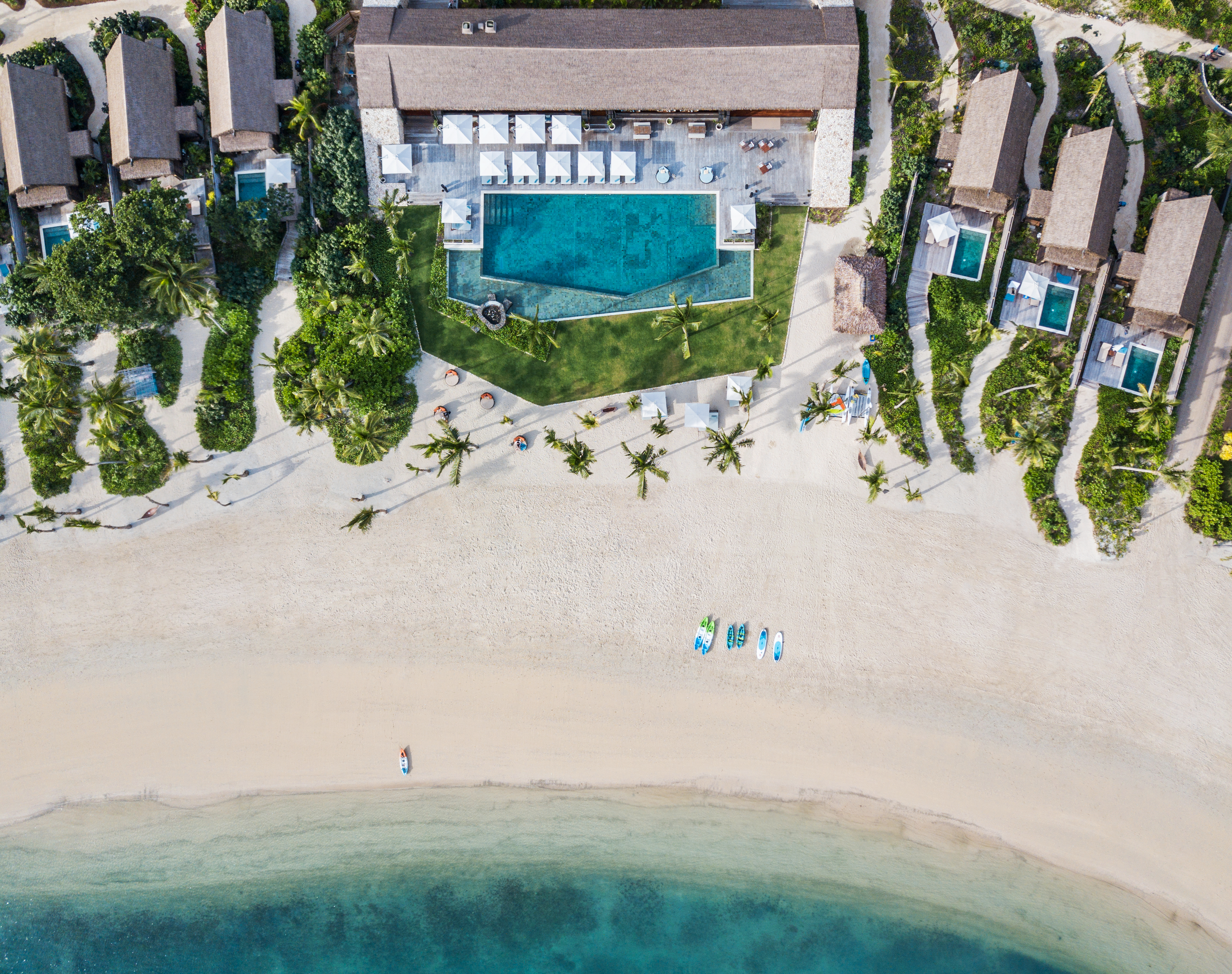
Delegate experience in Fiji is built from three things a conference programme can actually schedule: a small number of activity operators with published group limits, a cultural protocol that rewards being got right, and a geography where a beach, a rainforest river and a private island are all inside a two-hour radius of the plenary room.
This hub covers what to put in the free-time block, how to run a partner programme, what a pre- or post-tour extension should look like, and — the part most destination copy skips — the published capacity constraints that decide whether an activity works for 40 delegates or 400.
What should go in a Fiji delegate programme?
Start from the constraint, not the brochure. Most Fiji activity operators are built for leisure travellers in ones and twos, and only a handful publish a group figure at all. The table below lists what is actually published, which is the difference between a programme that runs and one that queues.
| Experience | Where | Published group constraint | Published timing |
|---|---|---|---|
| ZIP Fiji | Pacific Harbour and Nadi | Up to 16 guests with 5 guides per departure; max weight 135 kg; min age 3 | About 3 hours depending on group |
| Malamala Beach Club | Its own island IN the Mamanucas | Up to 350 people for corporate functions; full-island buyout available | ~30 minutes from Port Denarau |
| Cloud 9 | Floating platform IN the Mamanucas | Private functions and exclusive hire offered; no capacity published | Not published |
| Sigatoka River Safari | Sigatoka Valley | Not published; three pickup points — Coral Coast, Nadi/Denarau, Sigatoka Town | Not published |
| Rivers Fiji | Upper and Middle Navua, Pacific Harbour | Not published | Not published |
| Sigatoka Sand Dunes National Park | ON the Coral Coast | "Guided tours and special environmental programs for groups are available upon request" | Short trail 1 hour; long trail 2 hours |
| Sleeping Giant Zipline | Holika Rd, Nadi | Not published | Open 7 days, 10am–5pm |
| Kula WILD Adventure Park | ON the Coral Coast | Not published | Open daily 10am–4pm, last entry 3:30pm |
The most important number in that table is 16. ZIP Fiji publishes a maximum of 16 guests with five guides per departure. A 100-delegate group therefore needs seven staggered departures across the day, not one activity slot — and that changes the coach schedule, the catering and the whole afternoon. Design around published limits early, because discovering them at the operations meeting is how a partner programme falls over.
How do you build a partner programme that people actually attend?
Partner programmes fail when they are a consolation prize. In Fiji they work when they use the things a delegate in a plenary room cannot: water, culture and space.
Three structures that hold up:
The half-day cultural morning. A village visit with a proper sevusevu, a market walk and a craft session. This needs a guide who has a standing relationship with the community — Sigatoka River Safari publishes partnerships with 18 remote communities in the Sigatoka Valley and includes a kava ceremony in its jet-boat itinerary, which is the model to look for. Read Fijian culture and custom before briefing anyone.
The island day. A boat out to a beach club, lunch, water time, back by 4pm so partners rejoin the group for the evening. Malamala Beach Club is the only operator in this category that publishes a hard headcount — up to 350 for corporate functions, on its own island roughly 30 minutes from Port Denarau — which makes it the easiest to plan against.
The land programme ON the Coral Coast. Sigatoka Sand Dunes National Park in the morning, Kula WILD Adventure Park or a lunch stop after. The dunes are Fiji's first national park, established in 1989, covering over 650 acres of dunes and dry forest with roughly half under protection. The National Trust publishes Lapita heritage dating back some 2,600 years, a burial site where over 50 individuals were found in the late 1940s, and what it describes as the largest collection of complete and near-complete Lapita pots from the Pacific region — plus over 37 bird species, eight of them endemic to Fiji. Two trails: a one-hour short trail and a two-hour long trail. Entry is $10 for adults, $7 for international students, $5 for local students, free under five. Open Monday to Sunday, 8am to 4:30pm, closed between 1pm and 2pm — that closure is easy to schedule a coach straight into.
What are the credible team-building options?
Fiji's team-building market is small and one operator is clearly built for it. Team Up Events Fiji describes itself as Fiji's premium business events partner, operates from Nadi and serves Denarau and Coral Coast resorts, and is the Fiji partner to Catalyst Global, a team-building network spanning 36 companies across more than 70 regions. That network membership is the closest thing to a credential anywhere in the Fiji activity market.
Beyond a facilitated programme, the honest options are adventure activities used as team experiences rather than bespoke team-building products:
- Rafting and kayaking on the Navua. Rivers Fiji runs rafting on the Upper Navua River and kayaking on the Middle Navua, from Pacific Harbour, and cites the river's UNESCO conservation area and Ramsar designations. Suits experienced paddlers and first-timers alike; group sizes are not published, so ask.
- Jet boat and village. Sigatoka River Safari, above.
- Ziplines. ZIP Fiji at Pacific Harbour or Nadi, with the 16-per-departure limit; or Sleeping Giant Zipline, a 35-acre eco-adventure park about 20 minutes from Nadi with seven zip lines running from 80 to 160 metres, open seven days from 10am to 5pm.
- Off-road. Off Road Fiji operates ON the Coral Coast and runs cave safari combinations with Sigatoka River Safari.
None of these publishes a corporate rate card. Build the brief around numbers and timings, send it to three operators, and compare on what they commit to rather than what they advertise.
What does a Fiji cultural evening involve, and how do you do it respectfully?
Two set-pieces dominate: the meke and the kava ceremony. Both are living cultural forms, not resort decoration, and the difference in how a group is received is entirely in the preparation.
Meke is traditional dance that tells stories through song and movement — Tourism Fiji describes men's meke as strong and virile in movement and women's as more graceful, sometimes performed with clubs, spears and fans. Most resorts run a weekly meke. If you are commissioning a performance for a delegate audience, engage the group directly through the venue, agree the fee in writing, credit the performers by name in the run sheet and the programme, and allow time for them to explain what the meke is about. There is no published rate guidance in Fiji for performers, which makes it more important, not less, that the fee is negotiated openly rather than bundled invisibly into a per-head cost.
Kava, or yaqona, is made from the dried, ground root of Piper methysticum, a pepper plant that takes three to four years to mature. The powder is mixed with cold water in a straining cloth and squeezed into the tanoa, the kava bowl, and served in a bilo, a coconut-shell cup. You will be offered "high tide" (a full cup) or "low tide" (half). The etiquette Tourism Fiji publishes: clap once before drinking, drink it in one, clap three times after.
The sevusevu is the presentation of kava to a village chief to seek permission to enter, opening with formal dialogue between the visitors' spokesperson and the host. Tourism Fiji notes half a kilogram of yaqona root costs around FJD$30–40 — a small line item that should never be omitted.
Village etiquette to brief every delegate on, per Tourism Fiji's published guidance: cover shoulders and legs, with a sulu around the waist; remove hats and sunglasses and carry bags in your hands rather than on your shoulders; take shoes off before entering any village building; never touch someone's head; wait for the masu, the prayer, before eating; and avoid village visits on Sundays.
Health note — guideline only. Kava is a traditional and central part of Fijian social life. It is also associated with reported liver injury: the US National Institutes of Health's LiverTox database records that between 50 and 100 cases of clinically apparent liver injury have been published, with more recent reports exceeding 100, and assigns kava its highest likelihood category as a known cause. Germany, Switzerland, France, Canada and the United Kingdom have banned or restricted kava products, and the US FDA issued a consumer advisory in 2002. Injury has been reported with traditional water-based preparations as well as solvent extracts. Delegates on medication, with liver conditions, who are pregnant, or who intend to drive should be told they can decline a bilo without offence. This is general information, not medical advice — confirm with a qualified clinician and with the Fiji Ministry of Health and Medical Services. Last reviewed 7 September 2026.
What about wellness, golf and slower free time?
Golf. Two courses publish enough detail to plan against. Natadola Bay Golf Course is an 18-hole, par-72 links-style championship course designed by Vijay Singh, which has hosted the 2009 Fijian Open, the Fiji International in 2014, 2016 and 2018, and the Nomura Cup. It publishes a driving range and practice facilities, a pro shop with equipment hire, the Vatu Lo Bar & Restaurant, and — usefully for a conference — private events, charity golf tournaments and multi-round group packages. Denarau Golf & Racquet Club is an 18-hole championship course, par 72, with four tees running from 5,169 metres off the Jade to 6,513 metres off the Black, and publishes corporate membership at FJD 6,450. Its convenience is the point: it sits inside the Denarau precinct, so a golf afternoon costs no transfer time at all.
Water. Diving is well developed and Pacific Harbour is the specialist base: Beqa Lagoon shark diving is run by operators who manage the Shark Reef Marine Reserve and the Fiji Shark Lab, with more than twenty years in that reserve. Group minimums, boat capacity and charter rates are not published anywhere, so contact the dive centre directly. Closer to Denarau, Hydro Sports Fiji and KaiWai Watersports Fiji handle in-resort water activity. Note the duty-of-care point covered in Fiji's event infrastructure: Fiji's recompression chamber is at CWM Hospital in Suva, not on the Coral Coast, and air evacuation for a dive incident must be arranged by the hyperbaric unit itself.
Doing nothing well. The most underrated free-time design in Fiji is a genuinely empty afternoon on a resort beach with a bar tab and no scheduled content. Delegates who have flown three to eleven hours and sat through two days of plenary do not need a fourth activity. Build one properly empty block into every programme.
How should a pre- or post-tour extension be structured?
The extension question in Fiji is really a transfer question, and the answer changes by island group.
- The Mamanucas are the practical extension. Mamanuca Express and SeaFiji run fast transfers from Port Denarau, and Turtle Airways publishes seaplane transfers of approximately 15 minutes to the Mamanucas. A two-night extension there costs you almost no travel time.
- The Yasawas cost a genuine travel day by sea — the Yasawa Flyer departs Port Denarau by 8.45am and returns around 6.00pm, running the length of the group and back. Turtle Airways publishes 33 minutes by seaplane as the alternative. Either build a rest day around the boat or fly the group; do not pretend the transfer is not there.
- Taveuni and Vanua Levu need a domestic flight and suit longer, smaller, higher-value extensions.
Sequence matters: run extensions after the conference, not before. A pre-tour puts your delegates on a boat the day before they need to be sharp, and any weather delay hits the plenary rather than the holiday.
Region-by-region detail is in Fiji's islands and regions and where to stay in Fiji.
Can a delegate group do meaningful community work in Fiji?
Yes, but book it honestly. Tourism Fiji runs Loloma Hour, an initiative encouraging visitors to spend an hour making a positive environmental, cultural or community impact during their stay, across four categories — wildlife conservation, cultural preservation, reef restoration and coastal protection — with a stated goal of 5,000 volunteer hours in its first year and 21 participating resorts. Ask your property whether it participates; that is the cleanest route to a credible CSR block.
Several Fijian organisations do work a corporate group would want to support: Rise Beyond the Reef, a non-profit established in 2014 working with over 600 women artisans from Sabeto Valley near Nadi; Vinaka Fiji, supporting remote Yasawa communities from Port Denarau Terminal with published project spending including 35 water tank installations and tertiary scholarships; and the Fiji Red Cross Society, established in 1952 and recognised as the 118th member of the International Red Cross and Red Crescent Movement in 1972.
The honest caveat: none of these organisations publishes a packaged corporate volunteering programme. There is no off-the-shelf village build or school project to book. Approach them directly, well ahead, and accept that a genuine partnership takes more lead time than a half-day activity slot. Buying from them — craft, produce, artisan work — is often the more useful contribution than sending 60 people to dig something.
Avoid the common error of assuming a coral-planting programme is available because a resort mentions coral gardening; some properties, such as Six Senses Fiji, publish reef restoration talks and guided snorkelling sessions of their own, but that is a resort activity, not a third-party conservation programme.
The next step
Set the free-time block before you set the session times, because the activity limits are less flexible than the agenda. Size the shortlist against the MICE Fiji capacity chart, then read designing a Fiji incentive programme for the reward-programme version of this material and the 40 best things to do in Fiji for the wider destination menu. Cultural performance and entertainment suppliers, including VOU Hub Fiji, are listed in the directory.