Fiji can hold a conference of up to about 900 delegates in a single purpose-built room, sleeps roughly 3.7 million room nights a year across seven precincts, and is reachable non-stop from 17 international cities. It offers no bid funding, its largest coach seats 53, and its cyclone season runs November to April. Those four facts, taken together, tell you almost everything about whether Fiji suits your event.
This is the master guide for business events in Fiji. It sets out what the country can actually do, in the order a planner needs it, and links to the detailed page for each decision.
Why would you hold a conference in Fiji?
Four arguments that survive scrutiny, and three that do not.
Access from Australasia is genuinely short. Nadi is served non-stop from Auckland, Wellington, Christchurch, Sydney, Melbourne, Brisbane, the Gold Coast, Cairns, Adelaide and Canberra, plus Los Angeles, San Francisco, Honolulu, Vancouver, Hong Kong, Singapore and Tokyo. Fiji Airports states Nadi handles "38 international scheduled flights on a daily basis" and "more than 2.1 million international passengers" annually.
Entry is frictionless for most delegates. Around 150 nationalities enter visa-free, and Fiji's Immigration Regulations expressly permit entry "to attend a conference or meeting". No visa applications, no invitation letters, no consular queues.
It performs in the off-peak. Tourism Fiji's own chief executive describes MICE as "a growing segment of the market, especially because it performs during off-peak periods". Fiji's national room occupancy for annual 2025 was 57.0%, and in the March 2026 quarter regional occupancy ranged from 60.7% on the Coral Coast down to 28.7% in the Northern Division. Low occupancy is negotiating leverage.
One destination does conference, incentive and partner programme. A plenary on Denarau, a team day on a Mamanuca island and a partner programme in the Sigatoka valley sit within a couple of hours of each other.
Against that: there is no subvention of any kind, most venues publish nothing so you negotiate blind, and the delegate-facing cost base just rose — a new 5% Tourism Services Tax applies from 1 September 2026 to hotels and tour operators turning over more than FJ$2 million. Our 12 reasons to hold your conference in Fiji makes the fuller case with the counter-arguments.
How big an event can Fiji actually hold?
The honest ceiling for a single-room plenary is around 900 delegates, and it is new.
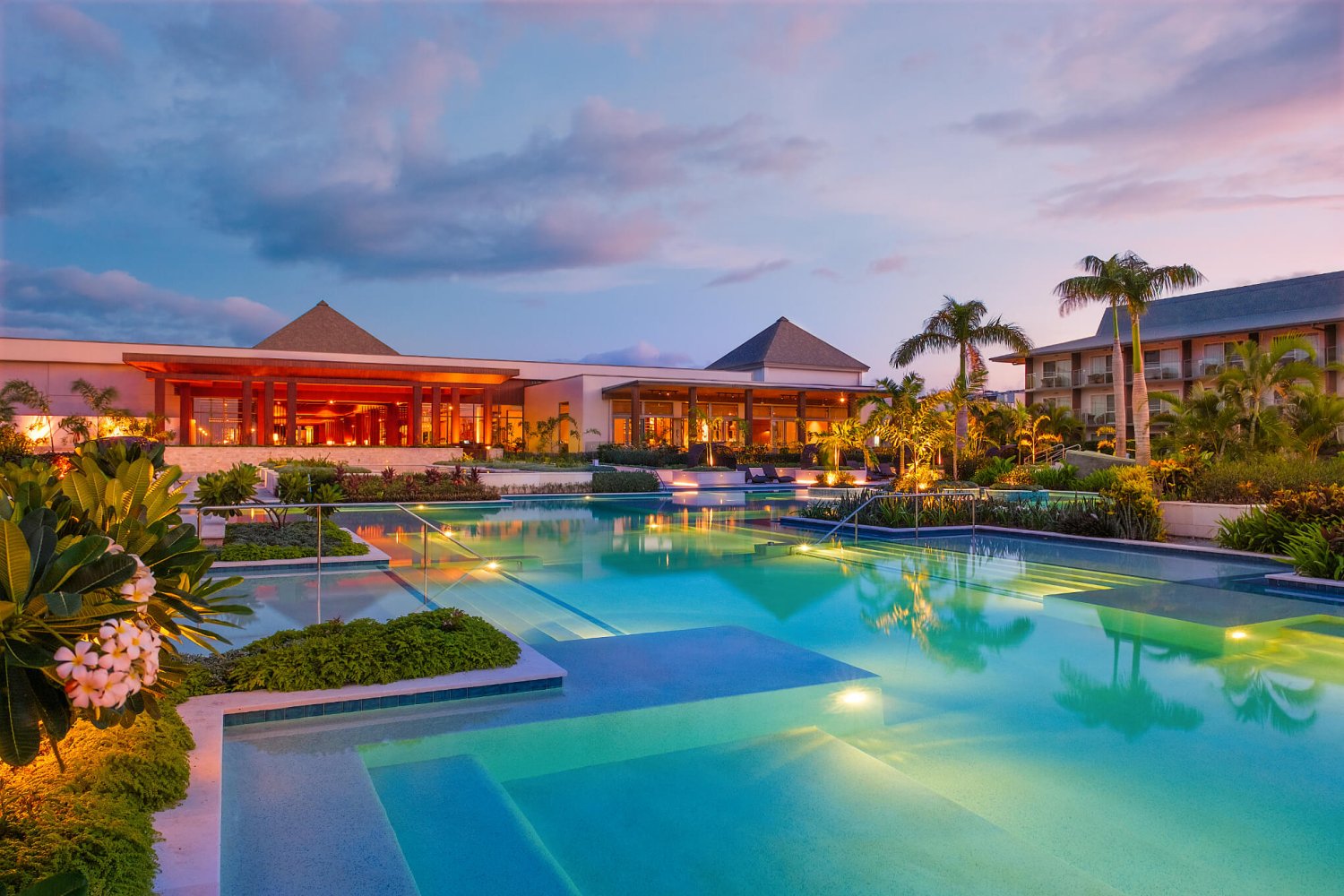
The Crown Convention Centre at Crowne Plaza Fiji Nadi Bay opened in November 2025, minutes from Nadi International Airport. The hotel markets it at "up to 900 delegates"; trade press reported it as a 600-seat venue. Its Grand Ballroom is recorded at 925 m², and it divides into three Event Centre rooms each published at 448 theatre, 180 banquet and 350 cocktail, alongside a Baravi Ballroom published at 450 banquet. The hotel has 324 rooms on site.
Below that, the next tier of published capacity:
| Venue | Precinct | Largest published capacity |
|---|---|---|
| Crowne Plaza Fiji Nadi Bay | Nadi | "Up to 900 delegates"; Grand Ballroom 925 m² |
| Shangri-La Yanuca Island | Coral Coast | Ratu Makutu Events Centre 650 theatre / 500 banquet; Rara 1,000 cocktail |
| Sheraton Fiji | Denarau | Denarau Island Convention Centre — 1,600 cocktail on the wedding chart |
| Warwick Fiji | Coral Coast | Talanoa Hall 400 theatre / 500 cocktail; "874 square metres" across three venues |
| Novotel Suva Lami Bay | Suva | Convention Centre 480 m², 350 theatre / 300 reception |
| Holiday Inn Suva | Suva | Lali Room 215 m², 250 theatre / 200 cocktail |
| First Landing | Vuda | Big Foot Island 300 cocktail; The Big Sea 250 theatre |
| The Westin Denarau | Denarau | Senirosi Ballroom 292.82 m², 200 theatre / 150 banquet |
| Yatu Lau Lagoon Resort | Pacific Harbour | 250 theatre in the largest room |
| Tanoa Waterfront | Lautoka | Old Mill Room 170 theatre; Sunset Lawn 200 reception |
The pattern is clear: Fiji is strong from 50 to 400 delegates, workable to about 900 in one room at one property, and above that you are splitting a plenary across rooms or precincts. It has no government-built national convention centre, and none appears in any current policy or budget document. A 2017 plan by the Fiji National Provident Fund for a 3,500-seat conference and exhibition centre at Momi Bay does not appear to have proceeded at that scale.
Our Fiji conference venue capacity chart holds the full data set for 37 properties, including where published figures contradict each other.
Where will 400 delegates sleep?
Room inventory is the constraint that catches planners out, because a venue that seats 900 rarely sleeps 900.
The largest single-property room counts published by brand sites are Hilton Fiji at 356, Crowne Plaza Fiji Nadi Bay at 324, Sofitel Fiji at 295, InterContinental Fiji at 266, Outrigger Fiji at 254 keys and Warwick Fiji at 247. Note that Marriott publishes no room count for any of its Fiji properties — Sheraton Fiji, the Westin, Momi Bay or Sheraton Tokoriki — so those have to be confirmed directly.
At precinct level, the only official capacity data is Fiji Bureau of Statistics room-nights, not keys. For annual 2025 Fiji had 3,685,933 rooms available in room nights, distributed as:
| Precinct | Rooms available, annual 2025 (room nights) |
|---|---|
| Nadi | 1,455,469 |
| Coral Coast | 659,807 |
| Suva | 596,984 |
| Yasawa & Mamanuca Group | 441,087 |
| Northern Division | 244,938 |
| Lautoka | 215,677 |
| Others | 71,971 |
Two practical readings. First, Nadi and Denarau hold roughly 40% of Fiji's accommodation capacity, which is why almost every large conference lands there. Second, no official body publishes a national room-stock count in keys — the Bureau measures room nights, and neither the Ministry nor the hotel association publishes an inventory figure. So for a 400-delegate event you build the room block property by property, not from a national number.
See group accommodation and room blocks in Fiji for cut-off dates, attrition and contracting.
How do you get a group into Fiji?
By Nadi, on Fiji Airways, and the network is moving.
Fiji Airways is the anchor carrier, with a mainline fleet of 14 aircraft — four A350-900s at 334 seats, three A330-200s at 273, one A330-300 at 313, five 737 MAX 8s at 170 and one 737-800 at 170 — on the most recent published figures. Air New Zealand, Qantas, Jetstar and Virgin Australia add Australasian capacity; Air Niugini, Solomon Airlines, Aircalin and Nauru Airlines serve the Pacific routes.
Four network changes matter for anything you are planning now:
- Dallas/Fort Worth ended on 7 September 2026. If a US delegate itinerary assumed a Texas gateway, it no longer exists.
- Gold Coast launched 11 June 2026, three weekly on a 737 MAX 8.
- Hong Kong rises to four weekly year-round from 22 September 2026, and Vancouver was upgraded from A330 to A350 from 8 September 2026.
- Western Sydney is announced from 19 March 2027, three weekly — relevant if you are bidding for 2027 or beyond.
Fiji Airways publishes a group-booking channel with a minimum of 10 passengers. It does not publish a dedicated MICE desk, and the group terms — deposits, name-change deadlines, free-of-charge allowances — are not public, so get them in writing.
The domestic network carries a hard constraint worth knowing before you plan an outer-island programme: services to Savusavu, Taveuni and Kadavu are flown on 19-seat DHC-6 Twin Otters. Moving 100 delegates to Taveuni means six aircraft rotations, not one flight. Nadi–Suva and Nadi–Labasa use 68-seat ATR 72s.
On the airport itself: Fiji Airports has contracted six new passenger boarding aerobridges under a $10.4 million programme, and is working to a 10-year strategic plan for 2025–2034 valued at over $1 billion, plus a 2025–2048 Nadi Airside Master Plan of 18 projects including 12 additional aircraft gates. Fiji recorded 986,367 visitor arrivals in calendar 2025, up 0.3% on 2024, with August the peak month at 99,737.
Full detail in getting a group into Fiji: air access for planners.
What will it cost?
The structure is knowable; the rates are not published.
Every major Fiji conference property is request-for-proposal only. Sheraton Fiji publishes no meeting rates, no minimum room nights and no delegate minimums. InterContinental Fiji states only that "the process starts with a proposal tailored to your requirements". So your comparison has to be built from your own RFP, asking every property the same questions.
The published cost inputs you can budget from today:
- 5% Tourism Services Tax on hotels and tour or cruise operators with turnover above FJ$2 million, effective 1 September 2026 for 12 months, with revenue ring-fenced to Fiji Airways. On top of existing taxes.
- 15% Non-Resident Withholding Tax on professional service fees paid to non-residents from Fiji sources, and the tax must be paid before FRCS will issue the tax clearance that lets funds leave Fiji.
- FJ$650.05 per Short Term Work Permit, if you need one for crew.
- Fiji Airways group fares from 10 passengers.
And one thing you can stop budgeting for: there is no subvention. Tourism Fiji's Event Development Fund and Marquee Event Fund both state in writing that they will not fund "Meetings, Incentives, Conferences or Exhibitions". See is there any funding or subvention for Fiji business events and what a Fiji conference costs.
When should you hold it?
May to October is the dry season and the safe answer. November to April is the wet season and, on the same calendar, Fiji's cyclone season — the Fiji Meteorological Service states it "runs from November to April, with peak activity typically occurring between January and March", and that "usually around two tropical cyclones affect Fiji per season".
The shoulder months are where the value sits. Occupancy data supports this: the March 2026 quarter recorded national room occupancy of 49.7%, well below the 57.0% annual figure, and Suva at 36.3%. A risk committee will ask about cyclones first, so go in with the numbers and a force majeure clause rather than reassurance.
One geographic point that changes the risk calculus: Fiji's west is genuinely dry. Fiji Met's 2024 station data recorded 1,974mm at Momi against 3,993mm at Laucala Bay in Suva and 4,371mm at Navua. A wet-season event on Denarau or at Momi Bay is a materially different proposition from one at Pacific Harbour.
See when to hold a conference in Fiji.
What will constrain you on the ground?
Four things, and all four are more relevant than anything in a brochure.
Coaches top out at 53 seats. TEWAKA publishes a 53-seat deluxe coach, Coastline Fiji a 50-seater, and Tourist Transport Fiji a 48-seat Yutong with a published fleet of nine such coaches. So 300 delegates is eight coaches at a realistic load, and 800 is roughly twenty across three or four operators. See moving 100, 300 and 800 delegates around Fiji.
Roads and bridges. Fiji Roads Authority's asset register records 6,433.977 km of network of which only about 28% is sealed, and its media centre carries recurring notices of temporary bridge weight restrictions plus height restriction works at Navua Bridge. The national maximum speed limit is 80 km/h. FRA runs a conditions line on toll free 5720.
Boat capacity. The largest passenger vessel in the country is the Yasawa Flyer III at 320 passengers, described by its operator as the largest fast ferry ever to operate in Fiji. That caps any single-sailing island day.
Production capability. Fiji has real in-country AV and staging — Encore Event Technologies Fiji, Microhire Fiji, Formscaff Fiji, plus local audio, lighting and hire firms — and the correct default is to source locally rather than freight kit in. See AV and production in Fiji and Fiji's event infrastructure.
What compliance work does an inbound event need?
More than most planners assume, and the trap is counter-intuitive.
A delegate is straightforward: Fiji's Immigration Regulations expressly permit entry on a Visitor's Permit "to attend a conference or meeting", and most nationalities get up to four months on arrival.
Anyone working at your event is not. Regulation 25 bars a visitor-permit holder from engaging in any business, profession or employment "whether or not for reward" — so a speaker, trainer, exhibitor or AV technician needs to declare business at the border and take a Business Visitors Permit instead. That permit is 21 days for Australian, New Zealand, Singaporean and American nationals and 14 days for other visa-exempt nationalities. The Ministry of Immigration's own FAQ is blunt about it: you can work if you declare business on arrival, and you cannot if you declared holiday and got four months.
Equipment is a separate process again — customs and carnets rather than immigration.
Read do speakers, trainers and crew need a work permit in Fiji and bringing event equipment into Fiji: customs and carnets. Guideline only — confirm with the Ministry of Immigration and the Fiji Revenue and Customs Service.
Duty of care
Fiji has three main public divisional hospitals — Colonial War Memorial in Suva at 458 capacity, Lautoka at 339 and Labasa at 161 — with sub-divisional hospitals at Nadi, Ba, Sigatoka, Savusavu, Taveuni and elsewhere. Private hospitals are concentrated around Suva and Nadi.
The practical rule: the further your programme sits from Suva, Nadi or Lautoka, the longer the evacuation chain. For outer-island incentive programmes, medical evacuation cover to Australia or New Zealand belongs in the risk register, and the daylight-only operating windows of seaplane and helicopter operators are part of that assessment.
Which precinct suits which event?
| Precinct | Choose it for | Watch |
|---|---|---|
| Nadi | Airport proximity, the largest single conference room in the country, short transfers | Not a beach destination in its own right |
| Denarau | 100–500 delegates, walkable resorts, marina for off-site programmes | Premium pricing; a built precinct rather than a desert island |
| Coral Coast | Best mix of scale and setting; Shangri-La and Warwick both handle 400-plus | An hour or more on every transfer |
| Suva | Government, association and university business; capital-city venues | Wettest precinct; 36.3% occupancy in March Q 2026 |
| Lautoka and Vuda | Value; 15–20 minutes from the airport | Smaller rooms; 36.1% occupancy |
| Pacific Harbour | Incentives, diving, quiet | Two to three hours by road; conflicting published drive times |
| Mamanucas | Incentive and reward programmes to about 100 | Every movement is a boat; 320-passenger ceiling |
| Yasawas | Small, high-value incentive groups | Two to five hours by catamaran |
Sector and scenario detail
Different sectors hit different constraints — a medical congress needs breakout count and exhibition space, an insurance incentive needs room quality and a partner programme, an association conference needs delegate cost above all. Our conference playbooks by sector and Fiji conference scenarios and benchmarks work through those, and designing a Fiji incentive programme and delegate experience in Fiji cover the programme side.
For catering and themed dinners see event catering in Fiji; for the impact side, running a sustainable event in Fiji; and for partners on the ground, Fiji DMCs, PCOs and event suppliers.
The order to work in
- Fix the delegate number and the month. Everything else follows from those two.
- Test air capacity for your origin cities before you fall in love with a venue — particularly if delegates are coming from the US or Asia.
- Shortlist on room inventory, not room capacity. The plenary is rarely the binding constraint.
- Issue one RFP with identical questions to three properties, since nothing is published and only your own questions will make them comparable.
- Cost the movement, in coaches and waves, before committing to an off-site programme.
- Sort compliance early — permits for anyone working, carnets for anything freighted, withholding tax for anyone paid.
- Get the season clause right, whatever month you choose.
Your practical next step
Start with capacity and inventory together: the Fiji conference venue capacity chart tells you what fits, group accommodation and room blocks tells you where they sleep, and the venue directory lets you compare properties side by side.
Then price it honestly with what a Fiji conference costs, and read is there any funding or subvention before you build a bid budget around money that does not exist.
Last reviewed 10 September 2026. Airline schedules, tax rates, immigration rules and venue capacities change — all figures are as published on the dates cited, and legal, immigration and tax content is guideline only. Confirm with the named authority before relying on it.