Fiji's dining divides cleanly into four things: resort restaurants, the Port Denarau marina strip, Suva's genuinely urban restaurant scene, and the traditional kitchens where kokoda and lovo are the point. Most visitors only ever see the first. The other three are where the country actually eats, and they are worth the taxi.
This is the hub for eating and drinking in Fiji — what to order, where the clusters are, who makes the beer, and what your bill carries in 2026.
What should you actually order in Fiji?
Start here, because the menu vocabulary is the barrier.
Kokoda is the national dish and the one to order first. Fresh fish — usually walu, Spanish mackerel, sometimes snapper or wahoo — marinated in lime or lemon juice for two hours or overnight until the flesh turns white through, then drained and folded into miti, coconut milk, with onion, tomato, cucumber, chilli, coriander and spring onion. Ceviche-style and entirely dairy-free.
Lovo is not a dish but a method: an underground oven of fire-heated river stones, layered with root crops first, then wrapped meat and fish, then vegetables, sealed with soil and cooked for one to two hours. Most resorts run a lovo night weekly.
Rourou is the heart-shaped taro leaf, prepared to remove a mild irritant and then cooked down into soup, curry or palusami. Ota is a freshwater fiddlehead fern, blanched and served with a fresh crunch. Nama is sea grapes, a caviar-textured seaweed that turns up on seafood platters. Duruka — nicknamed Fiji asparagus — is the unopened flower bud of a sugarcane relative, and it appears in markets in April and May, baked whole in coconut milk or tossed through a curry. Kuita vakalolo is octopus in coconut cream.
| Dish | What it is | Best ordered |
|---|---|---|
| Kokoda | Citrus-cured fish in coconut milk | Anywhere; the benchmark dish |
| Lovo | Underground-oven feast | Resort Fijian night, or a village |
| Palusami | Taro leaves in coconut cream | As a lovo layer |
| Rourou | Taro leaf, as soup or curry | Traditional kitchens |
| Ota | Blanched fiddlehead fern | Market-adjacent restaurants |
| Nama | Sea grapes | On a seafood platter |
| Duruka | "Fiji asparagus" flower bud | April–May only |
| Kuita vakalolo | Octopus in coconut cream | Traditional kitchens |
Alongside all of it sits Fiji Indian cooking, which is not a sideline but half the national palate. Tourism Fiji puts it plainly: traditional iTaukei dishes share the table with spicy Indian curries and Chinese stir-fries. Cassava and dalo are the staple root crops; roti and curry is the everyday working lunch across Viti Levu.
What is on the drinks list?
More of it is made in Fiji than most visitors realise.
Paradise Beverages (Fiji) Limited produces over sixteen brands of beer, spirits and ready-to-drinks. The beers are Fiji Bitter, Fiji Gold, Fiji Stout, Fiji Light, Vonu Pure Lager and Moni. The spirits and RTDs include Bounty Rum, Fiji Tribe vodka RTDs, Joskes Brew cane spirit, Katia flavoured vodkas and products under Rum Co. of Fiji.
The company began in 1957 as Carlton Brewery Fiji Limited, passed through Foster's Group Pacific and SABMiller, and became Paradise Beverages under Coca-Cola Amatil in 2012. It brews in Suva and Lautoka, and distils at Lautoka — the South Pacific Distillery was acquired in 1998.
Rum Co. of Fiji has been distilling in Lautoka since 1980 and runs two ranges: Bati, a two-year aged rum built for mixing, and Ratu, premium aged at five, eight and ten years. The Ratu 5-year is listed on the Fiji Government's own Fijian Made registry.
FIJI Water has been bottling since 1996 and distributes in more than sixty countries. Its own site gives a pH of 7.7 and describes an artesian aquifer filtered through volcanic rock. Note that we could not confirm the frequently repeated Yaqara Valley sourcing detail from the company's own site — so we are not printing it as fact.
And kava, which is not really a bar drink but is the drink that matters. See Fijian culture and custom for the protocol before you accept a bilo.
One honest gap: no primary or company source publishes alcohol strengths for Fiji's beers. Anyone quoting an ABV figure for Fiji Bitter is repeating an aggregator.
Where are Fiji's dining precincts?
Port Denarau Marina
The densest concentration of restaurants in Fiji outside Suva, about twenty minutes by taxi from Nadi International Airport and the departure point for every Mamanuca and Yasawa transfer. The complex carries a supermarket, bottle store, bank, money exchange, doctor's clinic and pharmacy alongside dining that runs from casual bars to proper restaurants. The yacht club bar is the Rhum-Ba.
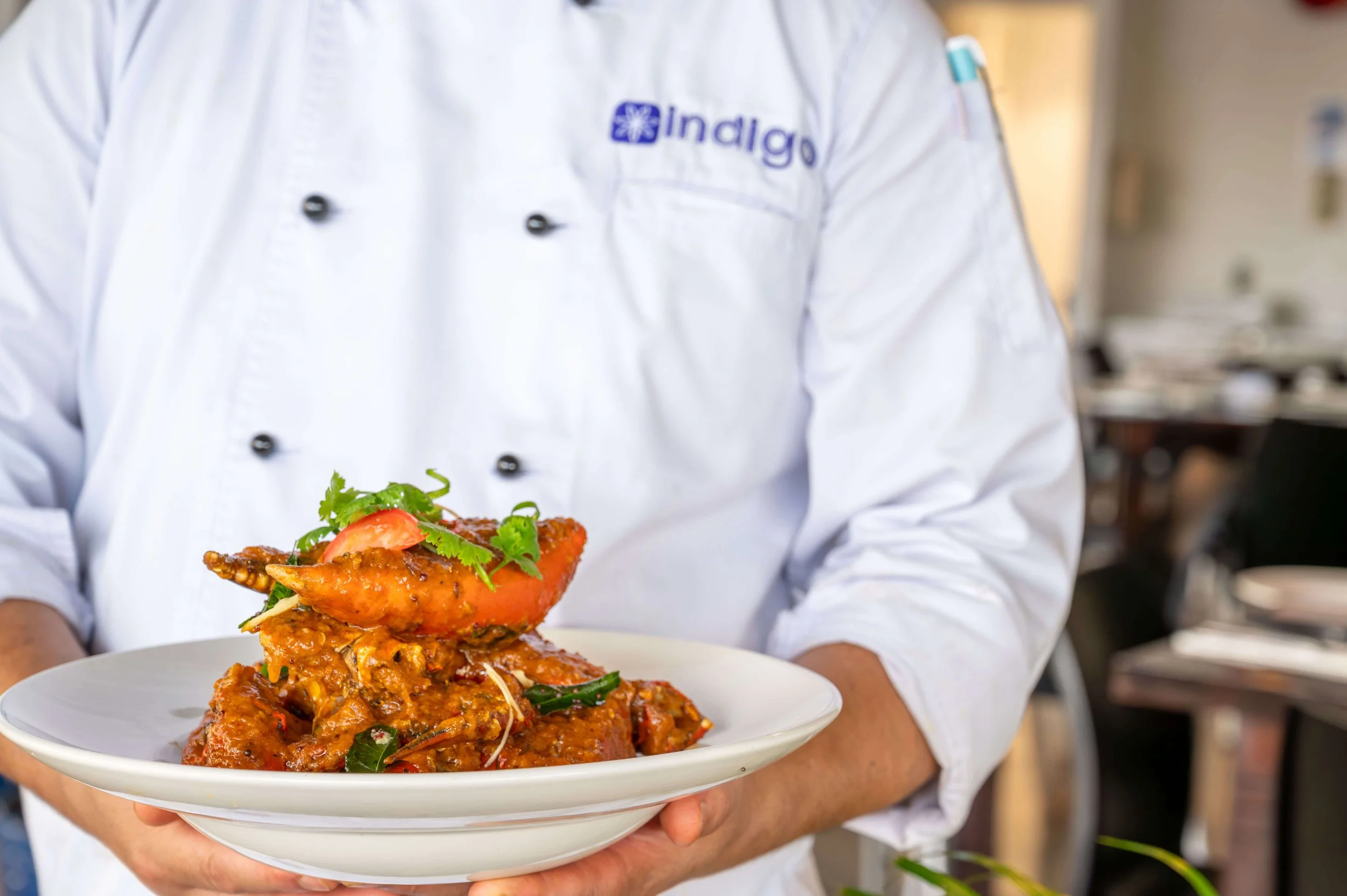
On the marina and around Denarau: Cardo's Steakhouse & Cocktail Bar, Indigo Indian Asian Restaurant & Bar, Nadina Authentic Fijian Restaurant — the place for kokoda, rourou soup and rourou balls — Bonefish Seafood Restaurant, Amalfi Italian Restaurant, Grills Restaurant & Bar, Cantina Grill & Bar and Lulu's.
For a conference or wedding this is the single most useful precinct in Fiji, because it lets you move a group off-property without a long coach run.
Nadi — Martintar, Wailoaloa and the town
Less polished, better value, more local. Wailoaloa is Nadi's beach and dining strip; Martintar is the roadside cluster between the airport and the town. Vasaqa and the Ice Bar are in the directory here. Tourism Fiji points to Sweet Laisa's Kitchen in Martintar for chargrilled fish and kuita vakalolo.
Suva — Victoria Parade and around
Suva is the only place in Fiji with a dining scene that behaves like a city's. Victoria Parade is the spine, carrying Bad Dog Café, Maya Dhaba, Traps Bar, O'Reilly's and Republic of Cappuccino in the Dolphin Centre. Beyond it the cluster spreads across Carnarvon Street, Gordon Street, Cumming Street, Thomson Street and Laucala Bay.
In the directory: Rudy's Italian Trattoria & Grill and Tiko's Floating Restaurant, the latter aboard a moored vessel on the Suva waterfront.
One correction worth making: Renwick Road is often listed as a Suva dining strip and we could not confirm a single restaurant on it. Victoria Parade and Cumming Street are the real answers.
The Coral Coast and Sigatoka
Sigatoka is the Coral Coast's commercial hub, about 69 to 70 kilometres from Nadi International Airport on the Sigatoka River, and it calls itself the Salad Bowl of Fiji because it supplies most of the Coral Coast's hotels and Fiji's municipal markets with fruit and vegetables. The Saturday market, busy with valley farmers, is the reason to time a visit for a weekend.
Directory listings along the coast include Sitar Indian & Thai Restaurant and Baravi Handicrafts & Cafe.
Lautoka and Vuda
Lautoka is the Sugar City — named for the cane belt, with a mill established in 1903 that remains the city's largest employer at around 1,300 workers, and Fiji's second largest port of entry. It became the administrative capital of the Western Division in 2012. Directory listings: Tukuni Restaurant, The Stadium View Sports Bar & Grill and, at Vuda Marina between Lautoka and Nadi, The Boatshed.
Pacific Harbour and the islands
Pacific Harbour's Arts Village functions as a shopping and eating complex, though we should note it has no official website and Tourism Fiji's own Pacific Harbour page does not mention it — so treat descriptions of it with mild caution. Lailai Lounge by Tropic Magic is the directory listing here.
Offshore, Malamala Beach Club sits thirty minutes from Port Denarau with an infinity pool, cabanas and an open-air restaurant, and Cloud 9 is a floating bar and pizzeria anchored in the Mamanucas.
What does a Fiji restaurant bill actually carry?
This changed materially five days before this article was written, and most of what is published online about Fiji hospitality taxes is now wrong.
| Charge | Status in September 2026 |
|---|---|
| VAT | 12.5 per cent — reduced from 15 per cent effective 1 August 2025 |
| Tourism Services Tax | 5 per cent — new, commenced 1 September 2026, applies to qualifying tourism operators with annual turnover above FJ$2 million |
| Service Turnover Tax (STT) | Nil. Ceased 31 July 2020 |
| Environment and Climate Adaptation Levy (ECAL) | Nil on services. Ceased 31 July 2021; the operative parts of the Act were repealed from 1 April 2022 |
| Card surcharge | Around 3 per cent on Visa and Mastercard, per Tourism Fiji |
| Tipping | Not customary or expected |
The ECAL point is worth dwelling on. Several professional-services and travel sites still describe a 5 per cent ECAL as payable on meals, beverages and accommodation. The Fiji Revenue and Customs Service rates table — updated 2 June 2026 — shows ECAL ending in July 2021 with no entry since, and the statute was repealed. If a quote you are given itemises ECAL, query it.
On the new Tourism Services Tax: bookings made before 1 September 2026 are not subject to it even where the service is delivered afterwards. Government and industry reporting indicates operators agreed to largely absorb the tax rather than pass it on, but the Fiji Hotel and Tourism Association warned visitors would end up paying and at least one resort is applying it to new bookings. Treat it as property-by-property.
Guideline only. Tax treatment depends on the operator and on Standard Interpretation Guidelines that were still being sought by the industry in late August 2026. Confirm with the Fiji Revenue and Customs Service and with the venue. Last reviewed 6 September 2026.
Cash still matters. Cards are widely accepted in tourist areas and larger establishments but Tourism Fiji is explicit that cash remains essential in villages, markets, small shops and the outer islands.
Can you book a Fiji restaurant for a group?
Sometimes, and it is worth asking early rather than assuming.
There is no market-wide data on how many Fiji restaurants offer private dining or function rooms — nobody publishes it. What is documented is a set of specific products:
- Malamala Beach Club states it takes corporate events for up to 350 people, plus cabana bookings for groups and full island buyouts.
- Rocks at Vomo Island runs a six-course signature Fijian menu for small groups of eight, or private villa dining.
- Kanu, with chef Lance Seeto, runs a five-course chef's-table degustation for groups of ten or more, Tuesday to Sunday.
- Donu at Paradise Cove runs a twelve-to-fourteen-course Japanese-Fijian omakase, open to outside visitors with advance booking.
- Paradiso in Suva describes itself as an event space with a dedicated events menu.
- Garden of the Sleeping Giant near Nadi is hireable for weddings, parties and corporate team-building.
Tourism Fiji's own guidance is that all venues require advance booking for group experiences or exclusive access. In practice, for anything over about thirty people outside a resort, use a caterer rather than a restaurant: My Kai and Chefs Catering Fiji are in the directory, alongside the full catering category.
Where to start
If you have one dinner in Fiji and want it to be Fijian, book Nadina at Port Denarau. If you have one dinner and want it to be memorable, take a boat: Malamala Beach Club or Cloud 9. If you are in Suva, walk Victoria Parade.
Browse the full directory by restaurants or bars and nightlife, filtered by dining style and by whether a venue takes group events. Or start from a location: Denarau, Nadi, Suva, the Coral Coast or Lautoka.
From here: Fijian culture and custom explains the lovo and the kava circle properly; the 40 best things to do in Fiji puts dining alongside everything else; and where to stay in Fiji covers which precincts put you within walking distance of a dinner.