Fiji gives photographers hard tropical light, a short golden hour and a legal framework around drones that most couples discover far too late. Book a Fiji-based photographer, schedule the ceremony to the sunset rather than the caterer, and settle the drone question in writing before anyone packs one. This guide covers all three.
When is the light actually good in Fiji?
Fiji sits at about 17-18 degrees south. That has two consequences photographers care about: the sun climbs high and hard through the middle of the day, and twilight is short. There is no long European dusk here.
Day length varies by roughly two hours across the year. In Suva, the longest days in December run to about 13 hours 20 minutes, with sunrise near 5:41am and sunset near 6:49pm. In June, daylight is around 11 hours. On 9 September, Suva sunrise was 6:06am and sunset 6:01pm.
| Season | Approx. daylight | Practical effect |
|---|---|---|
| December – February | Up to ~13h20m | Latest sunsets; ceremony can start 5:00–5:30pm and still finish in light |
| March – May | Shortening | Sunset pulls earlier through the period |
| June – August | ~11h | Earliest sunsets; a 4:00–4:30pm ceremony start is safer |
| September – November | Lengthening | Sunset pushes later week by week |
Two working rules follow from this:
- Set the ceremony start from sunset, not from dinner. A 45-minute ceremony followed by 45 minutes of couple and group portraits needs roughly 90 minutes of usable light before the sun goes. Work backwards.
- Do not schedule portraits for noon. Between about 11am and 2pm the overhead sun produces deep eye sockets and blown highlights on white fabric. If the ceremony must be midday for family or tide reasons, plan a second, short portrait session at golden hour and tell your photographer that is the plan.
Check the actual sunset time for your date and your island, rather than working from the table above. The figures here are for Suva; the western side of Viti Levu and the island groups differ, and a fifteen-minute error is enough to lose the shot you booked the whole day around.
What does Fiji's landscape do to a photograph?
The specific challenges are consistent across the country and worth briefing on:
- White sand and white dresses both blow out. Fiji's beaches are bright. Exposure is set for the dress, not the sky, and a photographer who has not shot here often gets this wrong once.
- Contrast is brutal under palms. Dappled shade is the hardest light on a face there is. Open shade — the side of a bure, a covered deck, the shadow of a tree line — is better than pretty dappled light every time.
- Reflected colour is everywhere. Green from vegetation and blue-green from lagoon water both bounce onto skin. It is correctable but it needs to be shot with intent.
- Humidity fogs lenses. Gear taken from an air-conditioned room to a beach fogs for several minutes. Photographers who work here acclimatise their kit early; it is one of the quickest ways to tell whether someone has shot in the tropics.
- Salt and sand end cameras. Reception on the sand, wind off the water, a bag left open: this is why local shooters carry weather-sealed bodies and rain covers even in the dry season.
None of this makes Fiji hard to photograph. It makes it distinctive, and it is exactly why experience in-country is worth paying for.
Can you fly a drone at a Fiji wedding?
Sometimes, with permission, and not by simply turning up with one. The Civil Aviation Authority of Fiji regulates remotely piloted aircraft systems, and its published rules are specific.
| Rule | What CAAF states |
|---|---|
| Distance from aerodromes | Must not be operated within 5 km of any international aerodrome or 3 km of any domestic aerodrome, unless authorised by the Authority |
| Line of sight | Must be operated within visual line of sight unless approved otherwise |
| Night flying | May be authorised by the Authority, by day or night, in visual meteorological conditions, with the device in visual sight at all times |
| Over people and property | Prohibited over moving vehicles and over public areas including resorts and hotels, except with prior authorisation from property management, CAAF and/or relevant authorities |
| Recreational use | Register using CAAF form OP-137 |
| Commercial use | Apply using CAAF form OP-138; written authorisation must be received from the Authority before flights |
Read the fourth row twice. A wedding at a resort is a shoot over a resort. Even a hobbyist guest with a drone needs the property's permission, and a paid photographer filming your wedding is operating commercially and needs CAAF's written authorisation in advance.
CAAF's FAQ page does not state a maximum altitude, a registration fee or penalty amounts. Do not assume the rules stop at the six lines above — treat the table as the shape of the regime and confirm the detail with CAAF for your date, your operator and your venue.
The practical drone checklist
- Ask the property, in writing, whether drones are permitted at all. Some do not allow them near guest areas at any time.
- Ask whether your venue sits inside the 5 km international-aerodrome radius. For properties in and around Nadi this is a genuine question, and CAAF is the only body that can answer it.
- If your photographer is flying, ask to see their OP-138 authorisation. "We've flown here before" is not an authorisation.
- Have a plan B. Drone footage is the first thing lost to wind, rain or a refused permission, and a film built around it has no second act.
Guideline only — drone rules change and enforcement is a matter for the regulator. Confirm current requirements with the Civil Aviation Authority of Fiji before any flight.
Should you bring a photographer from home or book locally?
Book locally, in most cases, and the reason is not only cost.
A Visitors Permit does not allow work or any form of employment in Fiji. Flying in a photographer and paying them to shoot your wedding is paid work performed in Fiji, regardless of where the invoice is raised. That is a matter for the Ministry of Immigration, not for your resort coordinator, and it is covered further in the Fiji wedding visa guide.
Set against that, Fiji has a real and growing photography market. The directory carries working photographers across the west, Suva, the Coral Coast and the north:
- Nadi and the west: Ocean Studio Fiji, Lia and Stu Photography, Leezett Photography, Nadi Bay Photography, Anais Photography
- Suva: Zoom Fiji Photography, K Thorpe Photography
- Coral Coast: Kirsten Satz Photography
- Taveuni and Vanua Levu: Melonie Ryan
- Film and video: Videoticz Fiji, Wedding Videographer Fiji, Rolling Moments Fiji
There is a third option that satisfies both concerns: bring your photographer as a guest, and book a local shooter for the ceremony. You get the person who knows your family and the person who knows the light.
What should a Fiji photography brief contain?
Most disappointment traces back to a brief that never existed. Send your photographer this, in writing, at least a month out.
| Section | What to specify |
|---|---|
| Timings | Ceremony start, sunset time for the date, when portraits happen, when you must be seated for dinner |
| Locations | Ceremony setting, portrait locations, wet-weather alternative, and how long it takes to walk between them |
| People | A named shot list of family groupings, and one person from each family who can gather them |
| Non-negotiables | The five frames you would be upset not to have |
| Cultural elements | Warrior escort, meke, choir, lovo, sevusevu — who is performing, and what has been agreed about photographing them |
| Deliverables | Number of edited images, delivery timeframe, file resolution, print licence, raw files or not |
| Coverage window | Start and finish times, and the overtime rate |
| Travel | Who pays for transfers, and whether an overnight stay is required |
The cultural row matters more than its length suggests. Fijian performers, choirs and warriors are people doing skilled work, not scenery. Ask before you photograph, credit them by name where you publish, and pay them properly. Fijian wedding traditions, done properly covers the etiquette in full.
The five frames worth naming
Every couple's list differs, but these are the ones people regret missing at a Fiji wedding: the walk down the aisle with the lagoon behind; both sets of parents together; the whole group, taken while everyone is still assembled and before anyone drifts to the bar; a wide frame that shows where you are, not just who you are; and the light at the last ten minutes of sunset.
How much does wedding photography cost in Fiji?
We are not going to give you a number, because Fiji photographers do not publish rates in any consistent way, and a made-up range would be worse than useless.
What we can tell you is what changes the price: coverage hours, whether a second shooter is included, travel and transfers, whether an overnight is required, whether film is included alongside stills, and the number of edited images delivered. The Fiji wedding cost guide sets out the same discipline across the whole budget: ask every supplier the same questions in writing so the quotes are comparable.
One cost that catches island weddings specifically: a Nadi-based photographer shooting in the Yasawas is not billing for a day, they are billing for travel plus a day plus travel, and possibly a room. Factor it in when you compare a mainland venue with an island one.
Where does Fiji photograph best?
Every property will tell you it has the best sunset. Some structural truths help more than that.
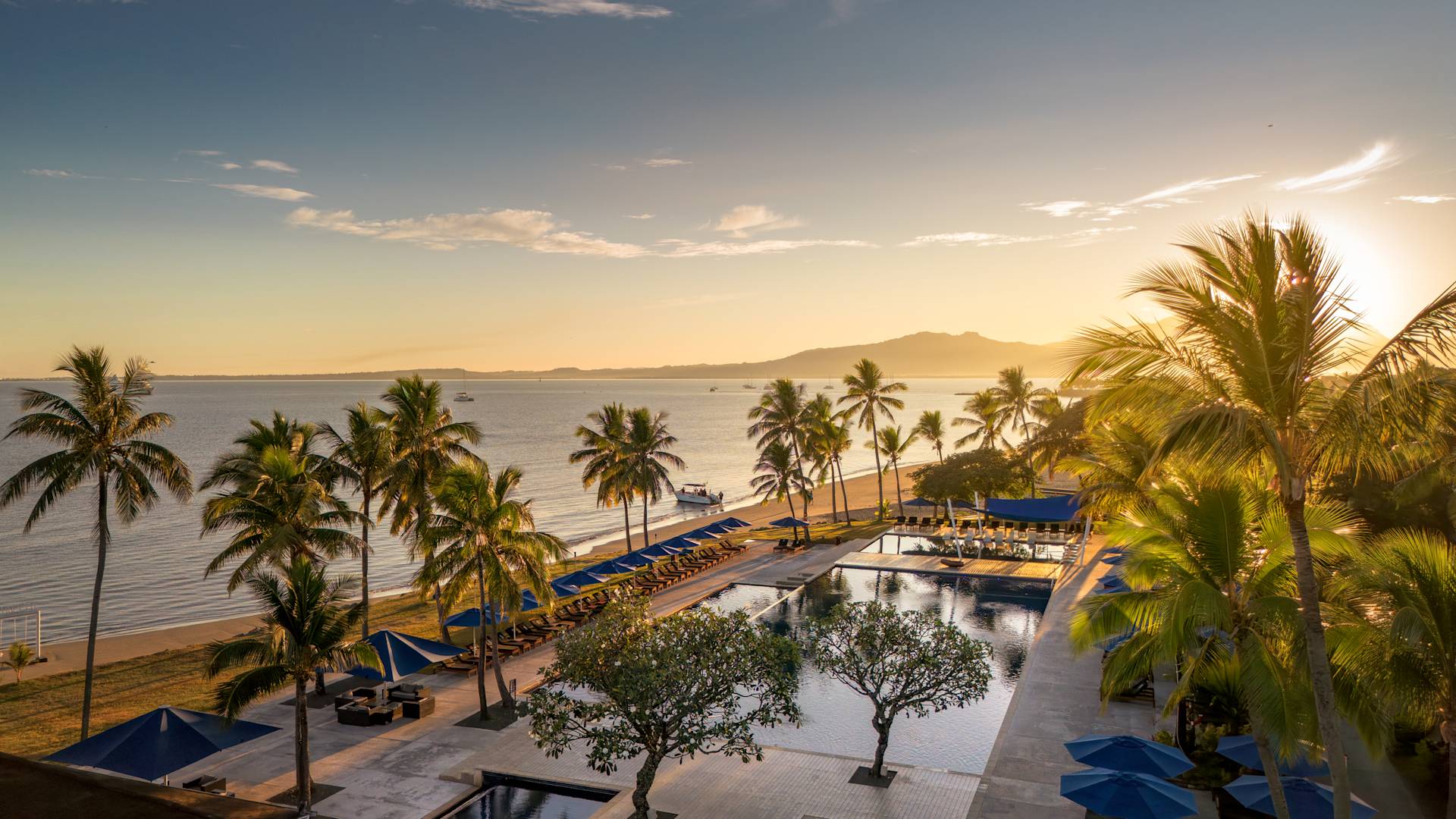
- West-facing properties get the sunset ceremony. Denarau and much of Nadi face west across the water. The Westin Denarau, Sheraton Fiji and Hilton Fiji Beach Resort & Spa sit in that band.
- The Mamanucas give you the classic island frame — small islands, reef, colour in the water. Tropica Island Resort, Matamanoa Island Resort and Tokoriki Island Resort are all in that group.
- The Coral Coast offers landscape variety — reef flats, headlands, gardens, the Sigatoka valley behind. Outrigger Fiji Beach Resort and Shangri-La Yanuca Island both sit on it.
- The north is where you go for the empty frame. Savusavu and Taveuni deliver images with nobody else in them. Daku Resort and Taveuni Palms Resort are examples.
Direction matters more than star rating for photography. Before you book, ask the property one question: which way does the ceremony site face, and where is the sun at the time we would be standing there?
The verdict
- Choose the ceremony time from the sunset, not the dinner service.
- Book a Fiji-based photographer; bring your own as a guest if you want both.
- Settle drones in writing with the property and with CAAF, or plan without them.
- Write a brief. The cultural elements section is not optional.
Next step: fix your date first, because the light depends on it — the best time to get married in Fiji has the month-by-month picture. Then shortlist venues by aspect using Fiji wedding resorts A-Z, and slot the photographer booking into the planning timeline. Full supplier categories, including hair, makeup and styling that will show up in every frame, are in Fiji wedding suppliers.