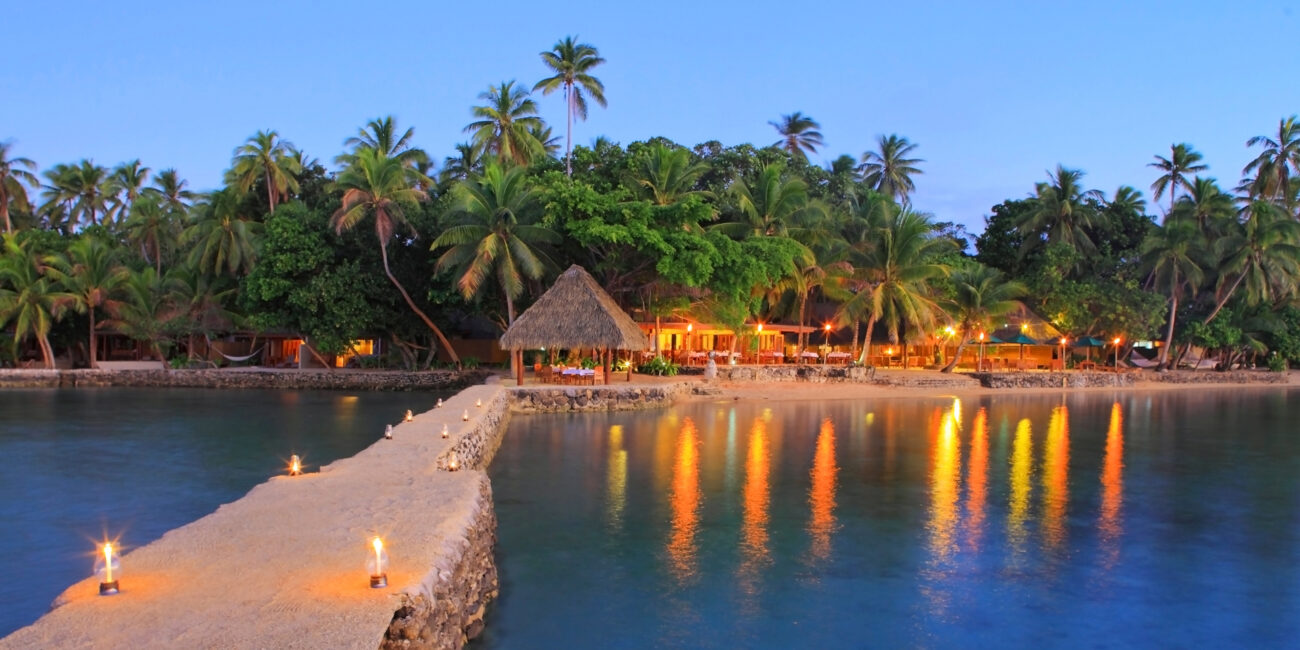
Beyond the Mamanucas and Yasawas that most visitors see, Fiji has thirteen outer-island airports, one UNESCO World Heritage town, a peer-reviewed 210 square kilometre lagoon, and a ferry network with almost no published timetable. Getting to any of it means a domestic flight, a ferry you book by phone, or a boat you arrange yourself. That friction is exactly why these islands feel different.
This guide covers what is verifiable. Where a transfer time or fare is not published by the operator, we say so rather than repeat a figure from a travel blog.
What counts as an outer island?
Everything beyond the two chains served by the Denarau day-trip boats: Vanua Levu and Savusavu, Taveuni, Kadavu, the Lomaiviti group including Ovalau and Levuka, Beqa, the Lau group, Rotuma, and the private islands — Laucala, Wakaya, Toberua, Leleuvia, Nananu-i-Ra.
Which outer islands have an airport?
Fiji Airports operates fifteen public airports: Nadi and Nausori international, plus thirteen outer-island airports.
| Airport | Island group |
|---|---|
| Savusavu | Vanua Levu |
| Labasa | Vanua Levu |
| Taveuni (Matei) | Taveuni |
| Kadavu (Vunisea) | Kadavu |
| Levuka (Bureta) | Lomaiviti / Ovalau |
| Koro | Lomaiviti |
| Gau | Lomaiviti |
| Rotuma | Rotuma |
| Moala | Lau |
| Cicia | Lau |
| Lakeba | Lau |
| Vanuabalavu | Lau |
| Ono-i-Lau | Lau |
There is no airport on Beqa, Nananu-i-Ra, Vatulele, Yanuca, Toberua, Leleuvia or Caqalai. Laucala and Wakaya have private airstrips outside the Fiji Airports network.
Five domestic operators serve these routes: Fiji Link, a Fiji Airways subsidiary connecting Nadi and Nausori with Labasa, Savusavu, Taveuni and Kadavu; Northern Air; Turtle Airways seaplanes; Island Hoppers Helicopters; and Heli-Tours Fiji.
Northern Air publishes its own route list through its baggage page — Suva to Labasa, Taveuni, Savusavu, Moala, Gau, Levuka and Nadi — along with a 15kg checked allowance, FJ$10 per kilogram excess and FJ$150 per bulky item such as a surfboard. Its fleet is small aircraft: Britten-Norman Islanders at 8 seats and Embraer Bandeirantes at 18. That matters for group travel — an 18-seat aircraft means a 40-person group is three flights, not one.
We could not retrieve any Fiji Airways or Fiji Link flight time, frequency or fare — the airline's site blocks automated access entirely. Treat any Fiji Link duration you read elsewhere, including on resort pages, as indicative until you see it on the carrier's own booking engine.
Taveuni: the garden island
Fiji's third-largest island, and the outer island that works best as a destination in its own right rather than a stop.
The 180th meridian marker at Waiyevo is the signature attraction, and it is worth describing correctly: Taveuni sits on 180 degrees longitude, not on the operative International Date Line, which is drawn around Fiji rather than through it. Call it the 180th meridian marker and you will be right where most travel writing is wrong.
Diving is the real draw. Tourism Fiji describes the Somosomo Strait between Taveuni and Vanua Levu as home to more than 1,400 reef fish species, with manta rays, spinner dolphins and humpback whales. Rainbow Reef holds many of the strait's best dives, famed for vivid soft coral. The Great White Wall is described by Tourism Fiji as Somosomo's most famous dive site, a sheer drop-off spanning 15 to 65 metres blanketed in white soft corals, best dived on a slack low tide and more suitable for experienced divers. Taveuni Ocean Sports operates in the area.
Bouma National Heritage Park holds three trails: the Tavoro Waterfalls, the Lavena Coastal Walk — a roughly 10 kilometre round trip ending at waterfalls with rock pools — and the Vidawa Rainforest Hike. Village-collected entry fees apply at each trail, and here the sources genuinely disagree: one Taveuni destination site publishes Tavoro at FJ$50 and Lavena at FJ$35 per person, while a resort compendium publishes Lavena at FJD 40. There is no park authority website to settle it. Budget roughly FJ$35 to FJ$50 per person in cash and confirm on arrival.
Waitavala is a 50-metre natural waterslide near Waiyevo, described by Tourism Fiji as a meandering, rollicking ride a short stroll from the road. Tourism Fiji publishes no fee; a small village contribution is commonly reported and we could not verify it.
Where to stay spans the range: Taveuni Palms Resort and Matangi Private Island Resort at the luxury end, Garden Island Resort with 30 rooms for divers, Paradise Taveuni with four recorded ceremony settings, Qamea Resort & Spa and Maravu Taveuni Lodge.
Vanua Levu and Savusavu
Fiji's second-largest island, and the most underrated place in the country for anyone who wants a working town rather than a resort strip.
Savusavu's Nakama thermal hot springs sit in the centre of town near the Hot Springs Hotel. The water runs close to boiling, and local residents have long used the springs as a natural cauldron for cooking dalo, fish and cakes. The site was upgraded in August 2022 with landscaping, stone walls, signage and three open-sided bures. These are for cooking and viewing, not bathing — worth being clear about before anyone arrives in swimwear.
J. Hunter Pearls runs the best-documented tour on any outer island. Farm tours operate Monday to Friday at 9.30am, running 1.5 to 2 hours, or 2.5 hours with snorkelling, at FJ$150 adult and FJ$50 for children up to 10, with a private tour and bay cruise at FJ$695. Minimum four guests, maximum ten, booked one to two days ahead. Pearls are cultured in Savusavu Bay, and depending on season you will see spat harvesting, oyster seeding or pearl extraction, finishing with an oyster tasting.
Copra Shed Marina is a restored 19th-century copra warehouse in Nakama Creek, with 8 berths for vessels up to 20 metres, 17 moorings and a floating dock for 12 yachts, plus border and customs services for arrivals by sea. The Savusavu Yacht Club, Captain's Café and Captain's Table are on site. Nearby, Nawi Island Marina publishes 132 serviced slips including 21 superyacht berths for vessels to 85 metres, built to Category 5 cyclone standards.
Accommodation ranges from Namale Resort & Spa and Nukubati Private Island to Jean-Michel Cousteau Resort, Koro Sun Resort & Rainforest Spa and Savasi Island Resort. Local transport includes Keldan's Taxi & Tours in Savusavu, and Muanivatu Trails runs village-led cultural experiences at Vuadomo Village — waterfall visits, the Nadamole healing pools, rainforest walks and traditional meal preparation, hosted by the Muanivatu people rather than presented as a resort activity.
Kadavu and the Great Astrolabe Reef
Fiji's fourth-largest island, and the one most often described with a claim that cannot be sourced.
The Great Astrolabe Lagoon has been properly measured. Peer-reviewed work published in Ocean & Coastal Management in 1999 gives a maximum length of about 22.5 kilometres, maximum width about 12.5 kilometres, surface area around 210 square kilometres, average depth 20 metres and maximum depth 37.5 metres, sitting roughly 70 kilometres south of Suva. Baseline studies from 1989 to 1992 found the lagoon relatively free from pollution, with reefs further from villages in better condition than those near settlements. The reef was named by Dumont d'Urville in 1827, after the ship he nearly lost there.
We found no credible primary source for the widely repeated claim that it is the world's fourth-largest barrier reef. Use the measurements instead; they are more impressive for being real.
Papageno Resort publishes a 30-minute boat ride from Vunisea and states plainly that the only regularly scheduled flights are operated by Fiji Link. Matava Eco Adventure Resort, Oneta Resort and Kokomo Private Island Fiji also sit in the group.
Beqa, Toberua and the easy private islands
These are the outer islands you can reach in an afternoon from Viti Levu, which makes them the practical choice for a short trip or an incentive add-on.
Toberua Island Resort publishes the best access of any genuinely remote Fiji island: a 20-minute vehicle transfer from Nausori Airport to Anitioki Village Jetty, then a 15-minute boat ride, with transfers running 24 hours and coordinated to flights.
Leleuvia Island Resort publishes the only complete transfer schedule and fare of any Fiji island operator. Twice-daily transfers to Bau Landing using three 28-foot powerboats, departing Leleuvia 9.00am and Bau Landing 10.00am, with afternoon services, taking about 45 minutes. Bau Landing to Leleuvia return is FJ$100 adult and FJ$50 child under 12, under 4 free; Levuka to Leleuvia return is FJ$180 and FJ$90, inclusive of 15 per cent VAT with a 5 per cent card surcharge.
Beqa Lagoon Resort publishes a three-hour drive from Nadi to Pacific Harbour Marina, with boat and ground transfers included in packages and a charter boat outside the regular schedule at a USD 200 surcharge. The crossing duration itself is not published. Beqa Adventure Divers publishes its rates in full for 2026 to 2027: a FJ$500 two-tank shark dive, FJ$475 soft coral and wreck dives, FJ$100 snorkelling, plus a FJ$25 per day Marine Reserve Levy, FJ$20 fuel and gear hire at FJ$30 per item or FJ$50 for a full set, with 5 per cent off three days and 10 per cent off five.
Also in the group: Royal Davui Island Resort, Lalati Resort & Spa with 14 rooms, and Kulu Bay Resort with 7.
Nananu-i-Ra is reached from Ellington Wharf, with Mac's Nananu Beach Cottages publishing pickups at 8.00am, 12.00pm, 2.00pm and 5.30pm daily at FJ$50 per person, and Nadi Airport to Ellington Wharf as approximately two hours by car.
Levuka: a World Heritage town that is hard to reach
Levuka Historical Port Town was inscribed by UNESCO in 2013 under cultural criteria two and four, and it remains Fiji's only World Heritage property, not on the List of World Heritage in Danger. UNESCO describes it as Fiji's first colonial capital, ceded to the British in 1874, and a rare example of a late colonial port town shaped by an indigenous community that continued to outnumber European inhabitants. The Sacred Heart Cathedral from the 1860s and the Royal Hotel from the late 1860s are cited among its heritage fabric. Fiji's tentative list holds three further sites: the Sovi Basin, the Sigatoka Sand Dunes and the Yaduataba Crested Iguana Sanctuary.
Now the honest part. Getting to Levuka is currently unreliable. Bureta airfield has been closed since COVID-19 despite runway upgrades, and commercial service has been absent for roughly a decade, the strip used only for medevac and training. In July 2026 Cabinet approved one flight a week to Ovalau, but no airline was named and no start date given. Sea access has also been disrupted — reporting in October 2023 noted Goundar Shipping had ceased the Natovi to Levuka route.
If Levuka is on your itinerary, phone ahead. Northern Air still lists a Suva to Levuka sector, which may mean the page is stale or that service is resuming. Do not plan around it without confirming.
Getting there by sea: the honest picture
This is the weakest-documented part of travel in Fiji, and pretending otherwise would not help you.
Goundar Shipping operates the main inter-island passenger and vehicle services, including Suva to Savusavu and Taveuni, Ellington Wharf to Nabouwalu, and routes reaching Vanuabalavu and Cicia in Lau. It has no working website. Its public channel is Facebook, and even the regional tourism body directs travellers there. Note that the domain goundarshipping.com no longer belongs to the company and now serves unrelated content — do not use it.
Patterson Brothers Shipping was wound up by order of the High Court on 12 October 2023, with an official receiver appointed and creditor debts over FJ$1.1 million. Both its web domains now fail to resolve. Do not treat it as a live operator.
Bligh Water Shipping has no website and we could not confirm it currently operates.
Other operators appear in tourism-association material: Interlink Shipping on Natovi to Nabouwalu, Venu Shipping on Suva to Levuka, and Suncity Ferry between Natuvu Wharf on Vanua Levu and Taveuni, which does not accept advance reservations.
The practical consequence: there is no Fiji inter-island ferry timetable you can plan a trip around from a desk. Third-party sites publish schedules, some of which conflict with each other and with news reporting. Phone the operator, or book through your accommodation, and build a spare day into any itinerary that depends on a ferry.
Lau and Rotuma: the genuinely remote
The Lau group is Fiji's least accessible. Five islands have airports — Moala, Cicia, Lakeba, Vanuabalavu and Ono-i-Lau — but we could not confirm current scheduled service to Cicia, Lakeba, Vanuabalavu or Ono-i-Lau from any carrier. Northern Air lists only Moala. Goundar reaches Vanuabalavu and Cicia by sea.
Cruising yachts need two permits: a general Fiji cruising permit and a specific Lau group permit, both issued by the iTaukei Affairs Board, with its main office on Queen Elizabeth Drive in Suva and regional offices at Lautoka, Levuka and Savusavu. Published guidance describes permits issued promptly, often while you wait, valid up to six months, arriving as a one-page letter in Fijian. That guidance dates back some years, so confirm current fees and process directly.
Realistically: no tourism infrastructure, no timetable to plan around, and independent travel means either a yacht with two permits or an irregular cargo and passenger ferry with village hospitality arranged in advance.
Rotuma lies 465 kilometres north-northwest of Fiji's main islands, with a distinct language and a Polynesian heritage separate from Fiji's Melanesian culture. It is not a commercialised tourist destination. Reporting in June 2026 described the tourism sector as thin, with one homestay receiving FJ$20,000 in government funding to expand to around 20 guests, and noted that online booking platforms often mislabel mainland properties as Rotuma stays — visitors usually arrange accommodation directly with local owners or through personal contacts. Fiji Airports states that Fiji Airways operates the primary service with limited frequency.
Rotuma also has a documented history of community opposition to organised tourism, including to weekend day trips introduced in 2020 without proper consultation. A Rotuma (Trespass) Regulations 1939 appears in the index of Fiji's laws, which suggests statutory landing controls, but we could not retrieve the text and will not characterise it. Check current entry requirements with the Council of Rotuma and with Fiji Airways before booking anything.
Permit, immigration and legal content here is a guideline only — confirm with the iTaukei Affairs Board, the Council of Rotuma and the Fiji Ministry of iTaukei Affairs. Last reviewed 27 September 2026.
Two islands not to plan around
Vatulele Island Resort has been closed for 14 years. The iTaukei Land Trust Board confirmed in early 2025 that it had commenced re-entry proceedings against the leaseholder citing prolonged inactivity, with resolution slowed by separate litigation. Vatulele is worth knowing for its red prawns and village culture; it is not an accommodation destination.
The Wakaya Club & Spa we could not verify. There is no accessible official resort website — the obvious domain resolves to an unrelated business — and only third-party listings are available. Confirm it is trading before committing.
COMO Laucala Island does operate, and its airport is the best-documented private strip in Fiji: ICAO NFNH, a 1,141 metre grooved concrete runway, aircraft to 40 tons, King Air B200 or B300 guest transfers, approximately 45 to 50 minutes from Nadi International, day and night operations, and customs and immigration clearance available on the island on approval.
Village protocol: sevusevu
If you visit a village anywhere in the outer islands, Tourism Fiji publishes the protocol clearly, and following it matters more here than in a resort.
- Offer a small bundle of powdered kava to the village chief to seek permission to enter communal lands as a guest. Buy it at a town market before you travel.
- Stoop low respectfully as you move to your allocated spot during the ceremony, and follow your guide.
- Remove your hat and sunglasses, and carry bags in your hands rather than on your shoulder, as a mark of respect to the chief.
- Cover legs and shoulders — long skirts or dresses, or T-shirts with knee-length shorts.
- Heads are sacred. It is disrespectful to touch someone's head. Ask about taboos specific to each village.
- Remove your shoes before entering any village building.
- Avoid visiting on Sundays, which are reserved for church and considered sacred in most villages.
So which outer island?
- Best all-round destination: Taveuni — world-class diving, waterfalls, the meridian marker, and enough to fill a week.
- Most interesting town: Savusavu — hot springs, a pearl farm with a properly published tour, two marinas and a working community.
- Easiest genuinely remote island: Toberua — 35 minutes total from Nausori Airport.
- Cheapest and best-documented transfer: Leleuvia — FJ$100 return, 45 minutes, on a published schedule.
- Diving above all: Kadavu for the Great Astrolabe, or Beqa Lagoon for sharks.
- Heritage: Levuka, if you confirm access first.
- Do not attempt casually: Lau and Rotuma.
The one rule that applies everywhere out here: build in a spare day. Small aircraft cancel for weather, grass strips waterlog, and ferries run to timetables nobody publishes. The islands are worth it; the schedule is not something to be brave about.
Next step
Pick one island group rather than two, and confirm the transfer directly with the carrier or the property before booking anything else. Domestic and inter-island flights in Fiji covers the air network, and Fiji's 333 islands, explained puts the geography in order.
More in this cluster: Fiji's Islands and Regions · Day Trip Islands From Denarau · browse where to stay.