Fiji's largest documented business event is the Asian Development Bank's 52nd Annual Meeting, held in Nadi from 1 to 5 May 2019. ADB's own post-event report records 3,582 participants from 76 countries. It worked — but not in the way most planners imagine. No single room in Fiji seats 3,000 people, and none did then.
Understanding how that event was actually assembled tells you more about Fiji's real ceiling than any capacity chart.
Who were the 3,582?
The headline number is not 3,582 delegates. ADB published the breakdown, and it is instructive for anyone sizing a Fiji programme.
| Category | Participants |
|---|---|
| Guests | 916 |
| Others | 906 |
| Delegates | 606 |
| Civil Society | 308 |
| ADB Personnel | 224 |
| Media | 220 |
| Accompanying Persons | 181 |
| Observers | 138 |
| Host Country Secretariat | 83 |
| Total | 3,582 |
Source: ADB, 52nd Annual Meeting Highlights.
The formal delegate count was 606. The other 2,976 were guests, media, civil society, accompanying persons and organisation staff. That distinction matters enormously for planning, because those groups have different accommodation profiles, different session access, different catering and — critically — different arrival patterns.
If you are told an event "brought 3,500 people to Fiji", ask for the split before you use it as a benchmark for your own.
What is the largest single room in Fiji?
Roughly 1,500 theatre-style, and the two contenders both publish contested figures.
| Venue | Space | Published theatre capacity | Published floor area |
|---|---|---|---|
| Sheraton Fiji Golf & Beach Resort | Denarau Island Convention Centre | 1,500 (Marriott); 1,200 seated (Australasian Leisure Management) — sources conflict | 18,890.8 sq ft (≈1,755 m²) |
| Crowne Plaza Fiji Nadi Bay | Crown Convention Centre | 1,500 / 1,450 / 900 — three published figures, unresolved | 925 m² or 493 m² — also conflicting |
| Shangri-La Yanuca Island | Ratu Makutu Events Centre | 650 | 648 m² |
| Sofitel Fiji Resort & Spa | Grand Ballroom | 700 | 800 m² |
| InterContinental Fiji Golf Resort & Spa | Watercourt ballroom | 600 | not published |
| Grand Pacific Hotel, Suva | Britannia Ballroom | 600 | 600 m² |
We are publishing the conflicts rather than picking a number, because the conflicts are the finding. The Denarau Island Convention Centre's floor area of 1,755 m² is well corroborated — Marriott's figure converts exactly to the 1,755 m² published independently by CIM Business Events. Its seated capacity is not: Marriott and Spice News say 1,500, Australasian Leisure Management says 1,200.
The Crowne Plaza data is worse. Its own venues page publishes a 493 m² pillarless ballroom seating 900. Travel Weekly reports 925 m² and 1,500 guests. IHG's page says 1,450. Note that 493 m² is also the published area of the separate Baravi Ballroom, which suggests the hotel's own page may be duplicating a figure. Do not plan against any single one of these without written confirmation from the venue.
A separate point of confusion worth clearing up: Marriott publishes its venue areas in square feet, not square metres, even where listing tools render them as "sq m". The Sheraton's Golden Ballroom is 6,458 sq ft — about 600 m², not 6,458 m². If you have seen a Fiji capacity comparison that makes Denarau look enormous, this unit error is usually why.
So how did 3,582 people fit?
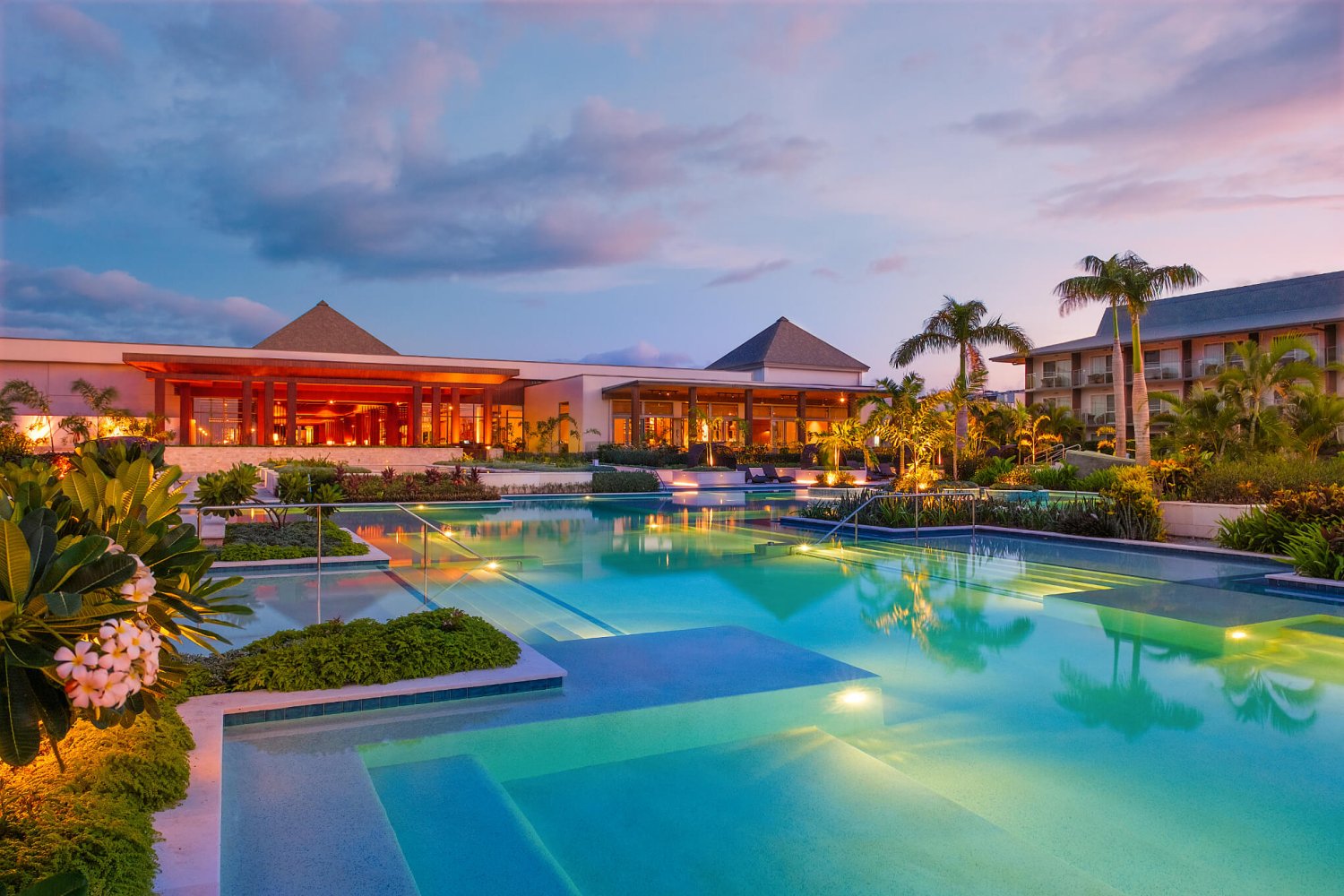
By distribution. The event ran across the Sheraton's Denarau Island Convention Centre, the Golden Ballroom, the Pacific Ballroom, and two temporary marquees of roughly 900 m² each, per CIM Business Events' reporting on the property's meeting facilities.
That is the actual Fiji answer at scale: a permanent convention centre as the anchor, the resort's secondary ballrooms as concurrent session space, and purpose-erected marquee capacity to absorb the overflow. Marquee hire stops being an optional extra and becomes structural.
The pattern repeats. Pre-COP31, hosted by Fiji from 5 to 8 October 2026 — a few weeks from now — expects over 2,000 delegates, and is being distributed across three separate Nadi resorts: the Sheraton for main events, Sofitel Fiji for side events and the Green Zone, and the Crowne Plaza for main exhibitions plus registration and accreditation. 126 side events were selected from 360 expressions of interest, alongside 32 exhibitions.
Two events, seven years apart, both above 2,000 people, both solved the same way. That is not a workaround. It is how Fiji does scale.
What does a distributed event actually require?
A precinct, not a venue
Denarau Island works for this because the properties sit within a few minutes of each other on one island, sharing a single road in. The Sheraton and Westin are connected properties. The Hilton and Radisson Blu are on the same strip. A delegate can walk or take a short shuttle between session venues.
Attempting the same distribution across Nadi, Denarau and the Coral Coast would not work — the Coral Coast is roughly an hour to an hour and a half from Nadi Airport by road, and you cannot run concurrent sessions across that gap.
Marquee and temporary structure capacity
Two 900 m² marquees is a serious build. Fiji has suppliers who do this — Clyde Equipment Marquee Hire, Tents & Awnings Ltd and Formscaff Fiji among them — but lead times and cyclone-rated engineering are real constraints, and a marquee of that size is a wet-weather liability as much as a wet-weather solution.
Accommodation across multiple properties
Denarau's four main conference resorts publish or are reported at: Sheraton not published, Westin 246 rooms, Radisson Blu 270, Hilton 356, Sofitel 296. No single property on Denarau houses 3,500 people. Neither does any property in Fiji.
Transport in waves
An arrival profile of that size cannot be handled as one movement. Tourist Transport Fiji publishes the largest documented coach fleet in the country — nine Yutong coaches at 48 passengers plus a guide, two 30-seaters, a 28-seat VIP coach, 17-seat mini coaches and six Toyota Hiace vehicles. Even that fleet, running continuously, moves people in waves rather than en masse.
Airport throughput
Here is a genuine gap. Fiji Airports publishes no terminal capacity, gate count or arrivals-hall throughput figure for Nadi International. Media reporting puts current volume at more than 2.1 million international passengers annually with a master plan targeting five million, and describes plans to add twelve gates — but the operator itself publishes no figure a planner could design an arrival profile against. You will need to work this through the airline and your ground handler directly.
What is Fiji's realistic ceiling?
On published evidence:
- Up to 600 in one room — comfortable, multiple venues, no structural complication.
- 600 to 1,000 in one room — two credible venues, both with contested published capacities. Confirm in writing.
- 1,000 to 1,500 in one room — the Denarau Island Convention Centre or the Crown Convention Centre, at the upper limit of what exists in Fiji.
- Above 1,500 — no single room in Fiji. You are distributing across spaces, properties, or marquees, and you need a precinct to do it in.
- Above 2,000 total participants — multi-property, as ADB 2019 and Pre-COP31 both demonstrate.
For context on non-conference space: Vodafone Arena in Suva seats 5,000 (4,000 grandstand, 1,000 floor) and has hosted conventions, but publishes no theatre-style or floor-area figures and is a sports arena rather than a plenary hall. HFC Bank Stadium holds 15,000 outdoors. There is no standalone government or privately operated convention centre anywhere in Fiji — every purpose-built conference facility in the country is attached to a hotel.
The verdict
If your event is 1,500 or under in a single plenary, Fiji works conventionally and you are choosing between a small number of venues on published capacity and fit.
If it is larger, Fiji still works — ADB proved it at 3,582 and Fiji is doing it again at Pre-COP31 next month — but you are designing a distributed event from the first day, not discovering the constraint at contracting. That means a precinct rather than a property, marquee capacity in the budget from the outset, an accommodation plan across four or five hotels, and an arrival profile built in waves.
Start with the capacity chart to see what each venue actually publishes, read which Fiji venue is actually the largest for the comparison in detail, and see Fiji conference scenarios and benchmarks for how smaller programmes size up. Venues in the Denarau precinct are listed under Nadi.