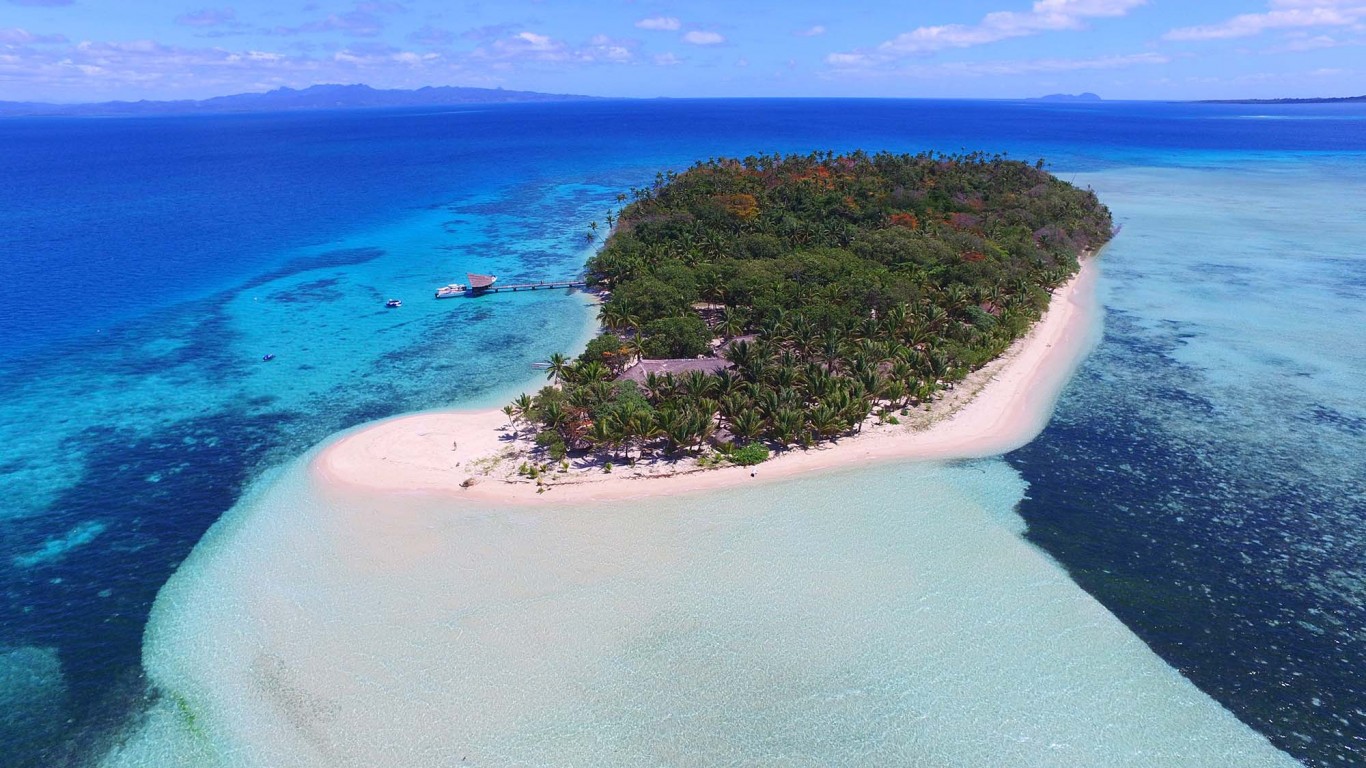
Almost always, the resort caters it. A Fiji wedding reception is usually a lovo feast, a seafood or island buffet, or a plated set menu, cooked and served by the venue's own kitchen under a per-head package with a timed bar. Outside caterers are the exception, not the default, and most island properties do not allow them at all.
Who actually caters a Fiji wedding?
Which model applies is decided by where you marry, and that shapes the menu, the drinks bill, the cake and the dietary plan.
| Catering model | What it means for the menu | Cost structure | Alcohol and corkage | Main risk |
|---|---|---|---|---|
| Resort in-house (Denarau, Nadi, Coral Coast, Pacific Harbour) | Set menus plus upgrade buffets; lovo on notice | Package price, minimum guests, per-extra-guest rate | Resort holds the licence; hourly packages; BYO usually banned | Customising costs extra |
| Island resort, no alternative (Mamanucas, Yasawas, Lomaiviti, Vanua Levu, Taveuni) | Whatever the kitchen makes from what the boat brought | Package price, often minimum-night terms | Resort holds licence and stock | A missed boat is a menu change |
| Mainland venue, external caterer | Free menu design, outside kitchen, your logistics | Caterer per head, venue hire, often a vendor fee | You may buy the liquor; someone must be licensed to serve | Power, water, refrigeration, wet weather are yours |
| Private villa or rented house | A hired chef in a domestic kitchen | Day rate plus food, or per head | You supply the drinks | Domestic kitchens are not built for 60 covers |
What is a lovo, and does it work for a wedding?
A lovo is an earth oven. Tourism Fiji describes digging a pit, lining it with wood and heating large river rocks over it. Green banana or palm leaves go on the hot stones, then food in layers: root crops (dalo, cassava, sweet potato), leaf-wrapped chicken, beef, pork and fish, then vegetables including palusami, pumpkin and breadfruit. More leaves, then soil. Tourism Fiji puts the cook at one to two hours, thecoconet.tv at 60 to 90 minutes once covered.
That is only the cooking. Someone first digs the pit, cuts firewood, gathers leaves, burns the fire down and rakes out the wood so only hot stones remain. A lovo is a gift of labour from a kitchen team, several people across most of a day. Jean-Michel Cousteau Resort notes it is "often reserved for special occasions in Fijian villages such as weddings, births, and funerals".
- Timing is one-shot. The pit opens when it opens; build the ceremony and photographs around it, and ask whether guests may watch.
- Portions are approximate. Leaf parcels and whole cuts, buffet-served: not plated, not portioned, not in courses. Want architectural plating? Set menu, and lovo the welcome night.
- It scales up better than down. For 20 guests it is heavy labour for a small yield; for 120 it is one of the few ways to feed everyone hot at once.
For the culture around the lovo, kava and the meke, read Fijian wedding traditions.
Which Fijian dishes should you know before writing a menu?
Fiji's food is reef and lagoon seafood, root crops, taro leaf and coconut, with a strong Indo-Fijian curry tradition alongside. Fish in lolo (coconut cream) is the safe main for mixed groups.
| Dish | What it is | Works for | Watch out for |
|---|---|---|---|
| Kokoda | Raw fish cured in citrus, dressed with coconut milk, chilli, onion, tomato | Canapés and entrées | Raw fish in heat — chiller to guest, never left standing |
| Palusami | Taro leaves baked in coconut cream, often with corned beef | A rich celebration side | Corned beef versions are not vegetarian |
| Rourou | Taro leaves cooked down in coconut milk, like creamed spinach | An easy vegetable side | Must be cooked through |
| Duruka | Unopened flower of a sugarcane relative, "Fiji asparagus"; in coconut milk or curried | Seasonal, a talking point | Tourism Fiji lists it as April and May only |
| Dalo and cassava (tavioka) | The staple root crops | Reliable, filling, always available | Denser than potato — portion down |
| Indo-Fijian curry, roti, dhal | Fiji's Indian tradition | Vegetarian, vegan, non-pork provision | Label mild and hot separately |
Ask also about ota (blanched fiddlefern in coconut milk) and nama (sea grapes) — grazing-table items, same-day perishables. Fijian d carries a leading n: kokoda is ko-kon-da. Flavours of Fiji Cooking School runs market tours and classes; for free nights see Fiji restaurants and bars.
What do Fiji resorts actually say about outside caterers?
The honest answer: most Fiji resorts publish no vendor policy. Three do.
| Property | What it publishes on food and drink | Vendor or corkage policy |
|---|---|---|
| Outrigger Fiji Beach Resort | Dream Wedding Package FJD $11,500: Fijian Feast (Lovo) Buffet Dinner, 3-hour beverage package, 2-tier cake; 30-100 guests; FJD $180 per extra | FAQ: "No, BYOB is strictly prohibited at private functions" |
| Fiji Marriott Resort Momi Bay | Three packages, FJ$5,800 to FJ$39,999, as set menu, Fijian buffet or cocktail party, with 3- and 4-hour beverage packages | Brochure: "Any external vendors ... must be approved for use by the resort and additional fees and conditions may apply" |
| Fiji Hideaway Resort & Spa | Fijian lovo buffet, 2-hour beverage package; 30 people, FJD$150 net per extra head, max 80; all guests must stay on site | Corkage: "We do not recommend this however happy to be able to source what you desire. Alternatively corkage fees apply" |
Everywhere else publishes menus or prices but no policy: Leleuvia (Fijian buffet dinner; "Being a desert island we have some limitations"), Daku Resort ("a Fijian Celebratory Feast or a simple Wedding breakfast"), The Remote Resort (elopement FJD$3,117), Tropica (FJ$2,999 and FJ$1,899), plus Musket Cove, Warwick Fiji, Sheraton Fiji and Shangri-La Yanuca, venue outlines only. Figures are each property's own and can change.
The rule: if a policy is not published, it still exists — it sits in the coordinator's proposal. Ask for it in writing before the deposit:
- May we bring an outside caterer or cake — vendor fee, service fee, insurance?
- If the cake is external, is there a cakeage charge, and who stores it?
- May we bring our own alcohol, and at what corkage rate per bottle?
- Which suppliers need approval, and by when?
How does the drinks bill work, and what is corkage?
Beverage comes three ways. A per-head package by the hour buys a set drinks list for a set window — Outrigger's runs three hours, Fiji Hideaway's two, Fiji Marriott Momi Bay's upper packages three and four. Tiers run soft drinks, then standard with local beer and house wine, then deluxe and premium adding spirits. On consumption bills what is poured against a capped tab. A cash bar passes the cost to guests when package hours expire.
Now corkage. The resort holds the liquor licence for its premises — the right to sell and supply alcohol there sits with the property, not you. Serving drink bought elsewhere, on their premises, with their staff and glassware, cuts across that licence and its revenue. A corkage fee is the charge for allowing it anyway, usually per bottle.
Two follow. Some refuse outright, as Outrigger does. Where corkage exists it is rarely published: Fiji Hideaway says only that corkage fees apply, without a rate. We quote no corkage figure, because none of the properties we checked publish one. Ask for the rate per 750ml bottle in FJD, in writing, and whether it is charged per bottle opened or brought. Duty and freight often make the package cheaper anyway — the same logic as the Fiji event catering hub.
Will your wedding cake survive a Fijian afternoon?
Sugar & Sparrow puts hot-weather buttercream softening above about 24°C, drooping detail above about 28°C and melting above about 32°C, near butter's melting point. A Fijian afternoon is in that third band. Whipped or fresh cream is worse — Craftsy advises extreme caution, refrigerated until service.
Humidity is the second problem: sugar pulls water from the air, so fondant and royal icing go tacky, painted colours bleed, and a cake moved from a cold fridge into humid air will sweat. Decorators in humid climates skip refrigerating a finished fondant cake, or box it so the card takes up moisture.
| Finish or style | How it holds up in Fijian heat | Use when |
|---|---|---|
| Fondant over a firm cake | The most heat-tolerant common finish — Craftsy notes fondant "tends to hold up the best", low in fat and stabilised by gelatin. Droops in direct sun; fruit and flowers on top wilt within the hour | Outdoor, tiered, long display |
| Ganache under fondant | Sets far firmer than buttercream at room temperature, giving sharp load-bearing edges. Still chocolate — Craftsy warns ganache alone is "fragile in the heat" | Tiered cakes wanting crisp edges |
| Stabilised American buttercream | Survivable if modified: part of the butter replaced with high-ratio shortening, plus meringue powder or cornstarch | Indoor or shaded, cut early |
| Naked or semi-naked | No armour over the crumb, so it dries and slumps fast; needs a stabilised frosting | Small cakes indoors, cut fast |
| Whipped or fresh cream | The worst option outdoors in Fiji | Refrigerated, indoors, served at once |
| Internal dowels and a central support | Essential — softening frosting removes friction and upper tiers slide | Any cake of two tiers or more |
A cake made in Nadi or Suva for an island wedding faces a road transfer, a boat and a jetty walk. Send tiers boxed separately and assemble on site; assembled tiers do not survive boat wake. Get in writing who carries it, whether the resort takes responsibility for a cake it did not make, and how much chiller space it has. Keep the display short and cut it early: after the speeches, not late at night.
Book early: Nadi-based Baked in the Tropics wants a finalised choice ideally eight weeks out. Also listed: Sweet Endings Fiji, Bakewell Cakes, Cakes 2000 Ltd, Cake World Nadi, Cake Crazy, Boo FJ Cakes & Treats — several trade mainly on Facebook, so confirm delivery and lead time. Full list under cake.
How do you handle allergies, halal and vegetarian guests on an island?
Lead times. An island kitchen may be a boat ride from a supermarket, and its order goes in days before guests arrive. Give final numbers and the full dietary list together, early — Fiji Hideaway asks for numbers at least two months out. Special ingredients are ordered on the mainland and shipped.
Confirm by name, not category. List named guests with their requirement — coeliac, anaphylactic to peanuts, no pork, vegan — and have the resort confirm each in writing, with the dish that guest will get.
Vegetarian and vegan provision is strong. Fijians of Indian descent were about a third of the population at the 2017 census, and Indo-Fijian cooking is everywhere: dhal, roti, vegetable curries. Rourou, palusami without corned beef, ota, cassava and dalo make a Fijian vegetarian menu with nothing imported.
Halal. Certification in Fiji is administered by the Fiji Muslim League. Ask whether the property or its meat supplier is certified rather than assuming, and ask about separate surfaces and utensils, not only the meat. If not, use a certified mainland caterer.
Cross-contamination. Buffets, a lovo included, are shared-utensil environments by design, and no menu planning makes one safe for a severe allergy. The rule is a separately prepared, separately plated meal delivered to that guest by name, by a staff member told which guest it is. Agree it with the head chef, not the coordinator, and have the guest carry an auto-injector. This is a guideline only — confirm allergen practice with the head chef and any medical question with the Fiji Ministry of Health and Medical Services.
On the mainland you may have a choice of kitchen. Chef's Catering Fiji caters events for up to 1,000 guests, works off-site, and states "We cater to all diets and can accommodate any dietary requirements". Suva's My Kai lists on- and off-site catering built on Fiji seafood and plant-based menus. Elite Catering Services, Yumi Catering, PQ's Top Taste and Corner Cafe Fiji are also listed; several run on social media, so confirm scope. See catering.
What about water, ice and food safety in 30-degree heat?
Water and ice. Put still water on every table before guests sit, and at the ceremony site — an afternoon beach ceremony with no water is how you lose a grandparent to heat. Ask whether the tap water is potable and the ice made from treated water; the answer differs between a Denarau resort and a small island. Ice is a consumable islands run out of: confirm the quantity ordered, keep it apart from the bar's service ice, and never let bottle ice reach a glass.
Timing. US Food and Drug Administration guidance is that perishable food should not sit in the danger zone — 4°C to 60°C — for more than two hours, dropping to one hour above 32°C. Hold cold items at or below 4°C, on ice or in a shallow container inside a deeper pan of ice. Refresh canapé trays rather than letting a table stand, open the lovo and eat, clear the buffet on time.
Verdict: which catering model suits your wedding?
- Resort in-house for a fixed price and no logistics — what most Fiji weddings do.
- Island resort if the island is the point, accepting that the boat shapes the menu.
- External caterer only on the mainland, at a venue that permits it in writing, with a planner.
- A lovo for 40+ guests, with the timeline built around a fixed pit-opening.
- Split the format if budget allows: a lovo welcome night, a plated dinner, a farewell brunch.
The deciding document is not the brochure but the written confirmation covering vendors, corkage, cake handling, dietary provision and numbers deadlines. Get it before the deposit.
What is your next step?
Shortlist two or three properties and send all four questions in one email, so you can compare answers. Then browse Fiji's catering and cake suppliers. Read Fijian wedding traditions before you brief a lovo, send the Fiji wedding guest guide to travelling guests, and if the destination is open, start with 10 reasons to get married in Fiji and plan the week after with the Fiji honeymoon guide.