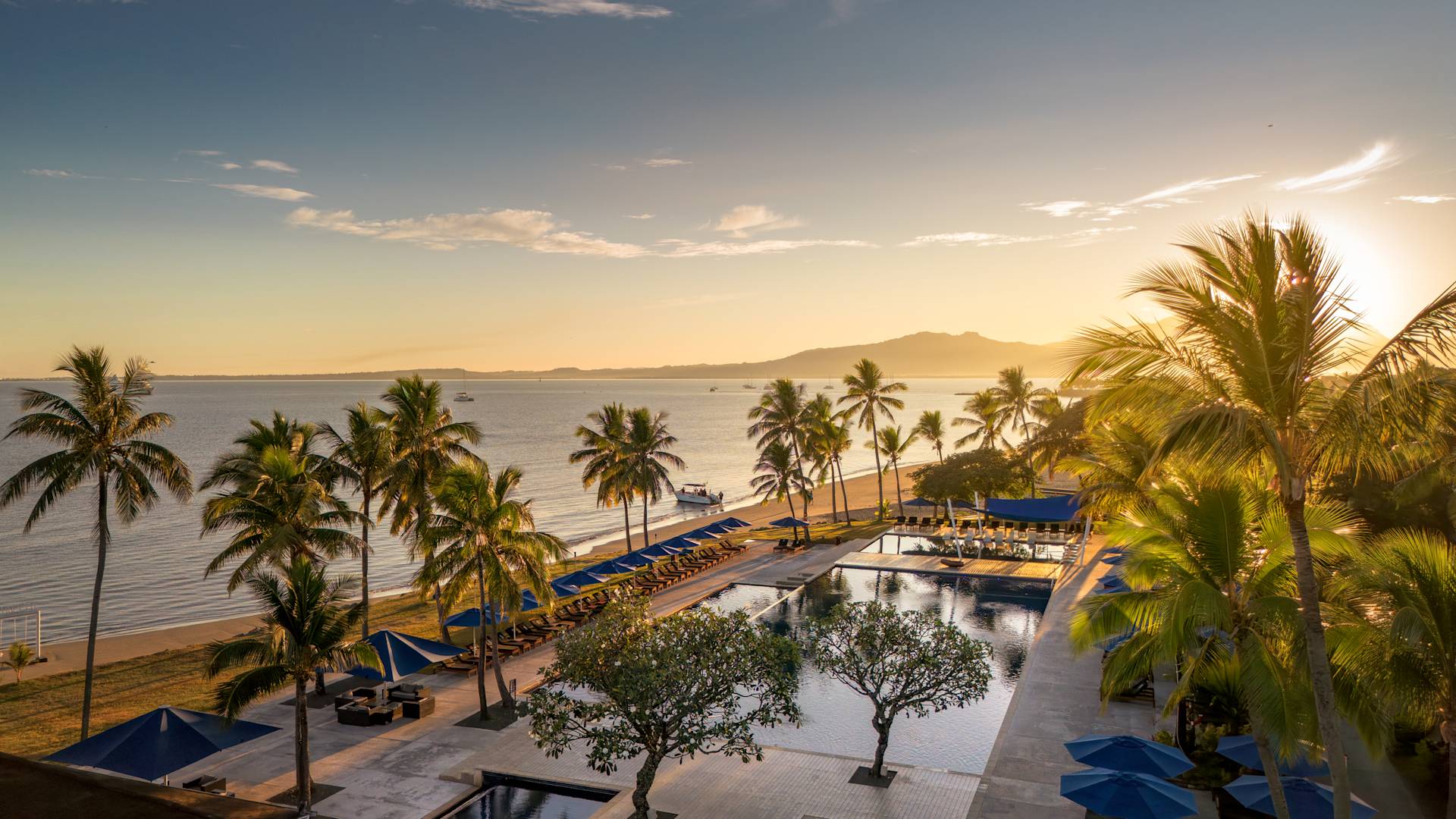
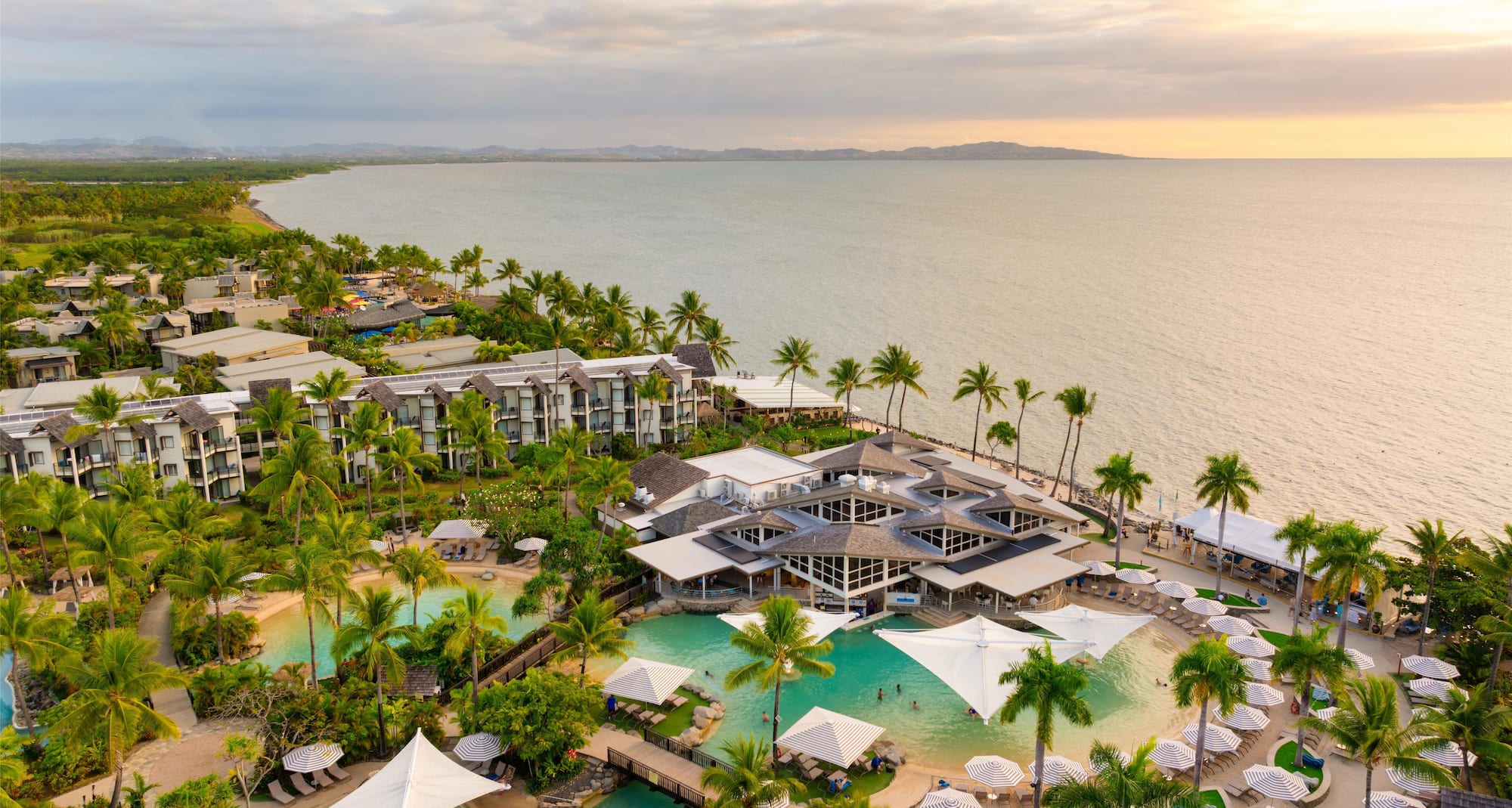
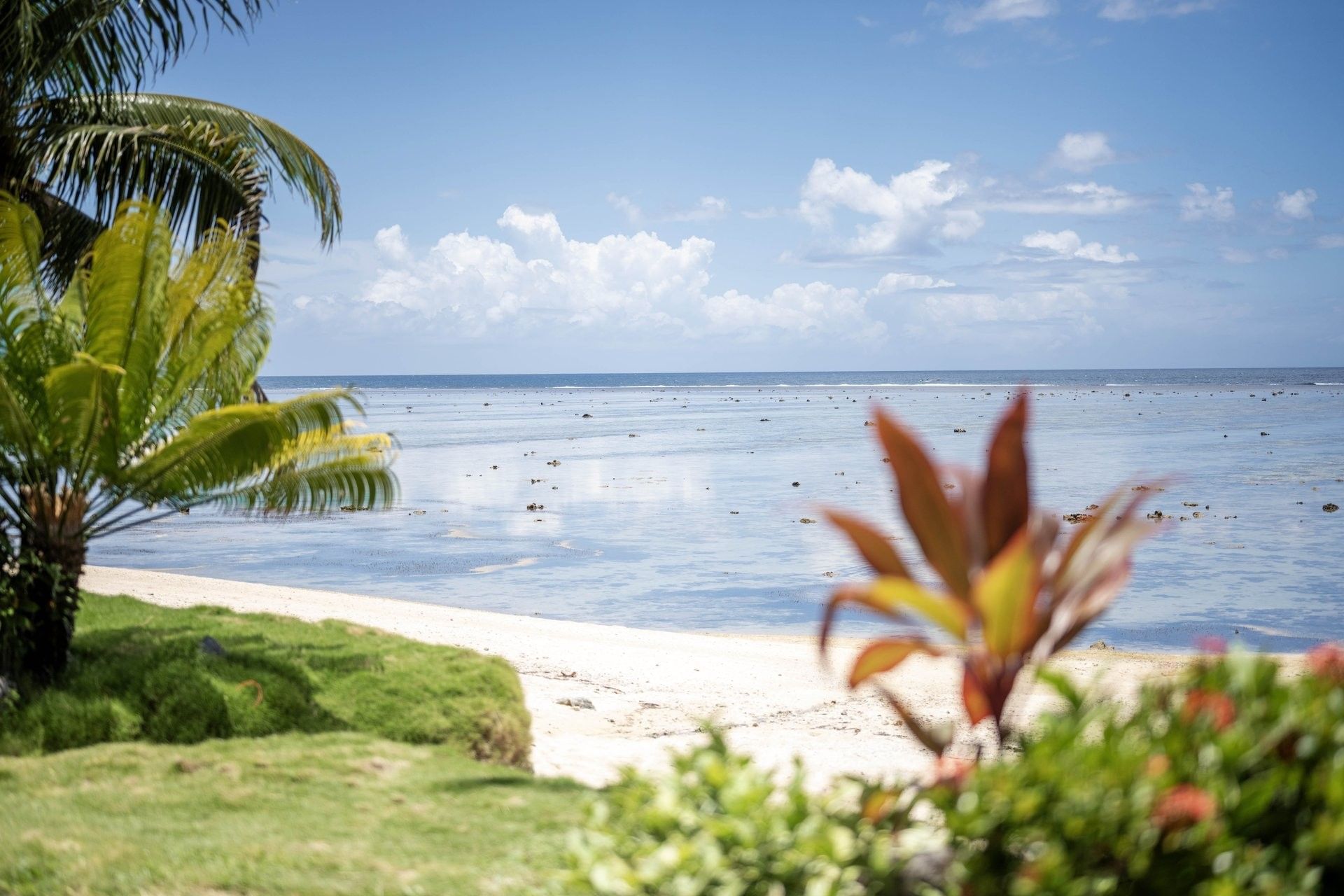
Denarau buys you time; the Coral Coast buys you landscape. Denarau's resorts publish transfer times from Nadi International of 20 to 30 minutes and sit on a 2.55 km² man-made peninsula with a marina, a golf course and nine resorts. Coral Coast properties publish 50 minutes to just over two hours, and get reef, river valley and rainforest in exchange.
That is the trade, and it is almost the only thing that separates them. Both sit in the same dry, leeward climate zone. Both have resorts capable of holding a conference. The difference is what you spend on the road and what you look at when you stop.
How far is each one from Nadi International Airport?
The published times do not agree with each other, so here they are as the operators state them.
| Property | Region | Transfer time published | Distance published | Source |
|---|---|---|---|---|
| Hilton Fiji Beach Resort & Spa | Denarau | 20 minutes | 20 km | Hilton's own location page |
| Sheraton Fiji Golf & Beach Resort | Denarau | 30 minutes | 15.0 km | Marriott's own overview page |
| Denarau generally | Denarau | 20 minutes | — | Tourism Fiji; Asian Development Bank delegate guide |
| InterContinental Fiji Golf Resort & Spa, Natadola | Coral Coast (west) | 55 minutes | 31.44 mi / ~50 km | Venue-sourcing aggregator listing |
| Shangri-La Yanuca Island | Coral Coast (Cuvu) | ~50 minutes | — | Shangri-La's own map and directions page |
| Outrigger Fiji Beach Resort | Coral Coast (Korotogo) | 1 hour 10 minutes | — | Outrigger's own site |
| Fiji Hideaway Resort & Spa | Coral Coast (Tagaqe) | 90 minutes | — | Fiji Hideaway's own site |
| Nanuku Resort | Pacific Harbour (east end) | Just over 2 hours | — | Nanuku's own site |
Note the Denarau conflict. Hilton Fiji Beach Resort & Spa publishes 20 km and Sheraton Fiji Golf & Beach Resort publishes 15.0 km, and both are on the same small island. They cannot both be right. The safe planning range is 15–20 km and 20–30 minutes, and for a group with luggage, use 30.
The Coral Coast figures, by contrast, are internally consistent: they simply describe a west-to-east progression along the Queens Road. There is no single Coral Coast transfer time, only a spread from about 50 minutes at the Natadola end to over two hours at Pacific Harbour.
What is Denarau, physically?
Denarau is not a natural island. It is a reclaimed peninsula of about 2.55 km², developed from mangrove and coastal land from 1969 onward, with the first hotel opening in 1975, and it is reached by a short bridge and causeway from the Nadi mainland.
Tourism Fiji describes it as Fiji's "most exclusive resort enclave" with nine family-friendly resorts, an 18-hole championship golf course at the Denarau Golf & Racquet Club, and the Port Denarau marina complex. Port Denarau is the practical centre: shops, restaurants, tour desks, and the departure point for almost every island day trip out of the Nadi area.
Directory properties on Denarau include Sheraton Fiji Golf & Beach Resort, Hilton Fiji Beach Resort & Spa, The Westin Denarau Island Resort & Spa and Radisson Blu Resort Fiji Denarau Island.
What is the Coral Coast?
The Coral Coast runs along the southern shore of Viti Levu from Natadola Beach in the west to Pacific Harbour in the east, with Sigatoka as its main town and gateway. The Queens Road is its spine — resort addresses read "Queens Highway, Korolevu" and "Off The Queens Highway, Sigatoka" — and the whole coast is road-accessible from Nadi without a boat or a domestic flight.
It is named for the fringing coral reefs that run close along the shoreline. Directory properties here include Shangri-La Yanuca Island, Warwick Fiji Resort and Spa, The Naviti Resort, Outrigger Fiji Beach Resort and InterContinental Fiji Golf Resort & Spa.
Which has the better beach and swimming?
This is where honesty pays better than adjectives, and where public sources are thinner than you would expect.
Denarau's beachfront is workmanlike. The most candid published description available calls it "adequate but not spectacular by Fiji standards," noting the sand is "a mix of natural beach and reclaimed shoreline" and the water "shallow and calm." Tourism Fiji's own Denarau page effectively concedes the point by selling day trips out to the Mamanucas and Yasawas, where "white-sand beaches, crystal clear water and incredible snorkelling awaits." The postcard beach is offshore, not on the peninsula.
The Coral Coast's water is governed by the reef. The fringing reefs are "quite shallow and often out of the water at low tide," while the reef edge "falls away 100s of metres just a short distance offshore." In practice that means excellent snorkelling and reef walking at some tides and very limited ocean swimming at others. Resorts handle this openly — Warwick's Tambua Sands Beach Resort markets reef walking as an activity, inviting guests to "step into the shallow reefs at low tide," and most Coral Coast properties lean on their freshwater pools.
If swimming off the beach at any hour is non-negotiable, neither is your answer. Build a Mamanuca island day into the programme instead.
Is one wetter than the other?
Not meaningfully. Both sit in Viti Levu's dry, leeward zone, on the opposite side of the mountains from Suva.
The scale of that difference is large: on the 1961–1990 baseline, Nadi records roughly 1,810 mm of rain a year against Suva's 3,040 mm — Nadi receives about 60% of Suva's total. The Fiji Meteorological Service's monthly summaries treat both areas as Western Division dry-zone stations, with Nadi Airport and Nacocolevu Research Station (Sigatoka) reported side by side.
In May 2025, for example, Fiji Met recorded Nadi Airport at 38.3 mm (42% of normal) and Nacocolevu at 73.3 mm (84% of normal) — the Coral Coast station wetter in absolute terms that month, but both plainly in dry-zone territory. Treat the two as climatically equivalent for planning and read our month-by-month Fiji weather guide for the seasonal shape.
What can you actually do from each?
| Denarau | Coral Coast | |
|---|---|---|
| Signature day trip | Island days from Port Denarau — South Sea Island full day FJ$285 adult; Malamala Beach Club full day FJ$215, half day FJ$185 | Sigatoka River Safari jetboat and village visit; Ecotrax rail-bike, FJ$239 adult / FJ$109 child |
| Land attraction | Denarau Golf & Racquet Club (18 holes); Big Bula Waterpark | Sigatoka Sand Dunes National Park — adults FJ$10, international students FJ$7, local students FJ$5, under-5s free; Kula WILD Adventure Park, 10am–4pm daily |
| Nature | — | Biausevu Waterfall: 20m two-tiered falls, 30-minute walk with nine stream crossings, village entry and guide fee payable at Biausevu |
| Evening | Free hour-long cultural dance at Port Denarau nightly except Sundays, 6.30pm; "Fiji Untold" twice weekly 8–10pm; Captain Cook sunset dinner cruise Tuesday–Sunday | Beqa firewalking at Outrigger, Tuesdays 5.30pm, FJ$30 adult / FJ$15 child; Shangri-La's Sacred Flame Show and Lovo Dinner, Mondays and Fridays 6pm, FJD 151 adult / FJD 76 child |
| Getting around | Everything walkable or a short shuttle; marina at the centre | Coach or car along the Queens Road; resorts are strung out over ~50 km |
One conflict worth flagging: the National Trust of Fiji, which manages the Sigatoka Sand Dunes, publishes "over 650 acres," while Tourism Fiji describes "a sprawling 360-acre sand dune system." Use the National Trust figure.
Which holds a bigger conference?
Denarau, comfortably — and it is not close at the top end.
| Space | Region | Banquet | Theatre / cocktail |
|---|---|---|---|
| Denarau Island Convention Centre (Sheraton Fiji) | Denarau | 1,000 | 1,500 theatre / 1,600 reception |
| Koro Lawn, Hilton Fiji | Denarau | 1,500 | 2,000 reception |
| Grand Ballroom, Sofitel Fiji | Denarau | 550 | 800 cocktail |
| Ratu Makutu Events Centre, Shangri-La Yanuca | Coral Coast | 500 | 650 theatre |
| Talanoa Hall, Warwick Fiji | Coral Coast | Not published | 400 theatre / 500 cocktail |
| Coral Coast Conference Centre, Warwick Fiji | Coral Coast | 200 | 400 cocktail |
| Watercourt ballroom, InterContinental Fiji | Coral Coast | Not published on the resort's own site | Up to 600 theatre |
All figures are as the operator publishes them. Note that InterContinental does not publish banquet numbers on its own site at all, and Warwick publishes cocktail and theatre for Talanoa Hall but not banquet — two more examples of why a Fiji capacity chart has to be read source by source. Our Fiji conference venues and capacity chart has the full picture, with conference venues on Denarau Island and conference venues on the Coral Coast going deeper on each.
So which should you choose?
Choose Denarau if the programme is short, the group is large, arrivals are spread across the day, or the itinerary depends on boats. Three nights, 200 delegates and a Mamanuca island day is a Denarau brief. So is any programme where a 90-minute coach transfer each way would eat a working session.
Choose the Coral Coast if the programme is four nights or more, the group is under about 400, and you want the destination to feel like Fiji rather than like a resort strip. Incentive groups, partner programmes, weddings and anything with a cultural or outdoor component are better served here — the river valley, the dunes, the waterfalls and the firewalking villages are all on this coast.
Choose neither if the brief is really about an island. Both are on or beside Viti Levu; the Mamanucas and Yasawas are a different product with a different transfer problem, covered in Fiji's islands and regions.
Next step
Read Denarau Island: the complete guide and Coral Coast Fiji: the complete guide for the detail on each, then browse the properties: Warwick Fiji Resort and Spa, The Westin Denarau Island Resort & Spa, Outrigger Fiji Beach Resort, plus operators Ecotrax Fiji, Sigatoka River Safari and Coral Coast Transfers Tours & Rentals. Or start from the Coral Coast city hub.